


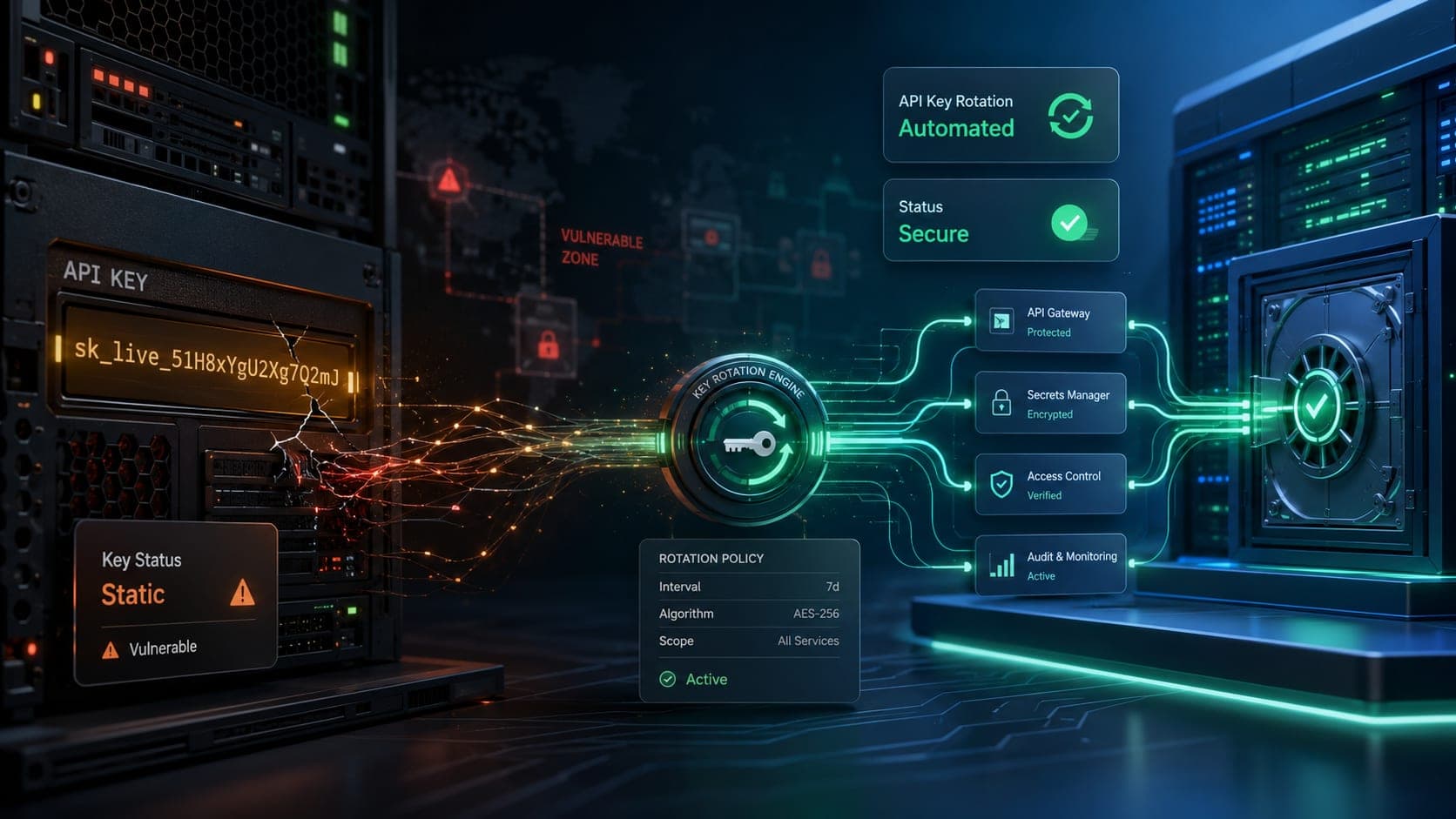
Every system that talks to another system needs a secret handshake. For many, that handshake involves API keys.
These keys are the gatekeepers, granting access to sensitive data and critical functionalities. But what happens when these gatekeepers are left unattended for too long? That's where the silent threat of compromised credentials emerges.
The Hidden Cost of Static API Keys
We've all been there: a new integration, a quick setup, and a static API key gets generated. It works, it's functional, and it gets pushed to production.
The problem is, these keys often remain unchanged for months, sometimes years. This creates a massive attack surface. If a key is ever leaked, intentionally or accidentally, an attacker has a direct, persistent line into your systems.
This isn't just theoretical. We've seen scenarios where a single leaked key led to unauthorized data access, service disruptions, and significant remediation costs. The longer a key is active, the higher the probability of compromise and the greater the potential damage.
Why Manual Rotation Fails
The logical solution is regular rotation. Yet, manually rotating API keys is a notoriously fragile process. It requires careful planning, coordination across teams, and meticulous testing.
Developers might forget, or the process might be too disruptive for live systems. This often leads to key rotation being deprioritized, or worse, skipped entirely. It becomes a task that’s always on the backlog but rarely gets done.
This is precisely the kind of operational drag that leads to security vulnerabilities. We believe that critical security practices should never rely on manual oversight alone; they need robust automation.
Engineering a Resilient Rotation Strategy
At Muhyo Tech, we approach security not as an afterthought, but as an integral part of system design. For API key management, this means building automation from the ground up.
Our strategy involves creating automated workflows that handle the entire lifecycle of an API key. This typically starts with a secure, centralized key management system. Tools like HashiCorp Vault, AWS Secrets Manager, or Azure Key Vault are foundational here.
These systems provide not only secure storage but also APIs for programmatic key generation, retrieval, and revocation. This is the bedrock upon which our automated rotation pipelines are built.
The Automation Pipeline: A Closer Look
The core of our approach is a multi-stage automated process. It's designed to minimize downtime and ensure seamless transitions.
First, the system identifies keys due for rotation based on a predefined policy (e.g., every 90 days). It then generates a new API key through the secure management system. This new key is immediately provisioned and tested in a non-production environment against the relevant services.
Once the new key is validated, the automation updates the configuration in the live application or service. This update is often done incrementally or with feature flags to allow for quick rollback if issues arise. The old key is then marked for deprecation.
Finally, after a grace period, the old key is automatically revoked. This entire sequence ensures that there's always a valid key in place, but the period where an old, potentially compromised key is active is drastically reduced.
Addressing the Tradeoffs: Downtime and Complexity
No engineering solution is without its tradeoffs. Implementing automated API key rotation introduces its own set of considerations.
The primary concern is potential downtime or service interruption. A poorly executed rotation could lead to a temporary disconnect between services. This is why our automation includes rigorous pre-checks and phased rollouts.
Another tradeoff is the initial complexity of setting up the automation. It requires investment in tooling, scripting, and testing. However, we view this as a necessary upfront cost to achieve long-term operational resilience and security.
The alternative—manual processes or no rotation—carries a far greater risk of catastrophic failure and security breaches. The engineering effort pays dividends in reduced risk and operational overhead over time.
Business Value: More Than Just Security
From a business perspective, automated API key rotation translates directly into tangible value. It significantly reduces the risk of costly security incidents and data breaches.
This enhanced security posture builds greater trust with customers and partners. It demonstrates a commitment to protecting sensitive information. This can be a competitive differentiator.
Furthermore, by eliminating manual tasks, our engineering teams can focus on higher-value development work, leading to faster feature delivery and innovation. It also contributes to cleaner, more auditable operational logs, simplifying compliance efforts.
Our Commitment to Resilient Systems
At Muhyo Tech, we architect systems with resilience and security baked in. Automated API key rotation is a prime example of how we proactively address operational risks.
We look for opportunities to automate repetitive, high-risk tasks. This frees up valuable human capital and hardens our clients' digital assets against evolving threats.
By embracing automated security practices, we help businesses launch faster, operate more reliably, and scale with confidence, knowing their foundational systems are secure and well-maintained.