


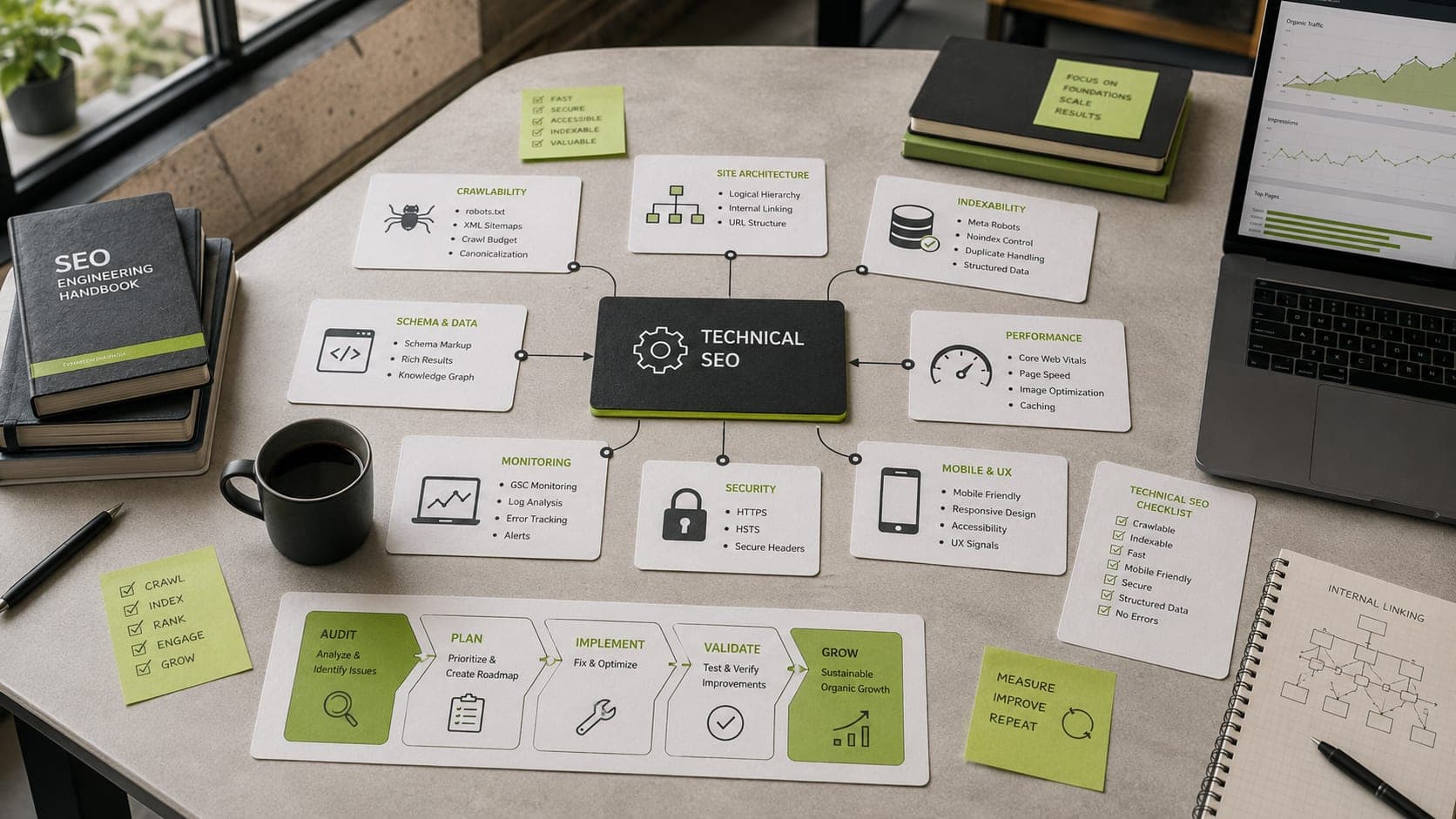
When a website struggles to attract qualified organic traffic, the immediate thought often goes to keywords or content. Yet, time and again, we find the real bottleneck lies deeper: within the technical foundations of the site itself.
Without a solid technical SEO base, even the most brilliant content can remain invisible to search engines and, critically, to potential customers.
The Core Problem: Fragmented Technical SEO Advice
Many founders and development teams piece together their technical SEO strategy from disparate blog posts or forum discussions. This often leads to an incomplete picture, where critical architectural decisions are overlooked or implemented without considering long-term SEO impact.
The result is a fragile system: a website that might rank for a few terms but lacks the foundational strength for sustained, scalable organic growth.
What is Technical SEO, Really?
Technical SEO is the practice of optimizing your website's infrastructure to help search engine crawlers efficiently find, crawl, interpret, and index your content. It’s about making your site easy for robots to understand, ensuring your human users can find you.
It’s the invisible engineering work that underpins all other SEO efforts, directly impacting discoverability and ultimately, your business's online visibility.
Why Technical SEO Isn't Optional Anymore
Ignoring technical SEO is akin to building a beautiful house on a crumbling foundation. It looks good on the surface, but it's prone to collapse under pressure.
For modern web systems, performance, accessibility, and crawlability are not just 'nice-to-haves'; they are essential for user experience and search engine rankings.
The Business Value of Strong Technical SEO
A technically sound website translates directly into tangible business benefits. It means more efficient use of crawl budget, improved search rankings, and a better user experience that keeps visitors engaged.
Ultimately, this leads to increased qualified organic traffic, more leads, and a stronger bottom line, reducing reliance on paid acquisition channels.
Foundational Pillars of Technical SEO Strategy
At Muhyo Tech, our approach to technical SEO starts with these foundational pillars. We integrate these considerations from the very first architectural discussions, not as an afterthought.
This proactive stance prevents costly refactoring later and ensures a robust, scalable system.
1. Crawlability: Guiding the Spiders
Search engine bots (like Googlebot) need to access and read your content to index it. If they can't crawl your site efficiently, they can't understand what it's about, and it won't appear in search results.
This pillar focuses on ensuring every important page is discoverable and accessible to crawlers.
- Robots.txt: This file tells crawlers which parts of your site they can and cannot access. Misconfigurations can inadvertently block critical sections of your site from being indexed.
- XML Sitemaps: An XML sitemap lists all the important pages on your site, providing a direct map for search engines. It helps them discover new or updated content more quickly.
- Internal Linking Structure: A logical and hierarchical internal link structure helps crawlers understand the relationship between your pages and pass 'link equity' throughout your site. It also significantly improves user navigation.
- URL Structure: Clean, descriptive, and hierarchical URLs are easier for both users and search engines to understand. Avoid long, keyword-stuffed, or parameter-heavy URLs where possible.
2. Indexability: Getting Seen by Search Engines
Once content is crawled, it needs to be indexed to appear in search results. Indexability ensures that search engines add your pages to their vast databases, making them eligible to rank for relevant queries.
This pillar is about confirming that your content is not only found but also successfully stored and understood by search engines.
- Meta Robots Tags (
noindex,nofollow): These HTML tags or HTTP headers instruct search engines whether to index a page or follow its links. Use them carefully to control what appears in search results. - Canonical Tags: For pages with duplicate or very similar content, the canonical tag tells search engines which version is the 'master' copy. This prevents dilution of ranking signals and crawl budget waste.
- Handling Duplicate Content: Beyond canonicals, addressing duplicate content issues (e.g., product variations, printable versions) through redirects or parameter handling is crucial for preventing penalties.
- JavaScript Rendering: Modern web apps heavily rely on JavaScript. Ensuring your content is rendered and visible to search engine crawlers, either server-side or client-side, is paramount for indexability.
3. Site Performance: Speed as a Ranking Factor
Page speed and overall site performance are no longer just about user experience; they are explicit ranking factors. Slower sites lead to higher bounce rates and poorer search visibility.
Optimizing performance is a continuous engineering effort that directly benefits both users and search engines.
- Core Web Vitals: Google's initiative to measure user experience through metrics like Largest Contentful Paint (LCP), First Input Delay (FID), and Cumulative Layout Shift (CLS. Optimizing these is critical for ranking.
- Image Optimization: Properly sized, compressed, and next-gen format images (e.g., WebP) can drastically reduce page load times. Lazy loading images below the fold also helps.
- Code Splitting and Minification: Reducing the size of JavaScript, CSS, and HTML files, and only loading necessary code, speeds up initial page loads.
- Server Response Time: A fast server response time is the foundation of a quick website. This involves efficient backend code, robust hosting, and content delivery networks (CDNs).
4. Mobile-Friendliness: Design for Every Device
With mobile-first indexing, Google primarily uses the mobile version of your content for indexing and ranking. A non-responsive or poorly optimized mobile experience will severely impact your organic performance.
This means designing and developing with mobile users as the priority, not an afterthought.
- Responsive Design: Ensuring your website adapts gracefully to various screen sizes and orientations is fundamental.
- Viewport Configuration: Correctly setting the viewport meta tag is crucial for instructing browsers on how to render the page on different devices.
- Touch-Friendly Elements: Buttons and links should be appropriately sized and spaced for easy tapping on touchscreens.
- Fast Mobile Loading: Mobile users often have slower connections. Optimizing for speed on mobile devices is even more critical than on desktop.
5. Security: Trust and Authority
Website security is a direct ranking factor and a critical component of user trust. Search engines prioritize secure sites, especially for sensitive transactions or personal data.
A secure site protects both your users and your search engine authority.
- HTTPS: Encrypting traffic with an SSL/TLS certificate is a fundamental security requirement. Sites without HTTPS are flagged as 'not secure' by browsers and are penalized by search engines.
- Regular Security Audits: Proactively identifying and fixing vulnerabilities prevents data breaches and website defacement, which can lead to de-indexing.
- Robust Hosting: Choosing a reputable hosting provider with strong security measures is the first line of defense against attacks.
- User Authentication & Authorization: For web applications, secure user management prevents unauthorized access and protects user data.
Architectural Decisions and Technical SEO Tradeoffs
Choosing the right architecture for your web system has profound technical SEO implications. Each approach comes with its own set of challenges and opportunities.
We help teams weigh these tradeoffs to make informed decisions that align with both their engineering goals and their organic growth objectives.
Comparing Rendering Strategies for SEO
| Strategy | Pros for SEO | Cons for SEO | Best Use Case |
|---|---|---|---|
| Client-Side Rendering (CSR) | Faster subsequent page loads after initial load, richer interactivity. | Initial load time can be slow (empty HTML), requires robust JavaScript rendering by crawlers (less reliable for Google, poor for others). | Highly interactive web apps where SEO isn't the absolute top priority for every page, or with robust pre-rendering. |
| Server-Side Rendering (SSR) | Fast initial page load (full HTML), easily crawlable by all search engines, better for pages requiring fast indexation. | Can be slower for subsequent page loads, increased server load. | Content-heavy sites, e-commerce, blogs, and marketing pages where initial load and crawlability are critical. |
| Static Site Generation (SSG) | Extremely fast load times (pre-built HTML), highly secure, very easy to crawl and index. | Content updates require a rebuild, not suitable for highly dynamic or user-generated content. | Blogs, documentation, marketing sites, portfolios, and any content that doesn't change frequently. |
| Hybrid (e.g., Next.js) | Combines benefits: SSR for critical pages, CSR for dynamic parts. Excellent for SEO. | Increased complexity in development and deployment. | Complex web apps, e-commerce, or platforms requiring a mix of static, server-rendered, and client-rendered content. |
At Muhyo Tech, we often gravitate towards hybrid frameworks like Next.js because they offer the best balance. They allow us to optimize critical marketing and content pages for instant crawlability and performance, while still building highly interactive web application features.
This approach gives our clients the best of both worlds: strong organic discoverability and a rich user experience.
Common Technical SEO Mistakes to Avoid
Even experienced teams can fall into common technical SEO traps. Recognizing these pitfalls early can save immense effort and prevent significant drops in search visibility.
Our work often involves auditing existing systems to uncover and rectify these issues.
1. Blocking Critical Resources via Robots.txt
Accidentally disallowing CSS or JavaScript files can prevent Googlebot from properly rendering your page. If Google can't see your page as a user does, it can't assess its quality or mobile-friendliness.
Always test your robots.txt file and use Google Search Console's 'Robots.txt Tester' tool.
2. Ignoring Core Web Vitals and Page Speed
Many teams prioritize features over performance, only to find their rankings suffer. Speed is no longer a suggestion; it's a requirement.
Regularly monitor your Core Web Vitals and integrate performance budgets into your development workflow.
3. Poor Handling of Pagination and Faceted Navigation
For large sites, e-commerce, or archives, pagination and faceted navigation can create vast amounts of duplicate content or 'crawl traps.' This wastes crawl budget and dilutes ranking signals.
Implement proper canonicalization, noindex tags where appropriate, and intelligent parameter handling to guide crawlers.
4. Neglecting International SEO (Hreflang)
If your site serves multiple languages or regions, failing to implement hreflang tags correctly can lead to content being mis-served or competing against itself in search results.
Hreflang is complex; precise implementation is key to success.
5. Broken Internal Links and 404 Errors
Internal broken links create dead ends for both users and crawlers, hindering crawlability and user experience. Too many 404 errors signal a poorly maintained site to search engines.
Regularly audit your internal links and implement 301 redirects for moved or deleted content.
Implementing a Technical SEO Checklist
A systematic approach is vital. This checklist provides a framework for regular technical SEO audits and ongoing maintenance.
It's the kind of structured review we conduct when optimizing client sites for long-term organic success.
- Robots.txt Check: Ensure no essential pages or resources are blocked.
- XML Sitemap Audit: Verify all important pages are included, sitemap is up-to-date, and submitted to Search Consoles.
- Canonical Tag Review: Check for correct implementation on duplicate content and self-referencing canonicals.
- HTTPS Status: Confirm full HTTPS implementation and valid SSL certificate.
- Mobile Responsiveness: Test across various devices using Google's Mobile-Friendly Test.
- Core Web Vitals Monitoring: Regularly check PageSpeed Insights and Search Console's Core Web Vitals report.
- Crawl Errors: Monitor Google Search Console for crawl errors (4xx, 5xx) and fix promptly.
- Broken Links: Scan for broken internal and external links.
- Schema Markup Validation: Ensure structured data is correctly implemented and validated via Schema Markup Validator.
- Hreflang Implementation (if applicable): Verify correct use for international sites.
- JavaScript Rendering Check: Use 'Inspect URL' in Google Search Console to see how Google renders key pages.
- Page Speed Optimization: Review images, code, and server response times for further gains.
Measuring Success: What to Track
Technical SEO isn't just about checkboxes; it's about measurable improvements. Understanding which metrics reflect your efforts is crucial for demonstrating ROI and guiding future optimizations.
We emphasize tracking these key indicators to validate our engineering decisions.
- Organic Traffic: The ultimate indicator of success – more qualified visitors from search engines.
- Search Engine Rankings: Position improvements for target keywords.
- Crawl Stats: In Google Search Console, monitor pages crawled per day and average response time. Improvements here indicate better crawlability.
- Index Coverage: Track 'Valid' pages in Search Console's Index Coverage report. Reductions in 'Excluded' or 'Error' pages are positive.
- Core Web Vitals Scores: Monitor LCP, FID, CLS, and overall page speed metrics.
- Bounce Rate & Time on Page: Improved technical performance often leads to better user engagement.
- Conversion Rate: Ultimately, better discoverability and user experience should drive more conversions.
FAQs About Technical SEO
Q: How often should I perform a technical SEO audit?
For most sites, a comprehensive audit at least once a year is recommended, with more frequent checks (monthly/quarterly) for specific metrics like Core Web Vitals and crawl errors.
Q: Can technical SEO fix low-quality content issues?
No, technical SEO ensures your content can be found and understood. It cannot compensate for poor-quality, irrelevant, or unhelpful content. Both technical and content SEO must work in tandem.
Q: Is technical SEO only for large websites?
Absolutely not. Even small business websites or portfolios benefit immensely from strong technical SEO. It ensures your limited content budget is maximized by making every page discoverable.
Q: What's the role of AI in modern technical SEO?
AI is increasingly used in SEO tools to analyze large datasets, predict ranking changes, and identify technical issues more rapidly. It assists in diagnosis and analysis, making the engineer's job more efficient.
The Muhyo Tech Standard: Engineering for Discoverability
At Muhyo Tech, we don't just build websites; we engineer discoverable and performant web systems. Our approach integrates technical SEO from the architecture phase, ensuring every line of code contributes to a faster, more reliable, and organically discoverable product.
This commitment translates into less owner stress, stronger long-term growth, and a solid foundation for your digital presence.
A robust technical SEO strategy is the silent engine of organic growth. By focusing on crawlability, indexability, performance, mobile experience, and security, you build a web system that search engines love and users trust.
It's an investment in your long-term online visibility and a critical component of any successful digital strategy.