


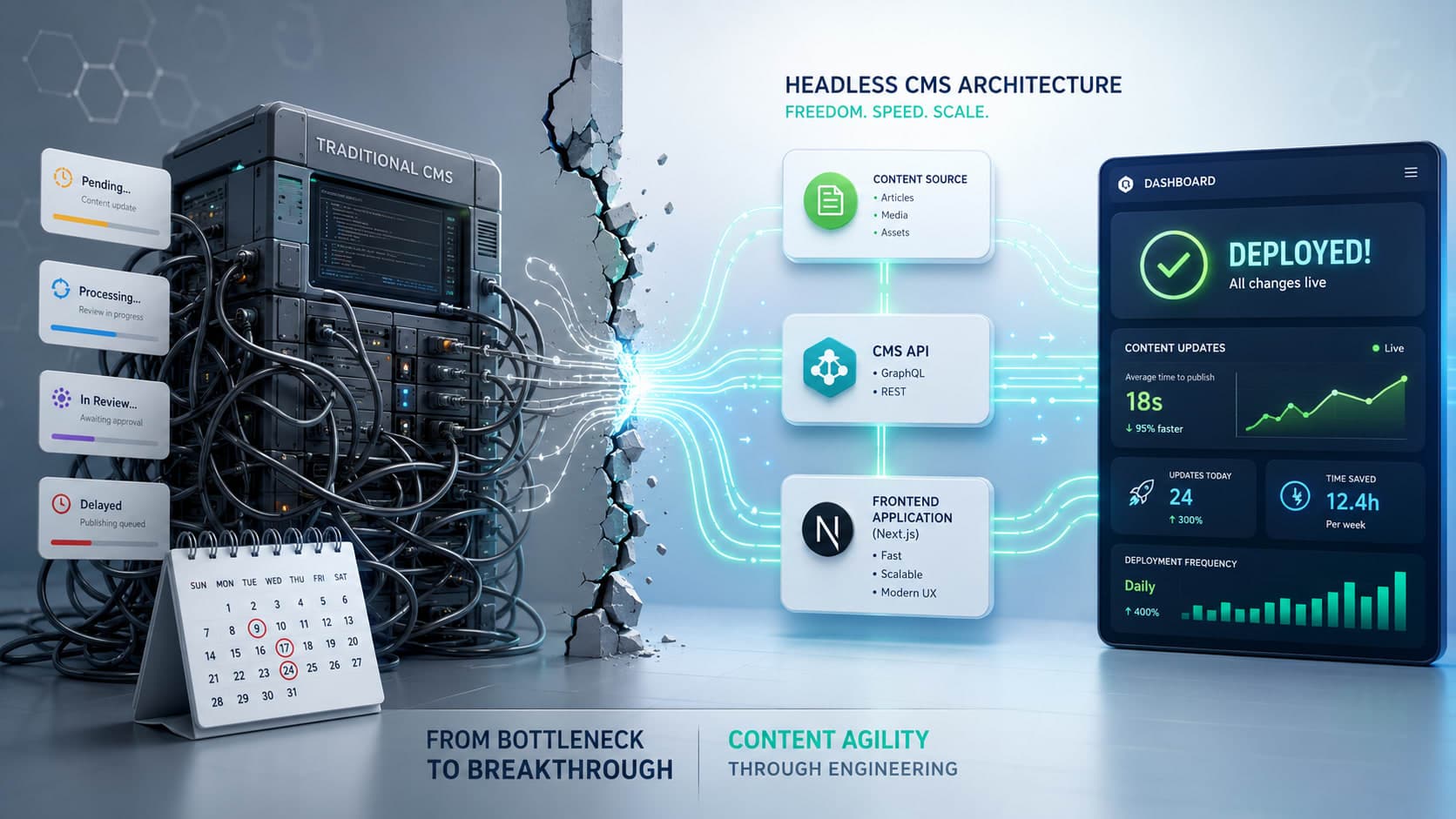
Remember the last time a marketing team needed a quick update on the homepage? Perhaps a minor text tweak or a new banner image for an urgent campaign. If your engineering team felt that familiar knot of dread, you've experienced the content update bottleneck firsthand.
It's a common pain point: a seemingly simple content change kicks off a full development cycle, complete with code commits, staging deployments, QA, and then finally, production. This process isn't just slow; it's a drain on resources and a major source of friction between marketing's need for speed and engineering's need for stability.
The Hidden Cost of "Simple" Content Updates
What looks like a five-minute content edit often translates into hours of developer time. This isn't because engineers are slow, but because traditional content management systems (CMS) tightly couple content with its presentation layer.
Every text change or image swap becomes intertwined with the codebase. This means every content update necessitates a re-deployment of the entire website, tying up valuable engineering cycles that could be spent on feature development or performance improvements.
Diagnosis: Why Our Traditional Stacks Slowed Everyone Down
The root cause often lies in the monolithic nature of older web architectures. Systems like traditional WordPress installations, while powerful, bundle the content database, administrative interface, and frontend presentation into a single, cohesive unit.
This tight coupling creates a dependency where changes to one part inherently affect the whole. Marketing waits on engineering, engineering juggles deployment schedules, and valuable opportunities for timely campaigns or SEO improvements are missed.
We've seen how this friction erodes team morale and impacts business agility. It's a clear signal that the underlying engineering approach needs a rethink to serve both content creators and developers effectively.
Engineering the Solution: Decoupling with Headless CMS
Our answer to this pervasive bottleneck has consistently been the adoption of a headless CMS architecture. This approach fundamentally separates the content management backend (the "head" where content is created and stored) from the frontend presentation layer (the "body" where content is displayed).
Instead of a single, integrated system, content is delivered via an API (Application Programming Interface) to any frontend. This could be a website built with Next.js, a mobile app, an IoT device, or even a digital display.
For engineers, this means freedom. We can use the best tools for the frontend without being dictated by the CMS's inherent templating system. For marketing, it means unparalleled agility, updating content independently without needing developer intervention for every minor change.
Beyond the API: Our Approach to Headless Implementation
Implementing a headless CMS is more than just picking a platform; it's about designing a workflow that empowers both content creators and developers. At Muhyo Tech, we follow a structured approach:
Content Modeling First
Before writing a line of code or even choosing a specific CMS, we focus on meticulous content modeling. This involves defining the types of content (e.g., blog posts, product pages, author profiles), their fields (title, body, image, tags), and relationships between them.
Structured content is key to flexibility. It ensures that content is reusable across different platforms and contexts, rather than being locked into a specific page layout.
Integrating with Modern Frontends
Our preferred frontend stacks, often leveraging frameworks like Next.js or React, are perfectly suited for headless architectures. We connect these frontends to the chosen headless CMS (e.g., Strapi, Contentful, Sanity) using their APIs, typically via GraphQL or REST.
This allows us to build highly performant, SEO-friendly websites that fetch content dynamically. The separation ensures that the frontend can be optimized independently for speed and user experience.
Preview and Automated Publishing Workflows
A crucial part of headless success is enabling content editors to preview changes before they go live. We engineer robust preview environments that reflect the exact live site, giving marketing teams confidence in their updates.
Furthermore, we set up automated deployment pipelines. When content is published in the headless CMS, it triggers an automated build and deployment of the frontend, often using platforms like Vercel or Netlify. This eliminates manual intervention and ensures fresh content is live within minutes.
SEO and Performance by Design
Decoupling doesn't mean sacrificing SEO or performance. In fact, it often enhances it. With a modern frontend framework, we have granular control over meta tags, structured data, image optimization, and server-side rendering (SSR) or static site generation (SSG).
These techniques are crucial for search engine visibility and delivering lightning-fast user experiences. Our engineering choices are always informed by the need for strong discoverability and speed.
Tradeoffs and Real-World Considerations
While headless CMS offers significant advantages, it's not without its tradeoffs. The initial setup can be more complex than a traditional all-in-one solution, requiring careful planning of content models and API integrations.
Content editors might also face a slight learning curve, as the editing interface is separated from the visual representation of the website. It's a different way of thinking about content, focusing on structured data rather than WYSIWYG page building.
Additionally, managing multiple services (CMS, frontend, deployment platform) introduces a new layer of operational overhead. However, in our experience, the long-term benefits in terms of agility, scalability, and developer satisfaction far outweigh these initial complexities.
The Business Outcome: Marketing Agility, Developer Sanity
By embracing headless CMS engineering, we consistently deliver projects that empower businesses. Marketing teams gain unprecedented control over their content, allowing for rapid campaign launches, A/B testing, and personalized experiences without waiting on developers.
This translates directly into faster market response, improved SEO rankings due to fresh, optimized content, and a reduction in operational stress. For our engineering team, it means fewer interruptions for trivial content changes and more time to focus on complex, high-impact features that drive real business value.
This approach embodies Muhyo Tech's commitment to building scalable, reliable, and performant digital systems. It's about engineering solutions that don't just solve immediate problems but lay a robust foundation for future growth and agility.
Ultimately, a well-implemented headless CMS isn't just a technical upgrade; it's a strategic shift that transforms how content is managed and delivered, putting power back into the hands of those who need it most.