


We've all been there: a content-rich website, built on a familiar Content Management System, slowly grinding to a halt. The initial ease of content creation eventually gives way to frustratingly slow page loads, plummeting Core Web Vitals scores, and a growing unease about search engine visibility.
This isn't just an aesthetic problem; it's a fundamental engineering challenge that directly impacts user experience and, by extension, your bottom line. At Muhyo Tech, we often see traditional CMS architectures becoming their own worst enemy for performance.
The Performance Trap of Monolithic CMS
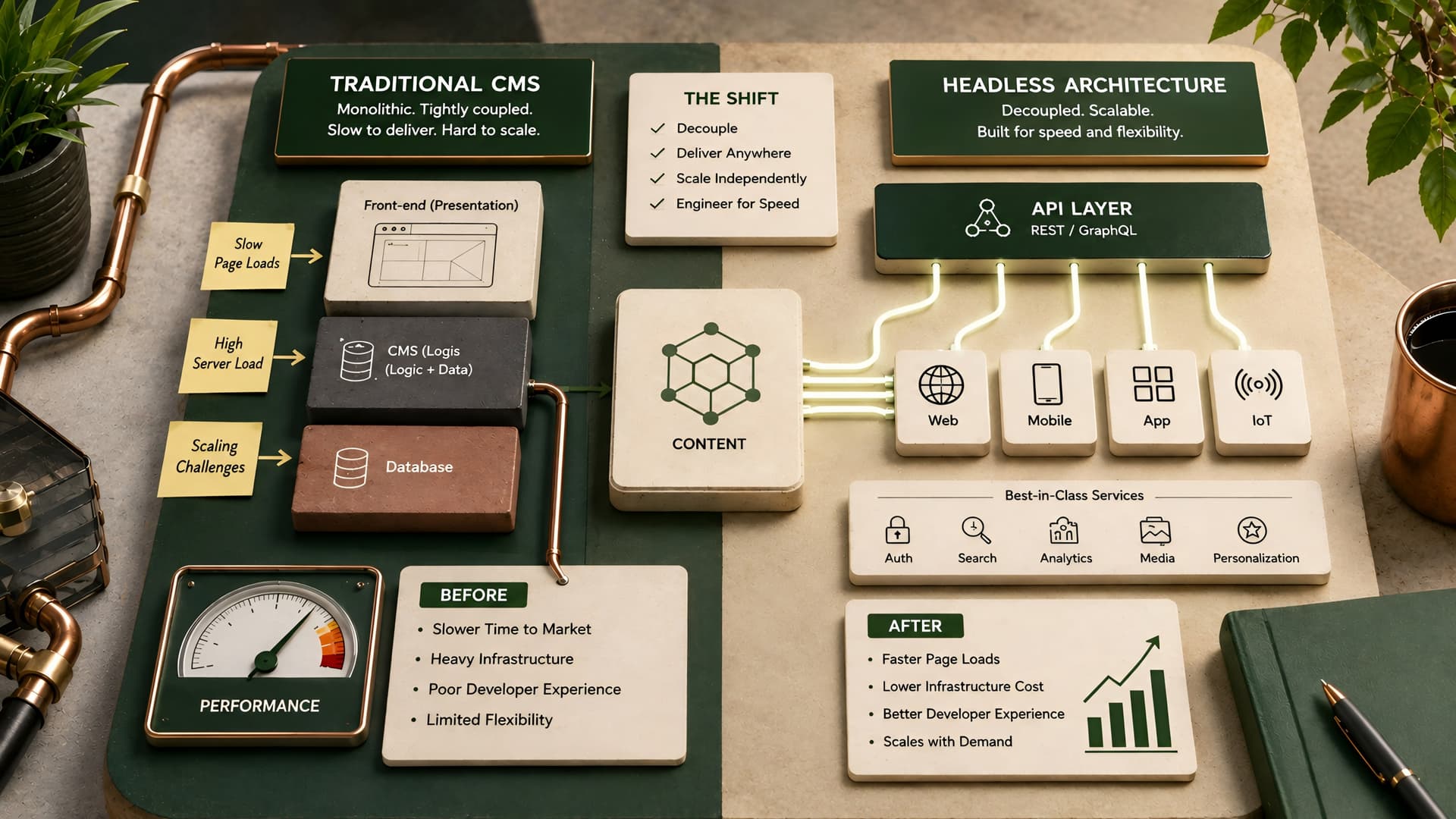
Traditional CMS platforms like WordPress or Drupal are designed as all-in-one solutions. They bundle content management, database, templating, and presentation layers into a single, tightly coupled system.
While convenient for rapid setup, this monolithic approach introduces significant overhead. Every page request often triggers complex database queries, server-side processing, and rendering cycles, even for static content.
This heavy lifting leads to slower Time To First Byte (TTFB), larger page sizes, and a poorer user experience. For technical SEO, this directly translates to lower crawlability, indexing challenges, and negative signals for search engine algorithms.
Enter Headless CMS: Decoupling for Speed
A headless CMS fundamentally changes this dynamic. It separates the 'head' (the front-end presentation layer) from the 'body' (the back-end content repository and administration interface).
Content is stored and managed in the headless CMS, then delivered via an API to any front-end application. This decoupling allows engineers to choose specialized tools for each layer, optimizing for performance where it matters most.
The core benefit is agility: content can be consumed by websites, mobile apps, IoT devices, or any other digital touchpoint without being tied to a specific rendering engine. For web performance, this means we can use modern front-end frameworks designed for speed.
How Headless Architectures Boost Performance
By decoupling the CMS, we gain several advantages for performance optimization. The front-end can be built with frameworks like Next.js, Gatsby, or Astro, which excel at delivering content quickly.
These frameworks leverage advanced rendering strategies, efficient asset delivery, and optimized build processes. This approach is central to how we design high-performance sites at Muhyo Tech.
Key Performance Optimization Strategies with Headless CMS
Moving to a headless architecture opens up a suite of powerful optimization techniques. These strategies directly address common performance bottlenecks found in traditional setups.
Our goal is to deliver content to the user's browser with minimal delay and maximum efficiency.
1. Static Site Generation (SSG)
SSG is a game-changer for content-heavy sites. With SSG, your website's pages are pre-rendered into static HTML files at build time, not at request time.
When a user requests a page, the server simply delivers the pre-built HTML, CSS, and JavaScript. There's no database query or server-side rendering on demand, making page loads incredibly fast and highly secure.
This approach significantly improves TTFB and Largest Contentful Paint (LCP) scores, critical factors for Core Web Vitals and overall SEO performance. It also scales effortlessly under heavy traffic.
2. Server-Side Rendering (SSR)
While SSG is ideal for largely static content, some pages require real-time data or user-specific content. For these scenarios, Server-Side Rendering (SSR) is the preferred method.
With SSR, the page is rendered on the server for each request, then sent as fully formed HTML to the client. This provides a fast initial load and ensures that search engine crawlers receive a complete, crawlable page.
Frameworks like Next.js offer excellent hybrid rendering capabilities, allowing you to choose SSG for static pages and SSR for dynamic ones within the same application. This flexibility is crucial for balancing performance and dynamic content needs.
3. Efficient Data Fetching Strategies
The way your front-end fetches data from the headless CMS API profoundly impacts performance. Over-fetching or under-fetching data can lead to unnecessary network requests or delayed content.
We advocate for GraphQL as a powerful API query language that allows the client to request exactly the data it needs, no more, no less. This minimizes payload sizes and improves load times.
For REST APIs, careful planning of endpoints and response structures is essential. Implementing caching strategies, both at the CDN level and client-side, further reduces the need for repeated data fetches.
4. Advanced Image Optimization
Images are often the largest contributors to page weight and a major drag on performance. With a headless setup, you gain complete control over image optimization.
Implement responsive images using srcset and sizes attributes to serve appropriately sized images for different devices. Leverage modern image formats like WebP or AVIF, which offer superior compression without sacrificing quality.
Using an image optimization service or a CDN with image transformation capabilities can automate much of this. Lazy loading images (loading them only when they enter the viewport) also dramatically improves initial page load times.
5. Critical CSS and Code Splitting
To further enhance perceived performance, we focus on delivering critical CSS and JavaScript first. Critical CSS includes only the styles necessary for the content above the fold, preventing render-blocking issues.
Code splitting breaks your JavaScript bundle into smaller chunks, loading them only when needed. This reduces the initial JavaScript payload, speeding up Time To Interactive (TTI).
Modern front-end frameworks automate much of this, but understanding the underlying principles allows for fine-tuned optimizations. These techniques directly improve First Contentful Paint (FCP) and TTI.
Comparing Rendering Strategies for Performance
Choosing the right rendering strategy is a core decision in headless development. Each has its strengths and weaknesses regarding performance, SEO, and development complexity.
| Strategy | Description | Pros for Performance/SEO | Cons |
|---|---|---|---|
| Static Site Generation (SSG) | Pages pre-built into HTML at build time. | Extremely fast, excellent Core Web Vitals, high security, easy to scale, great for SEO as content is fully present at request. | Rebuild required for content updates, not suitable for highly dynamic/user-specific content. |
| Server-Side Rendering (SSR) | Pages rendered on the server for each request. | Fast initial load, always up-to-date content, good for SEO (crawlers see full content). | Higher server load, can be slower than SSG due to on-demand rendering. |
| Client-Side Rendering (CSR) | Browser fetches data and renders content after initial HTML load. | Highly interactive, reduced server load (after initial fetch). | Poor initial load performance, potential SEO challenges (crawlers may struggle with empty HTML), worse Core Web Vitals. |
| Incremental Static Regeneration (ISR) | SSG with on-demand or time-based revalidation of static pages. | Combines SSG speed with content freshness, excellent for large sites with frequently updated content. | More complex to implement than pure SSG, requires careful caching invalidation. |
At Muhyo Tech, we lean heavily on SSG and ISR for most content-driven projects. This gives us the best balance of performance, SEO benefits, and content freshness. We reserve SSR for truly dynamic sections that require real-time user data.
The Business Value of a High-Performance Headless Site
Investing in headless CMS performance isn't just about chasing technical metrics; it translates directly into tangible business benefits.
A faster website leads to a better user experience, which in turn impacts engagement, conversions, and search engine visibility. We approach every engineering decision with these business outcomes in mind.
Improved Core Web Vitals and SEO Rankings
Google has made it clear that Core Web Vitals (LCP, FID, CLS) are crucial ranking factors. A headless architecture, properly implemented, makes it significantly easier to achieve excellent scores.
Faster load times and a smoother user experience signal to search engines that your site is high quality and valuable. This can lead to improved organic search rankings, higher visibility, and ultimately, more qualified traffic.
Enhanced User Experience and Engagement
Users expect instant gratification. A slow website frustrates visitors, leading to high bounce rates and reduced time on site. Headless sites, by design, are built for speed, offering a seamless browsing experience.
When users can access content quickly and effortlessly, they are more likely to explore more pages, engage with your content, and complete desired actions, whether it's making a purchase or filling out a form.
Reduced Bounce Rates and Increased Conversions
Studies consistently show a direct correlation between page load speed and bounce rate. Every second of delay can significantly increase the likelihood of a user abandoning your site.
By optimizing performance with a headless CMS, you create a more welcoming environment for visitors. This reduces friction in the user journey, keeps them on your site longer, and increases the probability of conversions.
Greater Scalability and Reliability
Static sites generated from a headless CMS can be served from a CDN (Content Delivery Network). This distributes your content globally, bringing it closer to users and reducing latency.
CDNs also handle traffic spikes effortlessly, making your site highly resilient and scalable. This means your website remains fast and available even during peak traffic periods, providing a reliable experience for all users.
Common Mistakes to Avoid in Headless CMS Implementation
While headless offers immense benefits, there are pitfalls to avoid. A poor implementation can negate many of the performance advantages.
Our experience shows that careful planning and a disciplined engineering approach are essential.
- Neglecting Image Optimization: Simply moving to headless won't automatically optimize images. You still need a strategy for responsive images, modern formats, and lazy loading.
- Over-reliance on Client-Side Rendering: Using CSR for all content can reintroduce SEO and performance issues that headless aims to solve. Choose SSG/SSR where appropriate.
- Inefficient Data Fetching: Fetching too much data or making too many API calls can slow down your front-end. Design your API queries and caching carefully.
- Ignoring Caching Strategies: Without proper caching (CDN, browser, API), even a fast front-end can suffer from repeated data fetches.
- Lack of Performance Monitoring: Don't just build it and forget it. Continuously monitor Core Web Vitals and other performance metrics to identify and address regressions.
Practical Checklist for Headless CMS Performance
To ensure your headless setup delivers on its performance promise, follow this actionable checklist:
- Choose the Right Headless CMS: Select a CMS that offers a robust API, good developer experience, and scalability.
- Select a Modern Front-End Framework: Opt for frameworks like Next.js, Gatsby, or Astro known for performance and SEO capabilities.
- Prioritize SSG/ISR: Use Static Site Generation or Incremental Static Regeneration for as much content as possible.
- Implement Responsive and Optimized Images: Serve images in modern formats (WebP, AVIF), use
srcset, and lazy load. - Optimize Data Fetching: Use GraphQL or carefully designed REST APIs to fetch only necessary data. Implement client-side and server-side caching.
- Critical CSS and Code Splitting: Ensure only essential CSS and JS load initially.
- Leverage a CDN: Deploy your static assets and front-end to a Content Delivery Network for global distribution and faster delivery.
- Minify and Compress Assets: Automatically minify HTML, CSS, and JavaScript, and enable Gzip/Brotli compression.
- Monitor Performance Continuously: Use tools like Lighthouse, PageSpeed Insights, and RUM (Real User Monitoring) to track Core Web Vitals.
- Preload Critical Resources: Use
<link rel="preload">for fonts, CSS, or JavaScript that are critical for the initial render.
Frequently Asked Questions (FAQs)
What is the main difference in performance between traditional and headless CMS?
Traditional CMS often renders pages on the server for every request, involving database queries and server-side processing, which can be slow. Headless CMS decouples this, allowing the front-end to use highly optimized rendering strategies like SSG or SSR, leading to much faster page loads and better Core Web Vitals.
Does a headless CMS automatically guarantee better SEO?
No, a headless CMS does not automatically guarantee better SEO. However, it provides the architectural foundation to achieve superior SEO performance through faster load times, better Core Web Vitals, and full control over markup for crawlers. Proper implementation of SSG/SSR, image optimization, and semantic HTML is still crucial.
What are Core Web Vitals and why are they important for headless CMS?
Core Web Vitals are a set of metrics from Google that measure real-world user experience for loading performance (Largest Contentful Paint), interactivity (First Input Delay), and visual stability (Cumulative Layout Shift). They are important because they are ranking factors; headless CMS architectures are inherently well-suited to optimizing these metrics due to their focus on front-end speed.
Is headless CMS suitable for all types of websites?
While highly beneficial for many, headless CMS is particularly suited for content-heavy sites, e-commerce platforms, and web applications where performance, scalability, and multi-channel content delivery are priorities. For very simple brochure sites with minimal content updates, a traditional CMS might offer a quicker, simpler setup, but often with performance tradeoffs.
The Muhyo Tech Approach to Headless Performance
At Muhyo Tech, we don't just build websites; we engineer solutions that perform. Our standard practice involves leveraging headless architectures combined with modern frameworks like Next.js to deliver websites that are not only blazing fast but also inherently SEO-friendly and highly scalable.
We believe that a performant website is a cornerstone of any successful digital presence, ensuring a superior user experience and stronger discoverability. This commitment to engineering excellence is what drives our performance optimization services, helping our clients launch with confidence.
Final Thoughts: Engineering for the Future of Web Performance
The shift to headless CMS isn't just a trend; it's an evolution in web engineering that prioritizes performance, flexibility, and scalability. By decoupling content from presentation, we unlock the ability to build truly exceptional digital experiences.
For founders and technical leaders, understanding these architectural choices is paramount. It’s about making informed decisions that pay dividends in user satisfaction, search engine visibility, and long-term business growth. Embrace the headless revolution, and engineer for speed.