


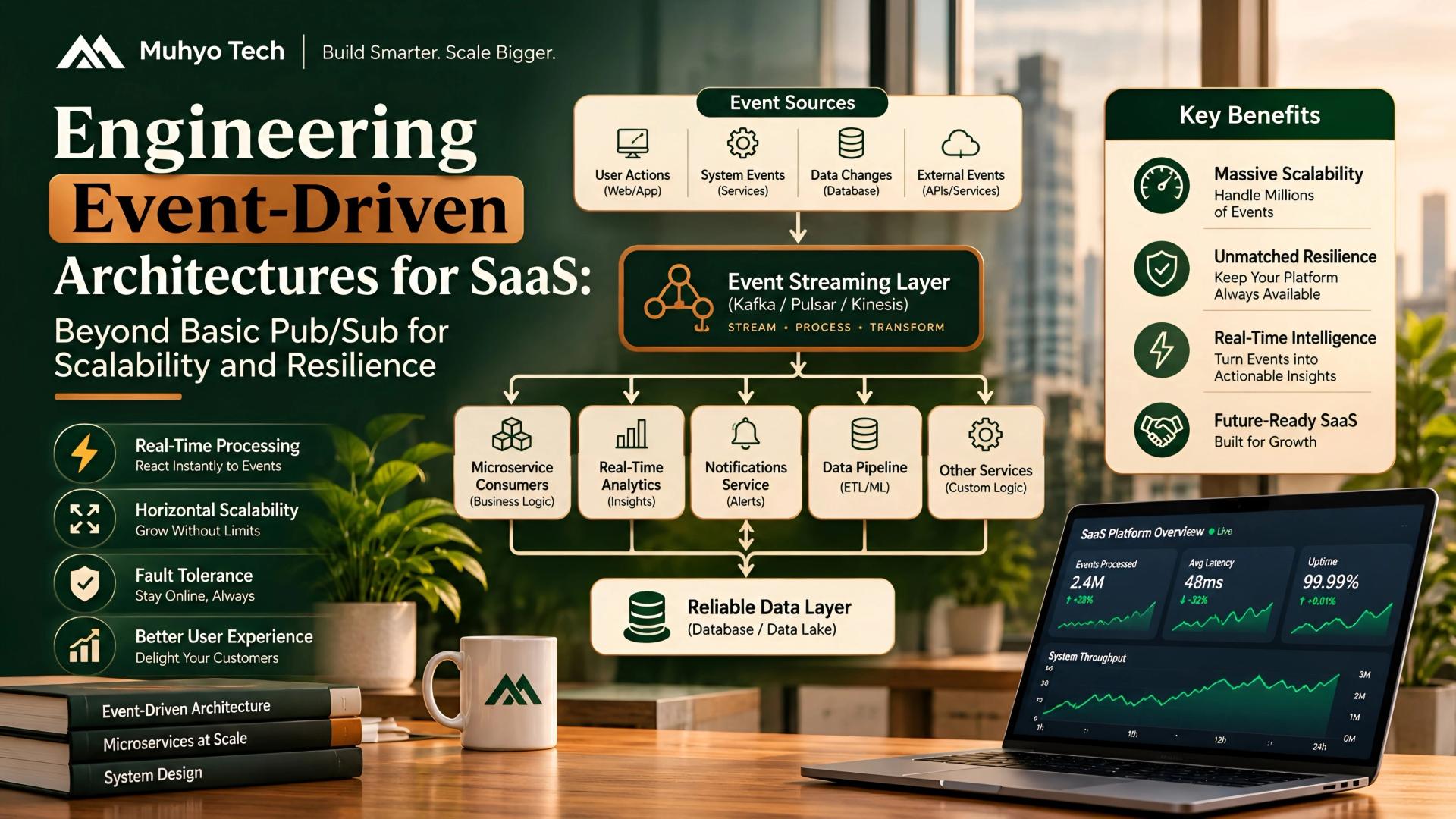
When building SaaS products, many engineering teams eventually hit a wall with traditional request-response architectures. As features grow and user loads increase, the tightly coupled nature of synchronous calls can lead to bottlenecks, cascading failures, and a painful developer experience.
This is where event-driven architectures (EDA) become essential, but simply adding a basic message queue isn't enough. True resilience and scalability in SaaS demand a deeper dive into advanced patterns.
The Limitations of Traditional Request-Response in SaaS
Imagine a user signing up for your SaaS product. In a traditional system, this might trigger a cascade of synchronous API calls: create user record, provision account, send welcome email, update CRM, and perhaps notify an analytics service. Each step relies on the previous one completing successfully and promptly.
If any of these services are slow or fail, the entire signup process grinds to a halt, or worse, fails completely. This tightly coupled dependency creates a brittle system, difficult to scale and prone to outages.
Why Event-Driven Architecture is a Game Changer for SaaS
An event-driven architecture fundamentally changes how components communicate. Instead of direct calls, components emit 'events' — immutable facts about something that happened in the system — and other interested components react to these events asynchronously.
This decouples services, allowing them to operate independently and concurrently. The benefits for SaaS are significant: improved fault tolerance, enhanced scalability, better responsiveness, and a clearer audit trail of system changes.
Core Components of an Event-Driven System
At its heart, an EDA involves several key players. Events are the messages themselves, describing a past occurrence. Event producers are services that publish these events, while event consumers subscribe and react to them.
An event broker, like Apache Kafka or RabbitMQ, acts as the intermediary, ensuring events are delivered reliably. This foundational setup allows for significant flexibility in how your SaaS application operates.
Beyond Basic Pub/Sub: Advanced EDA Patterns
While basic publish/subscribe is a start, robust SaaS platforms often need more sophisticated approaches. We frequently look at patterns like Event Sourcing and Command Query Responsibility Segregation (CQRS) to unlock deeper architectural advantages.
These patterns address specific challenges around data consistency, historical state, and read/write performance, which are critical for complex, high-throughput applications.
Event Sourcing: Rebuilding State from History
Event Sourcing is a powerful pattern where instead of storing only the current state of an application entity, we store every change to that state as a sequence of immutable events. The current state is then derived by replaying these events.
This provides an infallible audit log, allows for time-travel debugging, and enables projection of state into various read models. For a SaaS product, this means you can reconstruct any user's data at any point in time, which is invaluable for analytics, compliance, and debugging.
Tradeoffs of Event Sourcing
While powerful, event sourcing introduces complexity. Querying historical data directly can be challenging, requiring event stream processing or dedicated read models. The initial implementation effort is higher, and operational tooling needs to mature to support event stream management and replay.
At Muhyo Tech, we carefully evaluate the specific business needs before recommending event sourcing, prioritizing scenarios where historical state and auditability are paramount.
Command Query Responsibility Segregation (CQRS)
CQRS separates the responsibilities of reading data (queries) from writing data (commands). In a traditional CRUD application, a single data model serves both purposes. With CQRS, you maintain separate models, often optimized for their specific tasks.
This means you might have a highly normalized write model (for commands) and denormalized, purpose-built read models (for queries). When combined with EDA, commands generate events that update these read models asynchronously.
Benefits and Challenges of CQRS for SaaS
CQRS offers tremendous benefits for performance and scalability, especially for read-heavy SaaS applications. You can scale read models independently and optimize them for specific UI needs, leading to faster response times for users.
The main challenge is eventual consistency. Read models are updated asynchronously, meaning a query might not immediately reflect the latest command. This requires careful UX design and a clear understanding of consistency guarantees.
Implementing Reliable Message Delivery
The backbone of any robust EDA is reliable message delivery. This isn't just about events making it from producer to broker, but also ensuring consumers process them correctly and idempotently.
Patterns like 'at-least-once' delivery, dead-letter queues, and consumer group management are crucial. We often implement robust retry mechanisms and monitoring to catch and address message processing failures before they impact users.
Monitoring and Observability in EDA
With distributed systems, monitoring takes on new importance. You need to trace events as they flow through your system, understand processing times, and identify bottlenecks or failures across multiple services. Distributed tracing tools are indispensable here.
Comprehensive logging and alerting on message queues, consumer health, and event processing errors provide the visibility needed to operate these complex systems confidently.
Architectural Checklist for Event-Driven SaaS
- Define Event Schemas: Establish clear, versioned schemas for all events to ensure compatibility.
- Idempotent Consumers: Design consumers to process the same event multiple times without side effects.
- Dead-Letter Queues (DLQs): Implement DLQs to capture and handle events that fail processing.
- Distributed Tracing: Integrate tools to trace events across services and identify bottlenecks.
- Transactional Outbox Pattern: Ensure atomicity between database updates and event publishing.
- Event Versioning Strategy: Plan for schema evolution to avoid breaking changes as your system grows.
- Replay Capability: Ensure your event broker and consumers can support replaying events for recovery or new read model creation.
- Consistency Model Clarity: Clearly define where eventual consistency is acceptable and where strong consistency is required.
Business Outcomes: Why This Matters to Your SaaS Product
Moving to an event-driven architecture isn't just an engineering choice; it's a strategic business decision. It directly impacts your product's ability to scale with user growth, introduce new features rapidly, and maintain high availability.
The resilience built into these systems reduces downtime and improves customer trust. The ability to react to events in real-time opens doors for new features like live notifications, dynamic dashboards, and sophisticated analytics, all contributing to a more valuable product.
Frequently Asked Questions (FAQs)
When should a SaaS company consider an event-driven architecture?
SaaS companies should consider EDA when they face challenges with scalability, fault tolerance, real-time feature requirements, or when their existing monolithic or tightly coupled microservices architecture becomes difficult to maintain and evolve. Typically, this happens as the product matures and user load increases significantly.
What are the common pitfalls when implementing event-driven architecture in SaaS?
Common pitfalls include over-engineering simple problems, neglecting event schema evolution, failing to implement idempotent consumers, poor monitoring and observability, and not planning for eventual consistency challenges. It's crucial to start small, iterate, and invest in robust tooling.
How does event-driven architecture impact performance and maintenance?
EDA can significantly improve perceived performance by enabling asynchronous processing and dedicated read models. However, it adds operational complexity in terms of debugging distributed flows and managing message brokers. Maintenance shifts from single-service debugging to understanding event flows across services, requiring good observability.
What's the difference between a simple message queue and a full event-driven system?
A simple message queue often facilitates basic task offloading or inter-service communication. A full event-driven system, especially with patterns like Event Sourcing or CQRS, defines how the entire system's state changes are managed, recorded, and reacted to, forming the core fabric of the application's logic rather than just a communication channel.
Final Thoughts on Evolving Your SaaS Architecture
Embracing event-driven architectures for SaaS is a journey that moves beyond simple pub/sub. It involves a fundamental shift in how you think about data, state, and service interaction. By strategically adopting patterns like Event Sourcing and CQRS, you can build systems that are not only scalable and resilient but also more adaptable to future business needs.
At Muhyo Tech, we guide founders and engineering teams through these architectural decisions, helping to design and implement robust, event-driven solutions that truly empower their SaaS products for long-term success.