


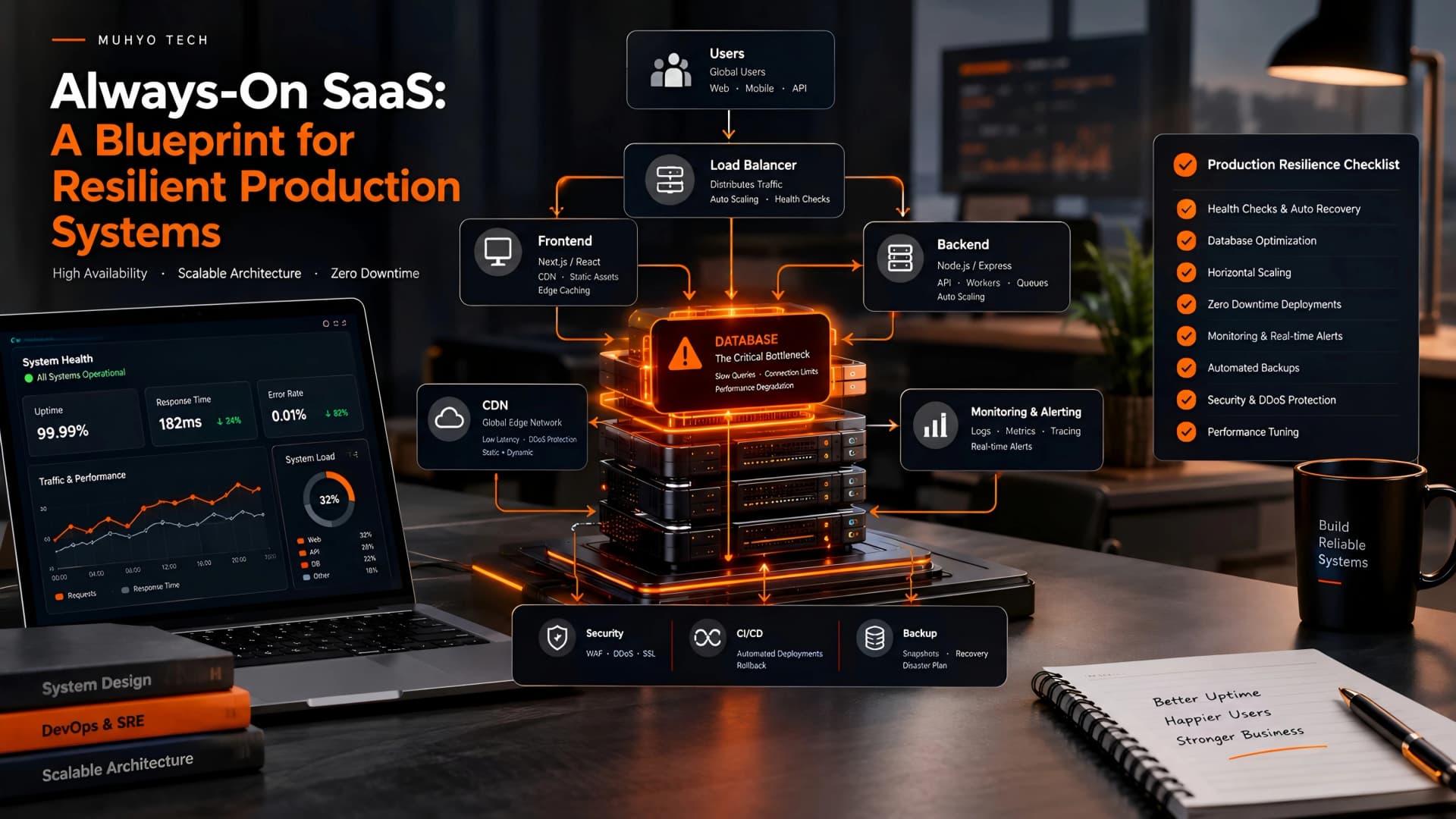
Imagine a SaaS application that never goes down, even when components fail. While 'never' is an ideal, designing for 'always-on' is the bedrock of modern SaaS success. Downtime doesn't just annoy users; it directly impacts revenue, erodes trust, and can be notoriously expensive to fix reactively.
Building a resilient SaaS architecture isn't about throwing more hardware at the problem. It's about a systematic approach to anticipating failure, isolating issues, and ensuring continuous operation through thoughtful engineering. This deep dive outlines a blueprint for achieving true fault tolerance in production SaaS environments.
The Core Challenge: Anticipating Failure
Every system, no matter how robust, will eventually encounter issues. Hardware fails, networks drop, software bugs emerge, and traffic spikes can overwhelm unprepared infrastructure. The real challenge for SaaS providers is acknowledging this inevitability and designing systems that can withstand these shocks without collapsing.
A single point of failure (SPOF) is the enemy of resilience. Identifying and eliminating SPOFs is the first, most crucial step in architecting an always-on system. This requires a shift from simply making components reliable to making the *overall system* resilient to individual component failures.
Pillars of Fault-Tolerant SaaS Design
At Muhyo Tech, our approach to resilient SaaS architecture is built upon several foundational pillars. These aren't just theoretical concepts; they are practical engineering mandates that guide our system design and implementation.
1. Redundancy and Replication
Redundancy means having duplicate components ready to take over if a primary one fails. This applies to every layer of the stack: compute, networking, storage, and databases.
For compute, this often involves deploying instances across multiple availability zones or even regions. Database replication, both synchronous and asynchronous, ensures data durability and availability even if a primary database instance becomes unreachable. Load balancers distribute traffic across healthy instances, automatically removing unhealthy ones.
2. Isolation and Decoupling (Microservices)
Monolithic applications are inherently less resilient because a failure in one module can bring down the entire system. Microservices architecture, by contrast, breaks down an application into smaller, independent services.
Each microservice can be developed, deployed, and scaled independently. This isolation prevents cascading failures: if one service experiences an issue, it doesn't necessarily impact others. This decoupling also simplifies debugging and allows for more targeted scaling, improving overall efficiency and resilience.
3. Asynchronous Communication and Queues
Synchronous communication between services can introduce tight coupling and latency. If Service A calls Service B, and Service B is slow or down, Service A also becomes impacted. Asynchronous patterns, often utilizing message queues (like Kafka or RabbitMQ), mitigate this risk.
Tasks are added to a queue, and worker services process them independently. This allows services to continue operating even if downstream dependencies are temporarily unavailable, providing a buffer and preventing backpressure from overwhelming the system.
4. Graceful Degradation and Circuit Breakers
A truly resilient system doesn't just fail or succeed; it can also degrade gracefully. If a non-critical feature's dependency is down, the system should ideally disable that feature temporarily rather than crashing entirely. Users can still access core functionality.
Circuit breakers are a design pattern that prevents an application from repeatedly trying to invoke a service that is likely to fail. After a certain number of failures, the circuit 'opens,' short-circuiting calls to that service and allowing it to recover, preventing resource exhaustion on the calling service.
5. Robust Error Handling and Observability
Comprehensive error handling at every layer, from network requests to business logic, is non-negotiable. This includes proper logging, alerting, and retry mechanisms with exponential backoff.
Observability — through metrics, logs, and traces — provides the crucial visibility needed to understand system behavior, diagnose issues quickly, and anticipate potential failures before they impact users. Without it, even the most resilient architecture is a black box when things go wrong.
Architectural Choices for Resilience: A Comparison
Choosing the right architecture involves understanding tradeoffs. Here's a look at common patterns and their implications for resilience.
| Architecture Style | Pros for Resilience | Cons for Resilience | Best Use Case |
|---|---|---|---|
| Monolith | Simpler initial deployment. Easier to reason about for small teams. | Single point of failure. Cascading failures likely. Difficult to scale components independently. | Early-stage startups, simple applications where fault tolerance is less critical than rapid iteration. |
| Microservices | Service isolation prevents cascading failures. Independent scaling. Technology diversity. | Increased operational complexity. Distributed transaction challenges. More services to monitor. | Large-scale SaaS, complex business domains, high availability requirements. |
| Serverless (FaaS) | Automatic scaling and high availability managed by provider. Pay-per-execution. | Vendor lock-in. Cold starts can impact latency. Debugging distributed functions can be challenging. | Event-driven workflows, APIs, background tasks where rapid scaling and managed infra are key. |
Multi-Tenancy and Resilience Considerations
Multi-tenancy introduces unique challenges and opportunities for resilient SaaS. While it offers efficiency by sharing infrastructure, it also requires careful isolation to prevent one tenant's issues from affecting others.
Strategies like tenant-aware load balancing, dedicated queues per tenant for critical operations, and resource quotas are essential. At Muhyo Tech, we often design multi-tenant systems with clear boundaries, ensuring that resource contention or errors from one tenant don't compromise the stability or performance for others. This balance of efficiency and isolation is a critical part of our engineering standards.
Building a Resilient Pipeline: CI/CD and Deployment Strategies
Resilience isn't just about runtime architecture; it extends to how software is delivered. A robust Continuous Integration/Continuous Deployment (CI/CD) pipeline is vital.
Automated testing (unit, integration, end-to-end) catches bugs before they reach production. Deployment strategies like blue/green deployments or canary releases minimize downtime and allow for quick rollbacks. Immutable infrastructure ensures consistency and reduces configuration drift, preventing a common source of production issues.
The Muhyo Tech Approach to Resilience: Practical Engineering
When we design systems at Muhyo Tech, we don't just pick technologies; we engineer for robustness from the ground up. This involves:
- Threat Modeling: Proactively identifying potential failure points and attack vectors.
- Chaos Engineering: Intentionally injecting failures into systems to test their resilience and uncover weaknesses before they become incidents.
- Automated Recovery: Implementing self-healing mechanisms where possible, such as auto-scaling groups and automated database failovers.
- Disaster Recovery Planning: Documenting and regularly testing procedures for recovering from major outages, including data backups and restoration.
We believe that a resilient system is a well-understood system. This means clear documentation, runbooks, and a culture of continuous learning from incidents, big or small. Our goal is always to reduce the blast radius of any potential failure.
Common Mistakes in Pursuing SaaS Resilience
Even with the best intentions, mistakes happen. Here are a few common pitfalls to avoid:
- Over-optimizing too early: Building overly complex fault-tolerant systems for a product that hasn't found product-market fit can be a waste of resources. Start simple, iterate.
- Ignoring observability: A system without proper monitoring, logging, and alerting is a ticking time bomb. You can't fix what you can't see.
- Not testing disaster recovery: Having a disaster recovery plan is great; *testing* it regularly is essential. Plans often fail under real pressure if not practiced.
- Assuming cloud providers are infallible: While cloud infrastructure is robust, regional outages and service-specific issues still occur. Design your application to be resilient *within* and *across* cloud regions.
- Neglecting security: A resilient system that is also insecure is not truly resilient. Security vulnerabilities can be a major source of downtime or data loss.
Business Value of a Resilient SaaS Architecture
The investment in a resilient SaaS architecture delivers tangible business benefits:
- Maximized Uptime & Revenue: Direct correlation between availability and revenue, especially for subscription-based models.
- Enhanced Customer Trust & Loyalty: Reliable service builds confidence and reduces churn.
- Reduced Operational Risk: Fewer critical incidents mean less stress for engineering teams and predictable operations.
- Faster Recovery Times: When failures do occur, robust systems recover more quickly, minimizing impact.
- Competitive Advantage: Outperforming competitors in reliability can be a significant differentiator.
Ultimately, a resilient architecture allows founders and business owners to focus on growth and innovation, rather than constantly firefighting production issues. It's an investment in long-term stability and success.
Frequently Asked Questions (FAQs)
What are the key principles of resilient SaaS design?
Key principles include redundancy, isolation (e.g., microservices), asynchronous communication, graceful degradation, robust error handling, and comprehensive observability. These work together to anticipate and mitigate failures.
How does multi-tenancy impact SaaS resilience?
Multi-tenancy requires careful isolation strategies to prevent issues with one tenant from affecting others. This involves dedicated resources, tenant-aware routing, and robust resource quotas to ensure fair usage and stability across all users.
What tools or technologies are used to build resilient SaaS applications?
Common tools include cloud platforms (AWS, Azure, GCP), containerization (Docker, Kubernetes), message queues (Kafka, RabbitMQ), load balancers, database replication, monitoring tools (Prometheus, Grafana), and CI/CD pipelines (Jenkins, GitLab CI).
How do you test the resilience of a SaaS application?
Testing resilience involves techniques like chaos engineering (injecting failures), load testing (simulating high traffic), disaster recovery drills, and regular security audits. These tests proactively identify weaknesses before they cause production incidents.
Conclusion: Engineering for the Inevitable
Building an always-on SaaS application isn't a one-time project; it's an ongoing commitment to engineering excellence. It demands proactive thinking, a deep understanding of potential failure modes, and a willingness to invest in robust architectural patterns and operational practices.
By embracing redundancy, decoupling services, designing for graceful degradation, and relentlessly prioritizing observability, we can create SaaS platforms that not only survive the inevitable bumps but thrive, delivering continuous value to users and peace of mind to their operators. This is the standard we uphold at Muhyo Tech, ensuring the systems we build are ready for the real world.