


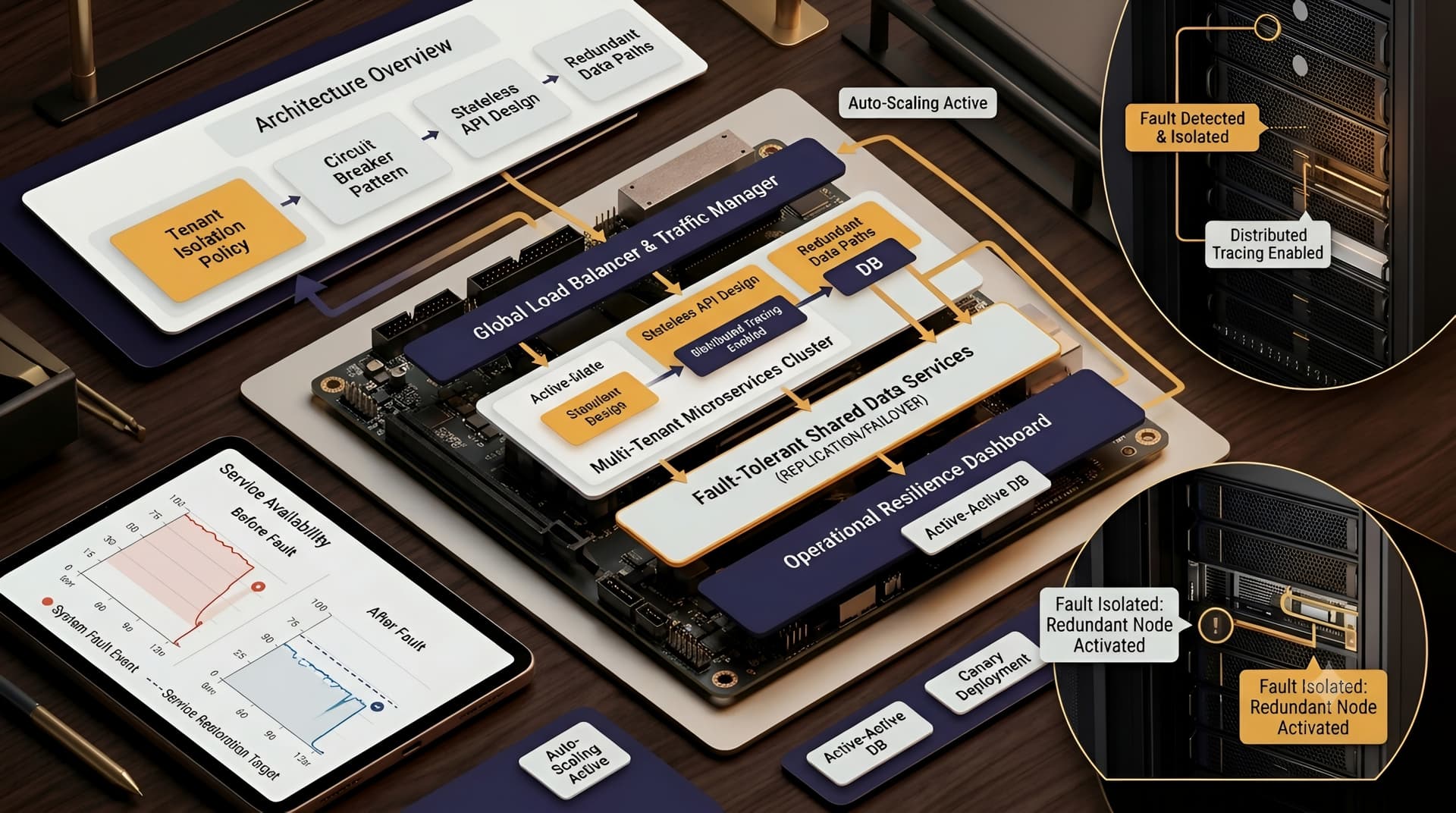
Imagine a critical service for one of your SaaS tenants suddenly experiences an outage. Without proper safeguards, this isolated incident can quickly snowball, dragging down other tenants and causing widespread disruption.
This cascading failure is a nightmare for any multi-tenant SaaS provider, eroding trust and impacting revenue. At Muhyo Tech, we understand the immense pressure to deliver consistent uptime across diverse user bases.
The Core Challenge of Multi-Tenancy: Shared Resources, Independent Failures
Multi-tenant architectures offer significant cost efficiencies and simplified management by sharing infrastructure across multiple customers. However, this shared environment introduces a unique reliability challenge: a problem affecting one tenant can easily bleed into others.
A misbehaving query from Tenant A, a spike in traffic from Tenant B, or an unhandled exception in a shared library can exhaust resources. This exhaustion might then starve requests from Tenant C, leading to an availability crisis for everyone.
Our goal in designing these systems is to build walls within the shared space. We aim to ensure that a failure in one tenant's domain remains contained, preventing it from becoming a systemic issue.
Tenant Isolation: The Foundation of Fault Tolerance
The first line of defense in a fault-tolerant multi-tenant system is strong tenant isolation. This means designing your architecture so that each tenant's operations are as independent as possible, even when sharing underlying hardware or services.
Effective isolation prevents 'noisy neighbor' problems and ensures that resource consumption by one tenant doesn't negatively impact another. We look for opportunities to segregate data, compute, and even network resources.
Database-Level Isolation
Data isolation is paramount for both security and reliability. There are several common strategies, each with its own tradeoffs.
Separate databases per tenant offer the strongest isolation but come with higher operational overhead. Alternatively, separate schemas or tables within a shared database provide a balance, requiring careful query design and indexing.
Choosing the right database isolation strategy depends heavily on the specific application's data sensitivity, performance needs, and anticipated scaling patterns.
Compute Isolation (Microservices and Containers)
Modern architectures often leverage microservices and containerization (like Docker and Kubernetes) to achieve compute isolation. Each tenant's critical workloads can run in dedicated containers or even separate service instances.
This allows for independent scaling, deployment, and resource allocation. If one tenant's service instance crashes, it doesn't bring down the entire application for everyone else.
We often design microservice boundaries around tenant-specific functions to maximize this benefit.
Implementing Circuit Breakers: Preventing Cascading Service Failures
Even with strong isolation, components will inevitably fail. A circuit breaker pattern is a crucial mechanism to prevent a failing service from overwhelming other parts of your system, especially in distributed microservice architectures.
Think of it like an electrical circuit breaker: when a fault is detected, it 'trips' and stops further requests from being sent to the unhealthy component. This gives the failing service time to recover and prevents its unresponsiveness from spreading.
How Circuit Breakers Work
A circuit breaker typically has three states: Closed, Open, and Half-Open.
- Closed: Requests pass through to the service normally. If the error rate exceeds a threshold, it transitions to Open.
- Open: Requests are immediately rejected without attempting to call the failing service. After a configurable timeout, it transitions to Half-Open.
- Half-Open: A limited number of test requests are allowed to pass through. If these succeed, the circuit returns to Closed; otherwise, it returns to Open.
Implementing circuit breakers around external API calls, database connections, or inter-service communications is a standard practice for us. This proactive approach dramatically improves system stability.
Bulkheads: Compartmentalizing Resources
The bulkhead pattern, inspired by shipbuilding, involves partitioning resources to isolate failures. If one compartment (or service component) floods, the others remain operational.
In a multi-tenant SaaS context, this means dedicating distinct resource pools for different types of requests or for different tenants. This prevents a resource hog from consuming all available capacity.
Applying Bulkheads in Practice
Consider a scenario where a tenant uploads large files. Without bulkheads, this operation could consume all I/O bandwidth, impacting other tenants' ability to process smaller, faster requests.
With bulkheads, you might allocate a dedicated thread pool, memory queue, or even network bandwidth for file uploads. This ensures that even if the upload service becomes saturated, core application functionalities for other tenants remain unaffected.
We often implement bulkheads by using separate queues for different job types or by configuring distinct connection pools for various database operations.
Robust Error Handling and Fallbacks
No system is completely immune to errors. How your application handles unexpected issues determines its resilience. Robust error handling isn't just about catching exceptions; it's about defining graceful degradation strategies.
For multi-tenant applications, this means ensuring that an error impacting one tenant's request doesn't crash the entire shared application instance. We design for specific failure modes and build in intelligent fallbacks.
Graceful Degradation and Fallback Mechanisms
When a non-critical service fails, can your application still provide a reduced but functional experience? For example, if a personalized recommendation engine is down, can you still show generic popular items?
Fallback mechanisms ensure that even if a part of the system is unavailable, the user experience for other tenants doesn't completely break. This might involve serving cached data, returning default values, or simply informing the user of temporary unavailability for a specific feature.
This kind of thoughtful design minimizes user frustration and maintains a baseline of service availability.
Monitoring, Alerting, and Automated Remediation
You can't fix what you don't see. Comprehensive monitoring is the eyes and ears of a resilient multi-tenant SaaS. This goes beyond basic server health checks.
We implement deep application-level monitoring, tracking metrics per tenant, per service, and per critical business transaction. This allows us to quickly pinpoint issues and understand their blast radius.
Key Monitoring Metrics for Multi-Tenancy
- Tenant-Specific Latency and Error Rates: Identify individual tenants experiencing performance degradation or high error volumes.
- Resource Utilization per Tenant: Track CPU, memory, network I/O, and database connections consumed by each tenant.
- Service Health and Circuit Breaker State: Monitor the health of individual microservices and the state of your circuit breakers.
- Queue Depths: Observe the backlog of messages in queues, indicating potential bottlenecks.
Automated alerting, tied to these metrics, ensures that our team is immediately notified of anomalies. Furthermore, we design automated remediation scripts to restart services, scale resources, or even failover components without manual intervention, whenever feasible.
Tradeoffs and Business Implications
Implementing advanced fault tolerance mechanisms isn't without its costs. While the benefits in reliability and customer satisfaction are clear, there are architectural complexities and operational overheads to consider.
These decisions often involve balancing engineering effort, infrastructure costs, and the criticality of the services provided. A simple marketing website will have different fault tolerance requirements than a mission-critical financial application.
| Fault Tolerance Strategy | Pros | Cons | Business Impact |
|---|---|---|---|
| Tenant Isolation (DB/Compute) | High security, limits blast radius, easier debugging. | Higher infrastructure costs, more complex deployments. | Reduced customer churn from data breaches, consistent UX. |
| Circuit Breakers | Prevents cascading failures, improves recovery time, graceful degradation. | Adds complexity to service invocation, requires careful configuration. | Higher overall system uptime, preserves core functionality. |
| Bulkheads | Protects critical services from resource exhaustion by others. | Requires careful resource partitioning, potential for under-utilization. | Ensures core features remain available during peak load or issues. |
| Robust Error Handling | Improved user experience during partial outages, better debugging. | Requires meticulous code design, can be overlooked. | Higher customer satisfaction, reduces support tickets. |
| Monitoring & Alerting | Early detection, faster MTTR, data-driven improvements. | Requires investment in tooling and expertise, alert fatigue if not tuned. | Minimizes downtime, protects revenue, builds trust. |
At Muhyo Tech, we carefully discuss these tradeoffs with founders and product teams. Our goal is to align the engineering investment with the actual business risk and strategic goals, ensuring the right level of resilience without over-engineering.
Muhyo Tech's Approach to Resilient SaaS Architectures
Our philosophy revolves around building scalable, robust systems that anticipate failure. We don't just build features; we build platforms designed for longevity and unwavering reliability.
When we engage with clients on full-stack web app development, multi-tenant fault tolerance is a critical part of the architectural discussion. This includes designing scalable API integration patterns and ensuring ongoing maintenance and support for operational excellence.
“Resilience isn't just a feature; it's a fundamental property of a trustworthy SaaS product. We engineer for the inevitable failures, so our clients don't have to experience them.”
We believe that a proactive approach to fault tolerance, embedded from the earliest design stages, yields the most reliable and cost-effective outcomes. It's about designing for robustness from the ground up, not patching problems after they arise.
Common Mistakes to Avoid
Even with good intentions, several pitfalls can undermine multi-tenant fault tolerance efforts.
- Insufficient Resource Isolation: Assuming shared resources will always behave, leading to 'noisy neighbor' issues and cascading failures.
- Over-reliance on Retries: While retries are useful, excessive or poorly configured retries can worsen a struggling service by adding more load.
- Lack of Tenant-Specific Monitoring: Generic monitoring can mask problems affecting only a subset of tenants, delaying detection and resolution.
- Ignoring Edge Cases in Error Handling: Failing to consider how the system should behave when external dependencies or critical internal components fail.
- Underestimating Operational Complexity: Implementing these patterns requires ongoing management, configuration, and testing, which can be overlooked.
Addressing these common mistakes early in the design and development lifecycle saves significant headaches down the line.
FAQ: Multi-Tenant SaaS Fault Tolerance
What is the primary goal of fault tolerance in multi-tenant SaaS?
The primary goal is to prevent a failure or performance degradation affecting one tenant from cascading and impacting other tenants. This ensures high availability and a consistent user experience across the entire customer base.
How does tenant isolation contribute to fault tolerance?
Tenant isolation segregates resources (data, compute, network) for each tenant, creating logical boundaries. This prevents resource exhaustion or errors within one tenant's operations from spilling over and affecting others in the shared environment.
Are circuit breakers and bulkheads the same?
No, they serve different but complementary purposes. A circuit breaker prevents your application from continuously calling a failing service. A bulkhead partitions resources to prevent one component's failure or excessive resource use from consuming all available resources and impacting other components.
What role does monitoring play in fault tolerance?
Monitoring is crucial for detecting failures, performance issues, and anomalies in real-time. Granular, tenant-specific monitoring allows for quick identification of the blast radius of an issue, enabling faster diagnosis and automated or manual remediation.
Is fault tolerance only for large SaaS applications?
While larger applications often have more complex needs, the principles of fault tolerance apply to SaaS applications of all sizes. Even smaller applications benefit from isolation and robust error handling to prevent customer dissatisfaction and maintain reliability as they grow.
Final Thoughts: Engineering for Trust
Building a multi-tenant SaaS application demands more than just feature development; it requires a deep commitment to resilience. Fault tolerance isn't an afterthought; it's a core architectural principle that safeguards your product, your reputation, and your revenue.
By thoughtfully applying strategies like tenant isolation, circuit breakers, bulkheads, and comprehensive monitoring, you build a system that can withstand the inevitable stresses of production. This engineering discipline ultimately translates into a more reliable product, happier customers, and a stronger foundation for growth.