


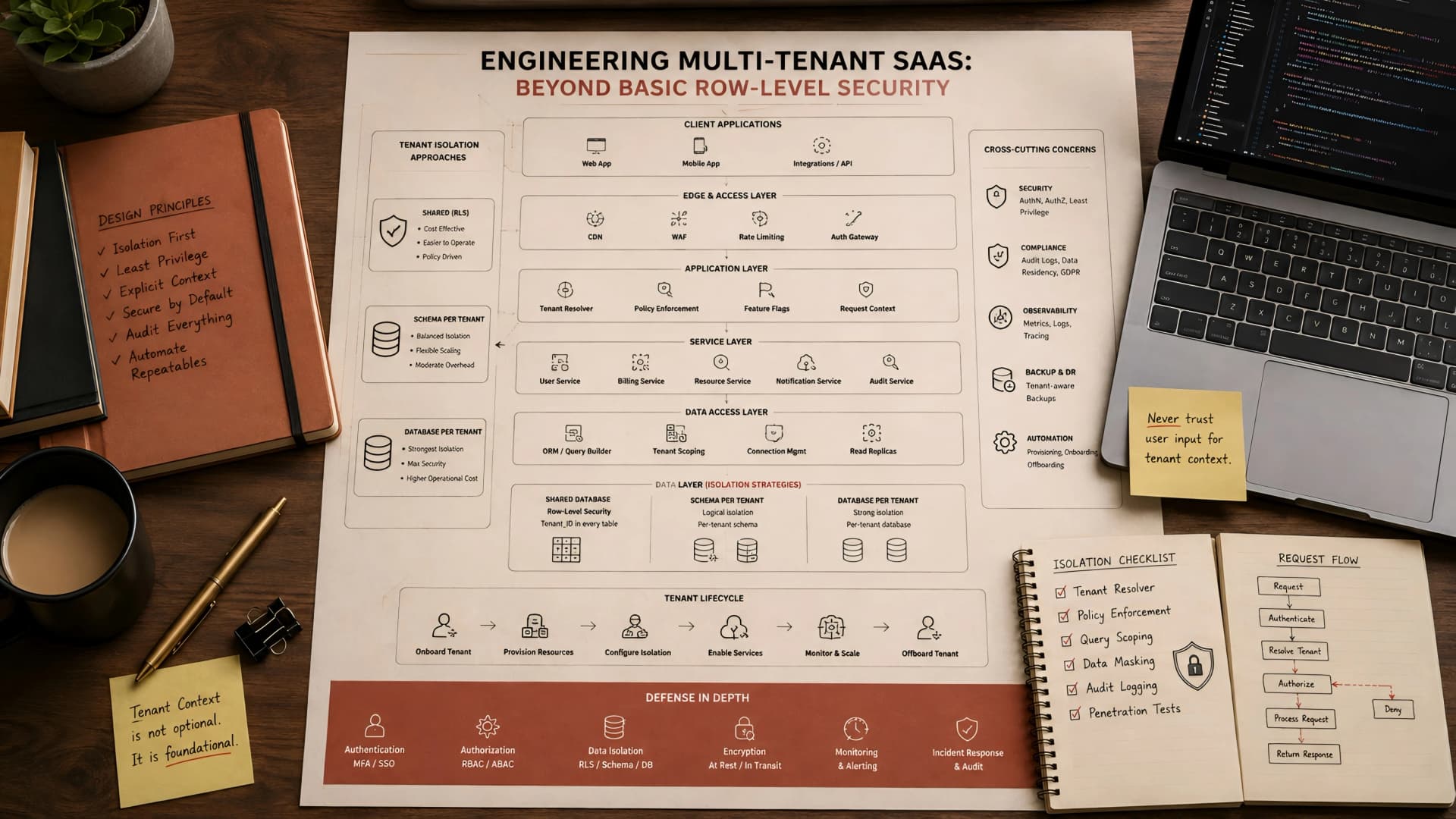
Building a multi-tenant SaaS application introduces a fundamental challenge: how do you ensure each customer's data is completely isolated and secure?
It's not just about preventing accidental data leaks; it's about building a foundation of trust and meeting stringent compliance requirements from day one.
The Core Problem: Data Isolation in Shared Environments
Many SaaS platforms start with a shared database model, where all tenant data resides within the same tables. This approach is often the quickest to get off the ground.
However, relying solely on basic row-level security (RLS) can quickly become insufficient as the application grows in complexity, features, and the number of tenants.
While RLS is a powerful first line of defense, it can introduce performance overhead and may not cover every edge case for highly sensitive data or complex query patterns.
Why Simple Row-Level Security Isn't Always Enough
Row-level security typically involves adding a tenant_id column to every relevant table. Application logic or database policies then filter data based on the authenticated user's tenant.
This works well for straightforward CRUD operations. But what about cross-tenant reporting, complex aggregations, or the risk of a misconfigured query accidentally exposing data?
The operational burden of ensuring every single query, every API endpoint, and every background job correctly applies the tenant_id filter is immense and error-prone.
Exploring Advanced Data Segregation Strategies
To address these challenges, we often look beyond basic RLS to more robust data segregation strategies. These approaches offer varying degrees of isolation, operational complexity, and cost.
The choice heavily depends on the specific product's security needs, compliance mandates, performance expectations, and anticipated scale.
Shared Database, Separate Schemas (Schema-Per-Tenant)
In this model, all tenants share the same physical database instance. However, each tenant's data is housed in its own logical schema.
For example, tenant_A.users and tenant_B.users would be distinct tables, even though they reside on the same server.
This offers a stronger logical separation than simple RLS, as misconfigured queries are less likely to accidentally cross schema boundaries.
Pros of Schema-Per-Tenant:
- Stronger logical isolation than RLS.
- Simplified backup and restore for individual tenants compared to shared tables.
- Schema changes can be managed per-tenant, offering more flexibility.
Cons of Schema-Per-Tenant:
- Still shares the same database server, so resource contention (CPU, memory, I/O) can be an issue.
- Managing many schemas can become complex, especially for migrations.
- Security is still reliant on the database's user/role management and application code to select the correct schema.
Separate Databases Per Tenant (Database-Per-Tenant)
This approach provides the highest level of data isolation. Each tenant has its own dedicated database instance, whether on the same physical server or, more commonly, on separate servers.
This is often the preferred choice for applications handling highly sensitive data or requiring strict compliance.
It virtually eliminates the risk of cross-tenant data leaks at the database level.
Pros of Database-Per-Tenant:
- Maximum data isolation and security.
- Performance is isolated; one tenant's heavy usage won't impact others.
- Easier to comply with regulatory requirements (e.g., data residency).
- Simplified backup, restore, and scaling for individual tenants.
Cons of Database-Per-Tenant:
- Higher operational overhead for provisioning, monitoring, and maintaining many database instances.
- Significantly higher infrastructure costs.
- Schema migrations across hundreds or thousands of databases can be a nightmare without strong automation.
Hybrid Approaches: Balancing Isolation and Cost
Sometimes, a pure approach doesn't fit, and a hybrid model makes the most sense. This could involve grouping smaller tenants into shared schemas or databases, while large enterprise clients get dedicated instances.
Another hybrid strategy might use a shared database with RLS for less sensitive data, while critical data for each tenant resides in separate, dedicated storage.
At Muhyo Tech, we often evaluate these hybrid models to balance strong security needs with practical operational efficiency and cost considerations.
Architectural Checklist for Robust Data Segregation
Regardless of the chosen strategy, a robust multi-tenant architecture requires careful consideration of several key areas. We look for these elements when designing scalable SaaS platforms.
- Tenant Identification: A clear, immutable tenant identifier must be present in every relevant data record, API request, and session.
- Database Connection Management: How are connections routed? Is it a shared pool with tenant context switching, or separate connection pools per tenant?
- Application-Level Enforcement: Even with database-level segregation, the application code must always be tenant-aware. This means ensuring all queries explicitly filter or target the correct tenant's data.
- Cross-Tenant Query Prevention: Implement strict measures to prevent accidental joins or queries across tenant boundaries.
- Backup and Restore Strategy: Design a system that allows for efficient, tenant-specific data recovery without affecting other tenants.
- Data Migration and Schema Evolution: Plan for how schema changes will be applied across multiple tenants or databases. Automation is key here.
- Monitoring and Auditing: Comprehensive logging and monitoring should track data access, identify unusual patterns, and provide an audit trail for compliance.
- API Security: Ensure API endpoints strictly enforce tenant context based on the authenticated user.
- User and Role Management: Design a system where users are clearly associated with a single tenant (or can switch tenants explicitly for administrative roles).
Trade-offs and Decision Criteria
Choosing the right data segregation strategy is a critical architectural decision. There's no one-size-fits-all answer, and each approach comes with its own set of trade-offs.
Founders and product teams must weigh security, cost, performance, and operational complexity.
| Strategy | Isolation Level | Operational Overhead | Cost | Performance Isolation | Use Case |
|---|---|---|---|---|---|
| Shared DB, RLS | Low (Logical) | Low | Low | Low | Early stage SaaS, low compliance needs |
| Shared DB, Schema-Per-Tenant | Medium (Logical) | Medium | Medium | Medium | Growing SaaS, moderate compliance |
| Database-Per-Tenant | High (Physical) | High | High | High | Enterprise SaaS, strict compliance, high security |
When we evaluate these options, we consider the immediate needs versus the long-term vision. A startup might begin with RLS, knowing a migration to schema-per-tenant or even database-per-tenant is on the roadmap.
The key is to design for future flexibility and understand the cost and effort of migration.
Common Pitfalls and How to Avoid Them
Even with a well-chosen strategy, pitfalls can emerge during implementation.
- Inconsistent Tenant ID Handling: Forgetting to pass the tenant ID in a background job or an obscure API endpoint can lead to data leaks. Consistent application-wide enforcement is crucial.
- Over-reliance on ORMs: While ORMs are convenient, they can sometimes mask the underlying SQL. Always verify that ORM-generated queries correctly apply tenant filters.
- Manual Schema Migrations: For schema-per-tenant or database-per-tenant, manual migrations across many instances are unsustainable. Invest in robust, automated migration tools from day one.
- Lack of Centralized Logging: Without a centralized system to aggregate logs from all tenants or databases, debugging and auditing become impossible.
- Ignoring Cross-Tenant Data: Some features, like global analytics or shared templates, might require controlled access to data from multiple tenants. Design these exceptions carefully, ensuring they are explicitly authorized.
Muhyo Tech's Approach to Multi-Tenancy
Our philosophy at Muhyo Tech is to build for scale and security from the outset, even if the initial deployment uses a simpler model. This means architecting the application with tenant-aware components.
We prioritize robust API design and thorough testing to ensure tenant context is always maintained.
We also focus heavily on automation for provisioning, deployment, and migrations, especially for database-per-tenant architectures, to mitigate the operational overhead.
The Business Value of Strong Segregation
Beyond the technical elegance, robust data segregation translates directly into significant business value.
It builds trust with your customers, assuring them their data is safe and isolated. This is paramount for enterprise adoption and meeting regulatory requirements like GDPR, HIPAA, or SOC 2.
It also reduces operational risk. Fewer data leaks mean less time spent on crisis management, fewer compliance fines, and a stronger brand reputation.
Ultimately, a well-architected multi-tenant system offers a more stable, secure, and scalable foundation for your SaaS product's long-term success.
Frequently Asked Questions
What is multi-tenant data segregation?
Multi-tenant data segregation refers to the architectural strategies used in SaaS applications to ensure that each customer's (tenant's) data is logically and/or physically separated from other tenants' data, preventing unauthorized access or accidental mixing.
Why is data segregation crucial for SaaS applications?
It is crucial for maintaining data privacy, security, and compliance with regulations (like GDPR, HIPAA), building customer trust, and preventing data breaches or cross-tenant data leaks.
When should I move beyond shared database with row-level security?
You should consider moving to more isolated strategies (like schema-per-tenant or database-per-tenant) when your application handles highly sensitive data, faces strict compliance requirements, experiences performance bottlenecks due to shared resources, or when individual tenant scalability becomes a priority.
What are the main trade-offs in choosing a data segregation strategy?
The main trade-offs involve balancing security and isolation levels against operational complexity, infrastructure costs, and ease of maintenance/schema evolution. Higher isolation generally means higher costs and more complex operations.