


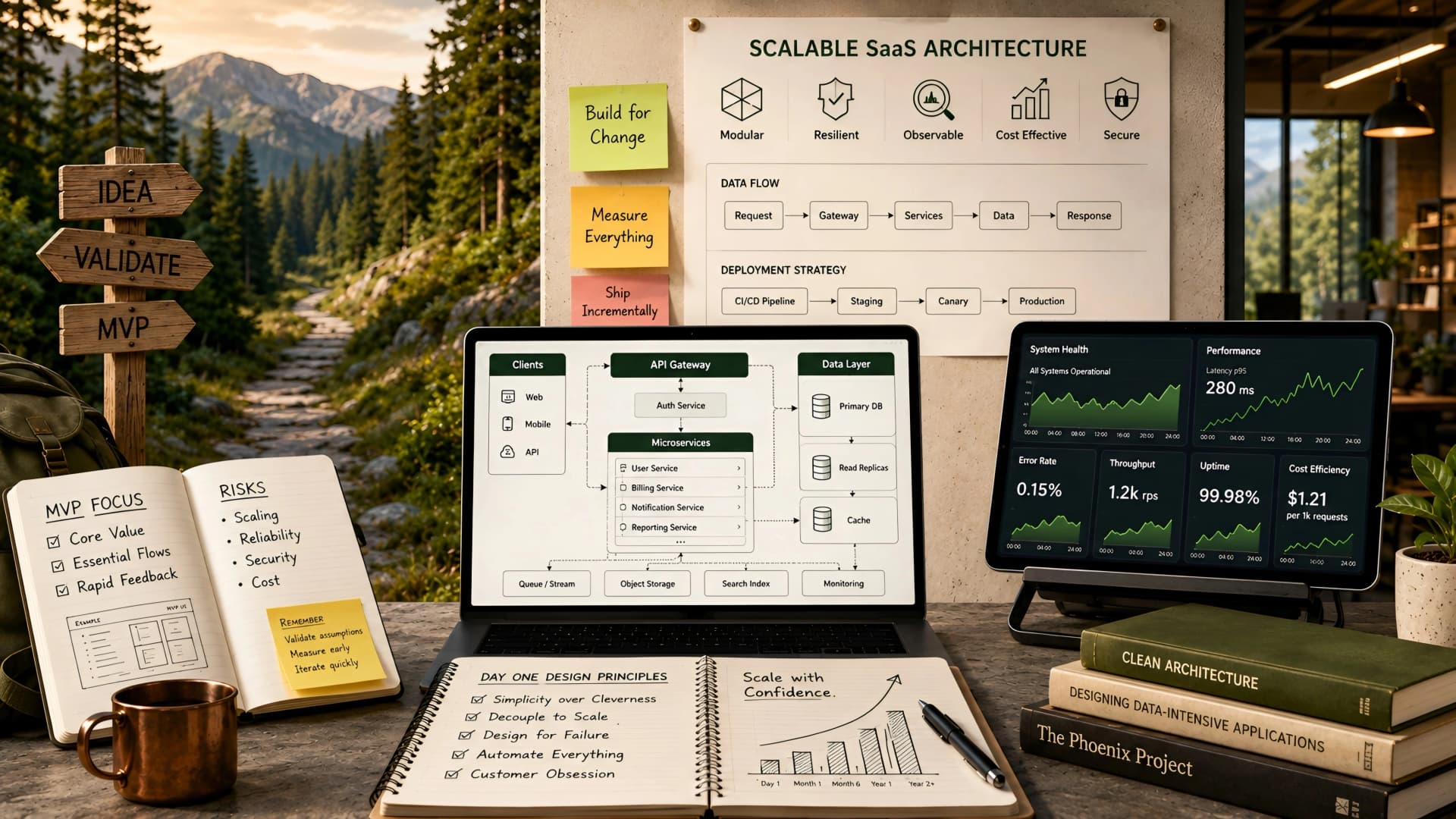
Launching an MVP is an exhilarating sprint. You get your product into users' hands, validate your core idea, and start gathering feedback. This initial speed is vital.
However, the moment your MVP gains traction, a new challenge emerges: how do you evolve that quickly-built solution into a robust, scalable SaaS platform without hitting a wall of technical debt?
The Post-MVP Architectural Reckoning
Many early-stage SaaS teams find themselves in a bind. The initial MVP architecture, designed for speed and minimal features, often struggles under increasing load or when new features need to be added quickly.
This isn't a failure; it's a natural consequence of prioritizing market validation. The real problem arises when teams fail to address these architectural shortcomings proactively, leading to painful refactors, slow development cycles, and a platform that can't keep up with its own success.
Why Proactive Scalability Matters (Even When Small)
Thinking about scalability early doesn't mean over-engineering. It means making informed decisions that allow for graceful expansion, rather than requiring complete overhauls.
At Muhyo Tech, we've seen how strategic architectural choices, made after initial validation but before significant growth, can dramatically reduce future development costs and risks. It's about laying a strong foundation, not building a skyscraper overnight.
Core Principles for Early SaaS Architecture
Before diving into specific technologies, let's consider the guiding principles. These should influence every architectural decision you make.
They help ensure your platform remains adaptable, performant, and cost-effective as you grow.
Principle 1: Loose Coupling and Modularity
Aim for components that can operate independently with minimal dependencies on others. This allows you to update, scale, or even replace parts of your system without impacting the whole.
Think of it like building with LEGOs instead of a single, monolithic block.
Principle 2: Statelessness Where Possible
Design your application servers to be stateless. This means they don't store any user-specific data between requests.
Stateless services are far easier to scale horizontally; you can just add more instances as needed, and any request can go to any server.
Principle 3: Asynchronous Processing for Background Tasks
Not every operation needs to happen in real-time within the user's request cycle. Heavy computations, email sending, data exports, or report generation are perfect candidates for background processing.
This keeps your user-facing application fast and responsive, improving the overall user experience.
Principle 4: Data Layer Independence
While often tightly coupled initially, consider how your data storage might evolve. Separating your data layer's concerns from your application logic provides flexibility.
This doesn't mean jumping to a complex multi-database setup immediately, but understanding the implications of your chosen database for future scaling and data access patterns.
Choosing Your Core Technologies: A Balanced Approach
The tech stack often feels like the first decision, but it should follow your architectural principles. Here's how we typically approach this at Muhyo Tech for early-stage SaaS.
Backend Frameworks: Stability vs. Speed
For the backend, you want a framework that offers a good balance of development speed, community support, and robust features. Popular choices include Node.js (with frameworks like Express or NestJS), Python (Django/Flask), Ruby on Rails, or Go.
Node.js is often favored for its performance with I/O-bound tasks and its single language for frontend/backend development, which simplifies team hiring and knowledge transfer.
Database Selection: Relational vs. NoSQL
This is a critical decision. Relational databases (like PostgreSQL, MySQL) offer strong consistency, mature tooling, and are excellent for complex relationships and transactional data.
NoSQL databases (like MongoDB, Cassandra, DynamoDB) excel at horizontal scaling, flexible schemas, and high-volume, unstructured data. Most SaaS applications benefit from the transactional integrity of a relational database for core business logic, potentially augmenting it with NoSQL for specific use cases (e.g., logging, user activity feeds).
| Feature | Relational Databases (e.g., PostgreSQL) | NoSQL Databases (e.g., MongoDB) |
|---|---|---|
| Schema | Strict, predefined | Flexible, dynamic |
| Consistency | High (ACID properties) | Eventual (often) |
| Scaling | Vertical scaling, horizontal with sharding (more complex) | Easier horizontal scaling |
| Use Case | Complex transactions, structured data, financial systems | Large volumes of data, flexible data models, real-time analytics |
| Complexity | Mature tooling, well-understood | Can be complex to ensure data integrity at scale |
Frontend Choices: SPAs vs. Server-Rendered
Single Page Applications (SPAs) built with React, Vue, or Angular provide rich, interactive user experiences and leverage APIs heavily. They can offer a desktop-like feel but often require more complex state management.
Server-rendered applications or hybrid approaches (like Next.js for React) provide better initial load times and SEO benefits, often with less client-side complexity. We often lean towards frameworks like Next.js for new projects due to its blend of performance, developer experience, and SEO advantages.
Designing for Scalability: Key Architectural Components
Beyond the core stack, specific architectural patterns and components enable a SaaS platform to scale effectively.
These are the building blocks that allow you to grow without constant re-engineering.
API-First Design
Treat your backend as a set of services exposed via APIs, even if your only client is your own frontend. This forces clean separation of concerns, makes future integrations (mobile apps, third-party services) easier, and simplifies testing.
RESTful APIs are a common and well-understood standard for this approach.
Microservices (or Monolith-First with Modularity)
While full microservices can be overkill for an early-stage product, designing your monolith with microservice-like modules from the start is highly beneficial. Identify logical boundaries for future services.
This 'modular monolith' approach gives you the benefits of a simpler deployment and development cycle initially, with a clear path to extracting services when needed, often called 'extracting bounded contexts'.
Queues and Message Brokers
Implement message queues (like RabbitMQ, Apache Kafka, AWS SQS) for asynchronous tasks. When a user uploads a large file or triggers a report, send a message to a queue instead of processing it synchronously.
A separate worker process can then pick up and handle these tasks, ensuring the main application remains responsive and preventing timeouts for users.
Caching Strategies
Caching is your best friend for performance and scalability. Identify data that is frequently accessed but doesn't change often.
Implement caching at various levels: CDN for static assets, reverse proxy caching (e.g., Nginx), in-memory caching (e.g., Redis, Memcached) for database query results, and client-side caching.
Horizontal Scaling Readiness
Ensure your application can be scaled horizontally from day one. This means:
- No shared state between application instances (stateless services).
- Using a load balancer to distribute traffic across multiple instances.
- Externalizing sessions (e.g., using Redis for session storage instead of server memory).
These considerations are fundamental to how Muhyo Tech approaches full-stack web app development for our clients, ensuring resilience and growth potential.
Operational Excellence and Maintainability
A scalable architecture isn't just about handling load; it's about being able to manage, monitor, and deploy it efficiently.
Operational overhead can quickly become a bottleneck if not considered early.
Infrastructure as Code (IaC)
Define your infrastructure (servers, databases, networks) using code (e.g., Terraform, AWS CloudFormation). This ensures consistent environments, makes disaster recovery easier, and allows for automated provisioning.
IaC is a foundational practice for robust, repeatable deployments.
CI/CD Pipelines
Automate your build, test, and deployment processes with Continuous Integration/Continuous Delivery (CI/CD) pipelines. This reduces human error, speeds up releases, and ensures consistent quality.
Tools like GitHub Actions, GitLab CI, or Jenkins are invaluable here.
Monitoring and Logging
Implement comprehensive monitoring and logging from the start. You can't fix what you can't see.
Track application performance (APM), server metrics, database performance, and user activity. Centralized logging (e.g., ELK stack, Datadog, LogRocket) is crucial for quickly diagnosing issues in a distributed system.
Tradeoffs and Common Pitfalls
No architectural decision is without its tradeoffs. The key is to understand them and make informed choices.
Over-engineering vs. Under-engineering
The biggest pitfall is often over-engineering for scale you don't yet have. A complex microservices architecture, multiple databases, and advanced caching layers are unnecessary for a product with 10 users.
Conversely, completely ignoring scalability will lead to a costly rewrite later. The sweet spot is a modular monolith with clear boundaries and a plan for eventual separation.
Premature Optimization
Don't optimize performance for parts of your system that aren't bottlenecks. Focus on profiling and addressing real performance issues as they arise.
Building a highly optimized, complex system for a feature that few users adopt is a waste of valuable development time.
Vendor Lock-in
Be mindful of how tightly you couple your architecture to a specific cloud provider or third-party service. While convenience is tempting, deep integration can make migration extremely difficult later.
Abstracting common services (e.g., email, payment gateways) behind your own interfaces can mitigate this risk.
A Staged Approach to Architecture Evolution
Architecture is rarely a 'set it and forget it' task. It's an ongoing evolution. Here's a typical staged approach we recommend:
- MVP Stage: Focus on core functionality, fastest time to market. Simple architecture, potentially monolithic.
- Post-MVP / Early Traction: Refactor critical components for maintainability and introduce foundational scalability elements (API-first design, queues, better database indexing). This is the stage where you plan for growth, not just react to it.
- Growth Stage: As user numbers and feature demands increase, start extracting services from the modular monolith. Implement advanced caching, load balancing, and potentially database sharding.
- Mature Stage: Full microservices, advanced distributed systems patterns, specialized data stores for specific needs, and continuous optimization.
This iterative approach allows you to defer complexity until it's genuinely needed, while still building on a solid foundation. Our work often involves helping teams navigate these transitions, ensuring smooth architectural upgrades as their business scales.
Checklist for Early-Stage SaaS Scalability
Use this checklist to guide your architectural decisions post-MVP:
- Are application services stateless?
- Are background tasks handled asynchronously via a queue?
- Is data access optimized (indexing, appropriate database choices)?
- Are APIs clearly defined and decoupled from the frontend?
- Is caching implemented at appropriate layers?
- Is infrastructure defined as code (IaC)?
- Are CI/CD pipelines in place for automated deployments?
- Is there comprehensive monitoring and centralized logging?
- Are session states externalized (e.g., Redis)?
- Is the database capable of horizontal scaling or sharding when needed?
Frequently Asked Questions
Should I start with microservices for my SaaS?
Generally, no. A modular monolith is often a better starting point. It offers a simpler development and deployment experience while allowing you to define clear boundaries for future microservices extraction. Microservices introduce significant operational complexity that can slow down an early-stage team.
How do I know when it's time to refactor my MVP architecture?
Look for clear signs: slow development cycles, frequent bugs in critical paths, performance bottlenecks under moderate load, difficulty onboarding new developers, or an inability to easily add new features without breaking existing ones. These are indicators that your current architecture is becoming a liability.
What's the most common mistake in early SaaS architecture?
The most common mistake is failing to anticipate growth at all, leading to an architecture that's rigid and difficult to adapt. This often manifests as tight coupling, lack of clear component separation, and reliance on synchronous processes for everything. Ignoring the importance of SEO-friendly website setup and performance can also cripple growth.
How can I balance speed-to-market with architectural quality?
It's a continuous balance. For the MVP, prioritize speed. Once validated, dedicate specific sprints to architectural improvements and refactoring key areas. Implement automated tests and monitoring to catch issues early. A pragmatic approach means building just enough quality to support the next stage of growth, not perfection for hypothetical scale.
Final Thoughts
Building a scalable SaaS architecture is a marathon, not a sprint. The decisions you make in the early stages, post-MVP, have long-lasting impacts on your product's ability to grow, adapt, and succeed.
By embracing principles of modularity, asynchronous processing, and an API-first mindset, you can build a robust foundation that serves your users effectively, reduces technical debt, and allows your business to scale gracefully. This proactive engineering approach is a cornerstone of how Muhyo Tech helps founders build for the future.