


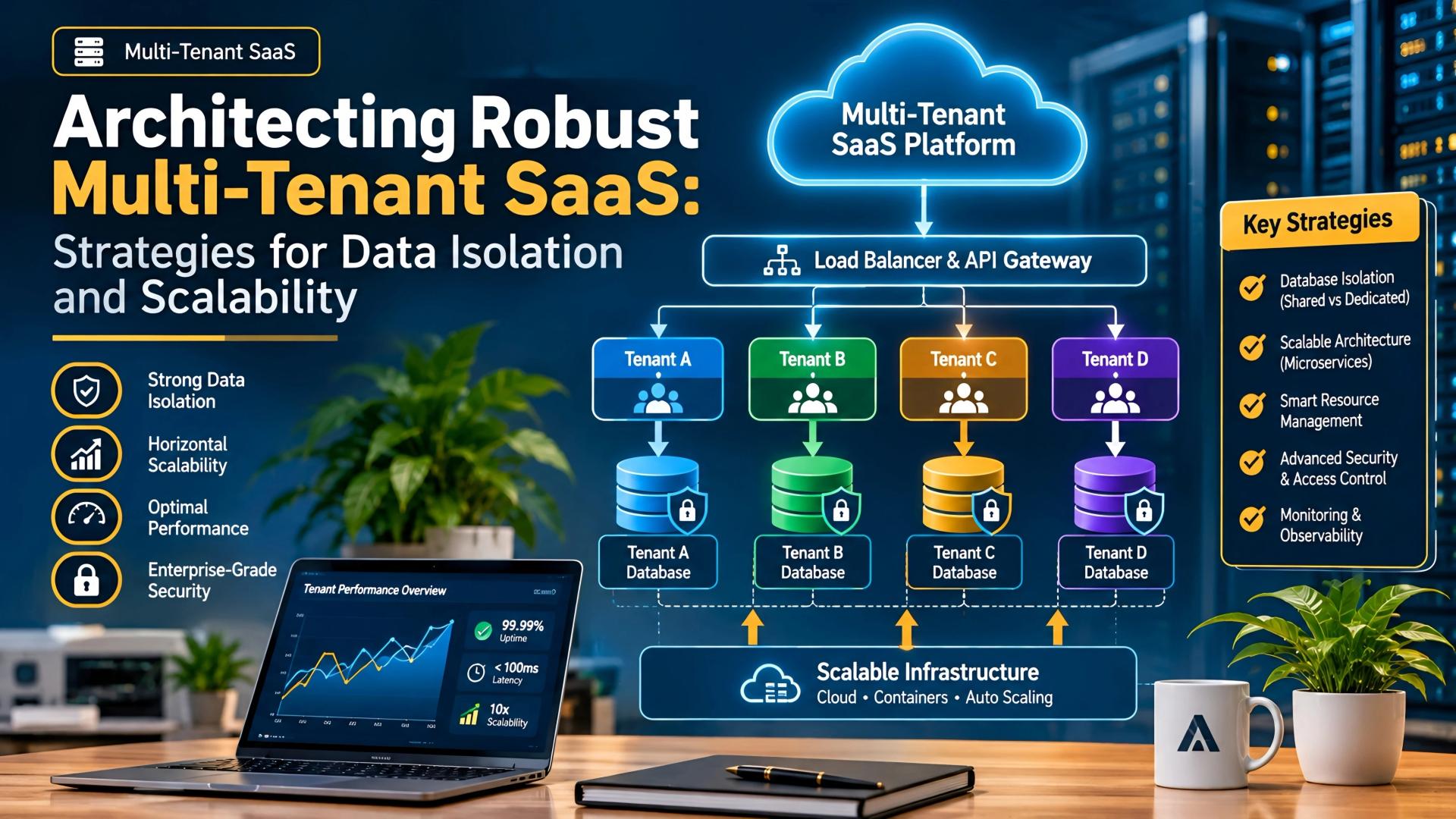
Navigating the Complexities of Multi-Tenant SaaS Architecture
Building a Software-as-a-Service (SaaS) platform often means serving multiple clients, or tenants, from a single instance of your application. This is the core of multi-tenancy. However, achieving true separation of tenant data, managing resources efficiently, and scaling without compromising performance or security is a significant engineering challenge.
At Muhyo Tech, we approach multi-tenant architecture with a deep understanding of these trade-offs. It’s not just about writing code; it’s about designing systems that are secure, scalable, and maintainable from the ground up. This guide delves into the critical architectural decisions you’ll face, focusing on robust data isolation and scalable systems.
Why Multi-Tenancy Matters for SaaS Growth
The allure of multi-tenancy is clear: it drastically reduces operational costs by allowing a single codebase and infrastructure to serve many customers. This efficiency translates directly into a lower cost of goods sold for the SaaS provider.
However, this shared infrastructure introduces inherent complexities. The primary concern is data isolation – ensuring one tenant's data is never visible or accessible to another. Neglecting this can lead to severe security breaches, compliance violations, and a complete loss of customer trust.
Foundational Multi-Tenancy Models: A Comparative Look
When designing a multi-tenant system, the first major decision revolves around how tenant data will be segregated. There are three primary models, each with its own set of advantages and disadvantages.
1. Shared Database, Shared Schema
This is often the simplest model to implement initially. All tenants reside within a single database, and a `tenant_id` column is added to every table that stores tenant-specific data. The application logic then filters all queries using this `tenant_id`.
Pros: Low infrastructure cost, simpler deployment and maintenance of the database tier, easier cross-tenant reporting (though this is often a security risk if not handled with extreme care).
Cons: Weakest data isolation; relies heavily on application-level logic for security. Performance can degrade significantly with scale as database tables become enormous. "Noisy neighbor" problem is prevalent, where one tenant’s heavy usage impacts others. Data backups and restores are more complex to isolate.
2. Shared Database, Schema-per-Tenant
In this model, a single database instance is used, but each tenant gets its own distinct schema within that database. Tables within each schema are identical, but they are physically separated.
Pros: Improved data isolation compared to shared schema, as schemas provide a stronger boundary. Easier to manage tenant-specific schema customizations if needed. Simpler data backup/restore for individual tenants.
Cons: Database connection management becomes more complex, requiring dynamic schema switching. The number of schemas is limited by the database system. Performance can still be impacted by the shared database instance. Schema migrations across all tenants can be challenging.
3. Database-per-Tenant
This is the most robust isolation model. Each tenant gets its own dedicated database instance. This could be a separate database within the same database server, or even on a completely separate database server.
Pros: Strongest data isolation and security. Excellent performance isolation; one tenant's load doesn't impact others. Easier to scale individual tenants or perform tenant-specific backups/restores. Simplifies compliance requirements for highly regulated industries.
Cons: Highest infrastructure cost and operational complexity. Managing a large number of database instances can be challenging. Application logic needs to dynamically connect to the correct tenant database. Schema migrations and updates across all tenant databases require careful orchestration.
Beyond Basic Isolation: Advanced Architectural Patterns
While the three models above address data storage, a truly robust multi-tenant architecture involves more than just database choices. We need to consider application-level concerns, tenant customization, and resource management.
Tenant Identification and Routing
The first step in any multi-tenant system is identifying which tenant a request belongs to. This is typically done via the subdomain (e.g., `tenant1.myapp.com`), a custom domain, or a `tenant_id` passed in the API request header or JWT token.
This identification mechanism dictates how requests are routed. For database-per-tenant, a central routing service or middleware maps the identified tenant to the correct database connection string. For shared database models, the `tenant_id` is simply added to the request context.
Tenant-Specific Configuration and Customization
Clients often require some level of customization. This can range from simple branding (logos, color schemes) to more complex business logic variations or feature flags.
We handle this by storing tenant-specific configurations in a dedicated configuration store, often a separate table in a shared database or a dedicated configuration service. This configuration is then loaded at runtime and applied to the application’s behavior.
For deeper customization, some systems allow for tenant-specific code deployments or feature toggles. This adds significant complexity and often requires careful sandboxing to prevent one tenant's custom code from impacting others.
Scalability Strategies for Multi-Tenant Systems
Scaling a multi-tenant application requires a different mindset than scaling a single-tenant application. We must consider both horizontal scaling of the application tier and vertical/horizontal scaling of the data tier, while always keeping tenant isolation in mind.
With a database-per-tenant model, scaling often involves adding more database servers or using database clustering solutions. For shared database models, scaling focuses on optimizing queries, effective indexing, and potentially sharding the data if the tenant count becomes astronomically high.
Application-level scaling involves deploying more instances of your web servers and APIs. Load balancers distribute traffic, but the architecture must ensure each instance can correctly identify and access the data for the incoming tenant's requests.
Security: The Paramount Concern
Security in a multi-tenant environment is non-negotiable. A breach in one tenant's data can have catastrophic consequences for your entire platform.
Beyond robust data isolation, we implement several layers of security:
- Strict authentication and authorization for users within their tenant context.
- Regular security audits and penetration testing.
- Secure coding practices to prevent injection attacks and other vulnerabilities.
- Data encryption at rest and in transit.
- Rate limiting and abuse detection to protect against DoS attacks.
We learned early in our practice that security is not an afterthought; it must be baked into the architecture from day one. Every design decision must be viewed through a security lens.
Engineering Trade-offs and Decision Criteria
Choosing the right multi-tenancy architecture involves balancing several competing factors:
| Factor | Shared DB, Shared Schema | Shared DB, Schema-per-Tenant | Database-per-Tenant |
|---|---|---|---|
| Isolation Strength | Low | Medium | High |
| Infrastructure Cost | Low | Medium | High |
| Operational Complexity | Low | Medium | High |
| Scalability Ceiling | Low to Medium | Medium | High |
| Tenant Customization Ease | Low | Medium | High |
| Development Simplicity | High | Medium | Low |
The decision often comes down to your specific business needs, compliance requirements, and expected growth trajectory. A startup might begin with a shared schema to iterate quickly, with a plan to migrate to a more isolated model as they grow and their security needs mature.
Common Pitfalls to Avoid
Many teams stumble when building multi-tenant systems. Awareness of these common issues can save significant time and resources.
A frequent mistake is underestimating the complexity of schema migrations. Rolling out a database change across hundreds or thousands of tenant databases requires robust automation and rollback strategies. Another pitfall is inadequate testing of data isolation; it's crucial to have automated tests specifically designed to try and breach tenant boundaries.
Finally, many overlook the "noisy neighbor" problem in shared infrastructure. Performance monitoring and resource throttling are essential to ensure a consistent experience for all tenants, regardless of their individual usage patterns.
Architectural Checklist for Robust Multi-Tenancy
Before diving into implementation, consider this checklist:
- Tenant Identification Strategy: How will you uniquely identify each tenant?
- Data Isolation Model: Which model (shared schema, schema-per-tenant, DB-per-tenant) best fits your security and scalability needs?
- Connection Management: How will your application dynamically connect to the correct data store?
- Configuration Management: Where and how will tenant-specific settings be stored and accessed?
- Security Layers: What authentication, authorization, encryption, and auditing measures are in place?
- Scalability Plan: How will you scale the application and data tiers as tenant count and usage grow?
- Monitoring & Alerting: What metrics will you track for performance, security, and resource usage per tenant?
- Deployment & Migration Strategy: How will you deploy updates and manage schema changes across tenants?
- Disaster Recovery & Backups: What is your strategy for tenant-specific backups and recovery?
Frequently Asked Questions
What is the most scalable multi-tenant architecture?
Generally, the Database-per-Tenant model offers the highest ceiling for scalability. It provides the best resource isolation, allowing individual tenants to scale independently without impacting others. However, it comes with the highest operational overhead.
When should I use a Shared Database, Shared Schema model?
This model is suitable for early-stage startups with a small number of tenants, where rapid development and low initial costs are paramount. It's also viable for applications where data sensitivity is lower and the risk of "noisy neighbors" is manageable. However, a clear migration path to a more robust model should be planned.
How do I handle tenant-specific customizations securely?
Tenant-specific configurations should be stored in a dedicated, secure location, separate from the main application code. Use a configuration service or a dedicated table with strict access controls. For more complex customizations, consider feature flags or controlled plugin architectures that isolate custom logic.
The Muhyo Tech Approach to SaaS Architecture
At Muhyo Tech, our engineering philosophy emphasizes building systems that are not just functional but also resilient and future-proof. When architecting multi-tenant SaaS applications, we prioritize a thorough understanding of client requirements, especially concerning data security, compliance, and scalability needs.
We advocate for choosing an architecture that aligns with the business’s long-term vision, even if it means a slightly higher initial investment. This proactive approach, focusing on robust data isolation and scalable infrastructure, minimizes costly refactoring down the line and ensures a stable foundation for growth.
Conclusion: Building for Tomorrow's Tenants
Architecting a multi-tenant SaaS platform is a journey filled with critical decisions. The choice of data isolation model, coupled with thoughtful strategies for configuration, security, and scaling, forms the bedrock of a successful service.
By carefully weighing the trade-offs and adhering to best practices, you can build a robust, secure, and scalable SaaS application that delights your customers and supports your business growth for years to come.