


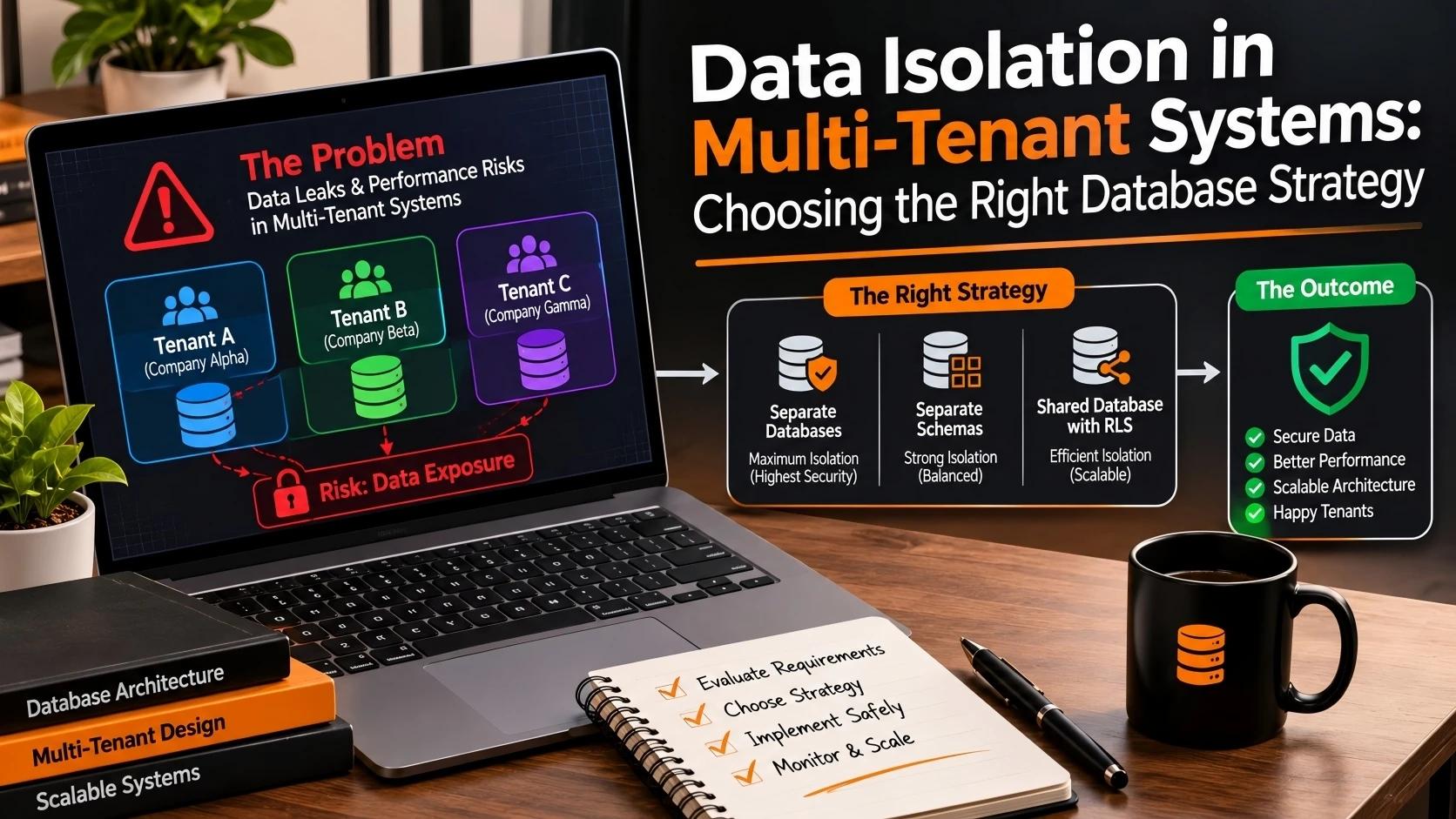
Building a multi-tenant SaaS application introduces a fundamental challenge: how do you keep each customer's data completely separate and secure, without creating an operational nightmare?
This isn't just a technical detail; it's a core business concern impacting compliance, trust, and your ability to scale. The choice of database strategy is critical, shaping everything from performance to maintenance overhead.
The Core Challenge: Balancing Isolation and Efficiency
When designing for multi-tenancy, the goal is to prevent data leakage between tenants while optimizing resource utilization. You want the strongest possible isolation without having to provision an entirely new infrastructure for every single client.
This tension between robust segregation and efficient resource sharing defines the trade-offs we constantly evaluate. Our foundational guide, "Architecting Robust Multi-Tenant SaaS: Strategies for Data Isolation and Scalability", explores the broader picture, but here we dive into the specific database choices.
Strategy 1: Database-Per-Tenant (Physical Isolation)
This approach gives each tenant their own dedicated database instance. It's the highest level of data isolation possible, as one tenant's data is physically separate from another's.
Think of it as having individual lockers for each customer, each with its own lock and key. This strategy significantly simplifies backup, restore, and migration operations for individual tenants.
Pros and Cons of Database-Per-Tenant
The primary advantage is unparalleled security and regulatory compliance. Performance issues in one tenant's database are also less likely to affect others.
However, operational overhead scales directly with the number of tenants. Managing hundreds or thousands of separate databases becomes a significant infrastructure and cost burden, requiring robust automation for provisioning and maintenance.
Strategy 2: Schema-Per-Tenant (Logical Isolation)
Here, all tenants share a single database server, but each tenant has their own schema within that database. Each schema contains tables specific to that tenant.
This is like a shared building with separate apartments for each tenant. The underlying database server is shared, but the logical separation of data is strong, enforced by database permissions.
Trade-offs for Schema-Per-Tenant
Schema-per-tenant offers a good balance between isolation and operational efficiency. It's easier to manage than database-per-tenant for a growing number of clients, as you're not spinning up entirely new database instances.
The downside is that performance bottlenecks at the database server level can still impact all tenants. Careful resource monitoring and query optimization become paramount to ensure smooth operation across the board.
Strategy 3: Shared Database, Row-Level Security (RLS)
In this model, all tenants share the same database and even the same tables. Tenant identification is handled at the application layer or, more robustly, at the database level using Row-Level Security (RLS).
Imagine a large open-plan office where each team has designated desks and access controls. Each row in a table includes a `tenant_id` column, and database policies ensure that a user can only see or modify rows associated with their specific `tenant_id`.
Implementing Row-Level Security
RLS offers the highest resource efficiency and simplifies database management for a very large number of tenants. It's often the most cost-effective solution for early-stage SaaS products or those with highly variable tenant usage.
The complexity shifts from infrastructure management to meticulous application and database policy design. A single misconfiguration in RLS can lead to critical data leakage, so rigorous testing and review are essential.
Muhyo Tech's Approach to Database Strategy Selection
At Muhyo Tech, we don't prescribe a one-size-fits-all solution. Our process begins with a deep dive into the specific requirements of the application, considering factors like expected tenant count, data sensitivity, regulatory compliance needs, and projected growth.
For instance, a highly regulated financial application would lean towards database-per-tenant for maximum isolation. A social networking app with millions of users and less sensitive data might opt for RLS for scalability and cost efficiency. We always factor in long-term maintainability and the cost of ownership.
Choosing the Right Strategy: A Decision Matrix
The optimal database strategy isn't about finding the 'best' option in a vacuum, but the 'right' option for your specific business constraints and future roadmap.
Consider the following when making your decision:
- Data Sensitivity & Compliance: How critical is absolute isolation? Are there strict regulatory requirements (e.g., HIPAA, GDPR)?
- Scalability & Cost: How many tenants do you anticipate? What's your budget for infrastructure and operational staff?
- Operational Overhead: How much automation can you build for provisioning, backups, and maintenance?
- Development Complexity: How much effort are you willing to invest in implementing and testing tenant isolation logic?
- Performance Requirements: What are the latency and throughput expectations for your tenants?
Each strategy offers distinct advantages and disadvantages. The key is to choose the one that aligns best with your product's lifecycle and business model. Our work in full-stack web app development and database integration often involves these critical architectural decisions.
Final Thoughts on Multi-Tenant Data Isolation
The choice of multi-tenant data isolation strategy is a foundational architectural decision, not an afterthought. It directly impacts your product's security, performance, and the cost of scaling.
Understanding the trade-offs between physical, logical, and row-level isolation allows for an informed decision. Prioritize security and compliance, but don't overlook operational efficiency and long-term scalability. A well-chosen strategy will support your SaaS growth for years to come.