


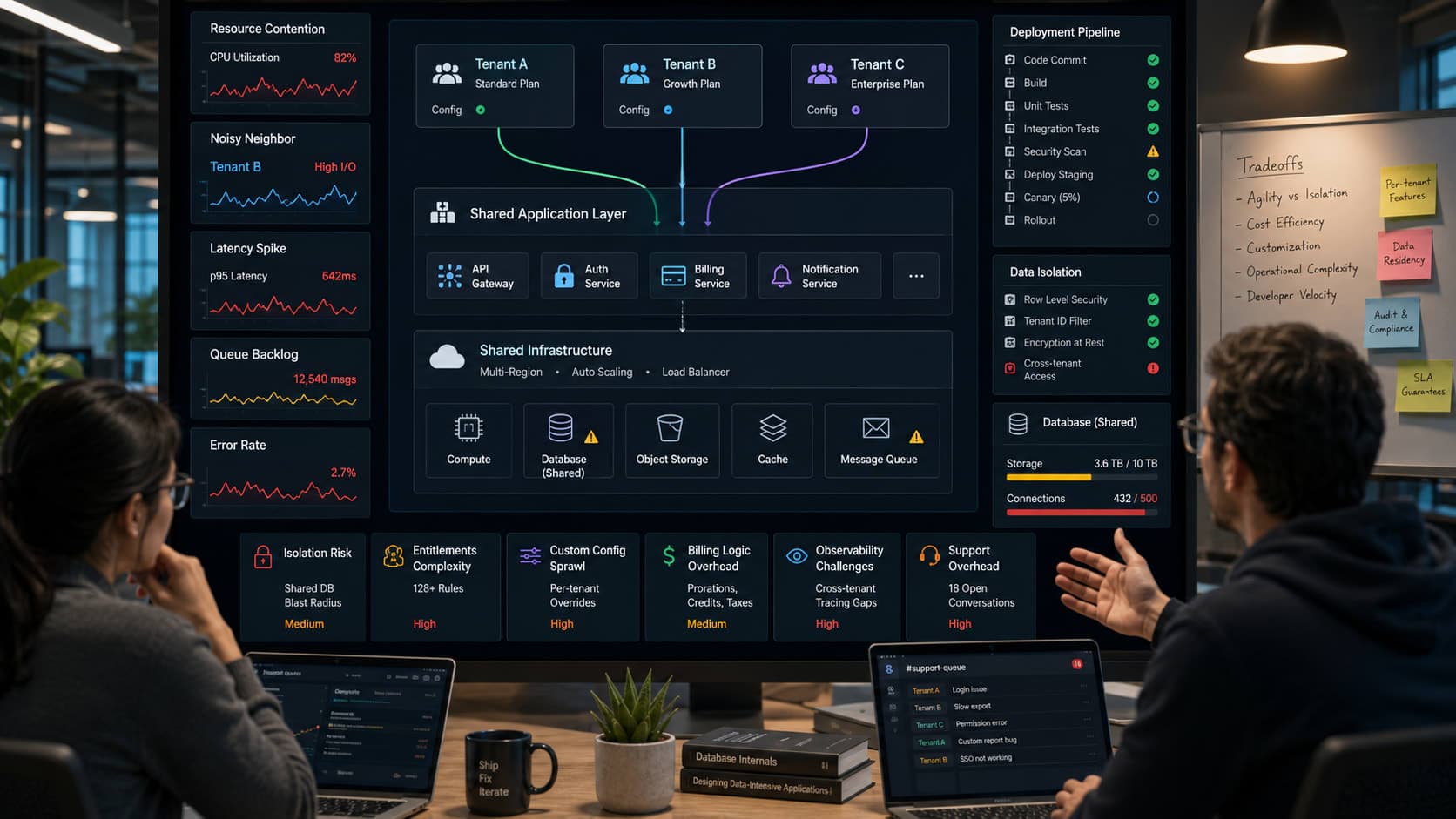
The allure of multi-tenancy in SaaS engineering is powerful. Imagine building a single application instance, deploying it once, and serving hundreds or thousands of clients, each with their isolated data and experience. On the surface, it promises significant cost savings and streamlined operations.
However, beneath that appealing surface lies a labyrinth of engineering complexities. What often starts as a perceived efficiency gain can quickly balloon into unexpected development cycles, security headaches, and operational burdens that devour resources.
The Core Promise and Its Architectural Debt
Multi-tenancy's central idea is resource sharing. Instead of provisioning an entirely separate stack for every customer, you share infrastructure, codebase, and often, even the database.
This sharing dramatically reduces initial deployment costs and simplifies updates, as you only deploy a new version once. Yet, this shared environment is precisely where the hidden costs begin to accumulate, demanding sophisticated architectural patterns.
Data Isolation: A Constant Vigilance
The first and most critical challenge is data isolation. Each tenant's data must remain strictly separate and inaccessible to others, a non-negotiable security and privacy requirement.
Achieving this requires meticulous design at every layer, from the database schema to the application logic. Every query, every API call, and every data access point must explicitly filter by a tenant ID.
This isn't just about adding a WHERE tenant_id = X clause; it's about ensuring that filter is *never* forgotten or bypassed. Overlooking it even once can lead to a catastrophic data leak, destroying trust and incurring massive costs.
Database Design: More Than Just a Column
When considering multi-tenancy, database strategy is paramount. We often see three common approaches: shared database with a shared schema, shared database with separate schemas, or separate databases entirely.
Each choice carries distinct tradeoffs. A shared schema with a tenant ID column is the most common and resource-efficient but introduces the most application-level complexity and potential for 'noisy neighbor' performance issues.
Separate schemas offer stronger isolation but increase schema management overhead. Separate databases provide the strongest isolation and performance guarantees but come with significantly higher infrastructure costs and operational complexity, especially during deployments and backups.
At Muhyo Tech, we carefully weigh these options based on client needs, always prioritizing security and scalability over perceived initial savings.
Operational Complexities and Developer Overhead
Deploying a single instance for multiple tenants sounds simple, but what about tenant-specific configurations, feature flags, or even custom domains? These needs multiply the operational burden.
Monitoring becomes more nuanced; an issue affecting one tenant might be masked by the overall system's health. Debugging requires an extra layer of context: which tenant is experiencing the problem?
Development itself becomes more complex. Every new feature needs to consider its multi-tenant implications, from permissions to data access. Testing matrices grow exponentially, as you must ensure features work correctly across various tenant configurations and data sizes.
Scaling and Performance: The Noisy Neighbor Problem
One of the insidious hidden costs is the 'noisy neighbor' problem. A single tenant with heavy usage or inefficient queries can degrade performance for all other tenants on the shared infrastructure.
Identifying and isolating such issues requires sophisticated monitoring and potentially dedicated tooling. While a single-tenant architecture allows you to scale a specific customer's instance independently, multi-tenancy often means scaling the entire shared system to accommodate a few demanding users, leading to higher overall infrastructure costs.
Designing for multi-tenancy from day one means anticipating these bottlenecks and building in mechanisms for resource throttling or dynamic scaling per tenant, adding significant upfront engineering effort.
Security: An Ever-Present Threat Vector
Beyond data isolation, the shared nature of multi-tenant systems presents unique security challenges. A vulnerability in one tenant's feature could potentially be exploited to gain access to another's data.
Implementing robust authentication and authorization per tenant, ensuring strict API gateway rules, and conducting regular security audits become even more critical. The attack surface is effectively multiplied by the number of tenants, demanding heightened vigilance and more extensive security engineering.
The Business Outcome: Informed Decisions for Long-Term Value
Understanding the hidden costs of multi-tenancy isn't about avoiding it entirely. It's about making informed architectural decisions that align with your business goals and budget.
For some applications, the efficiency gains outweigh the engineering complexities. For others, the cost of building and maintaining robust multi-tenancy might exceed the benefits, making a simpler, perhaps more distributed, approach more viable.
At Muhyo Tech, our approach to full-stack web app development, including API and database integration, emphasizes identifying these tradeoffs early. We help founders and product owners understand that while multi-tenancy offers an attractive promise of scalability, it requires a significant investment in thoughtful engineering to deliver on that promise securely and reliably, preventing costly rework down the line.
When to Embrace and When to Reconsider
Multi-tenancy is often a strong choice for applications with a high volume of small, relatively uniform tenants, where the cost savings on infrastructure and maintenance per tenant are substantial. Think about CRM platforms or project management tools for small teams.
However, if your tenants have highly divergent needs, require extensive customization, demand extreme data isolation guarantees, or have unpredictable, spiky usage patterns, the hidden costs can quickly become prohibitive. In such cases, a more isolated architecture, even if seemingly more expensive initially, might prove cheaper and more stable in the long run.
The critical lesson is that multi-tenancy is an architectural pattern, not a default. It's a powerful tool when used appropriately, but its true cost includes significant engineering expertise and ongoing vigilance. Choosing this path means committing to a higher standard of design, testing, and operational discipline to unlock its real value without falling prey to its hidden pitfalls.