

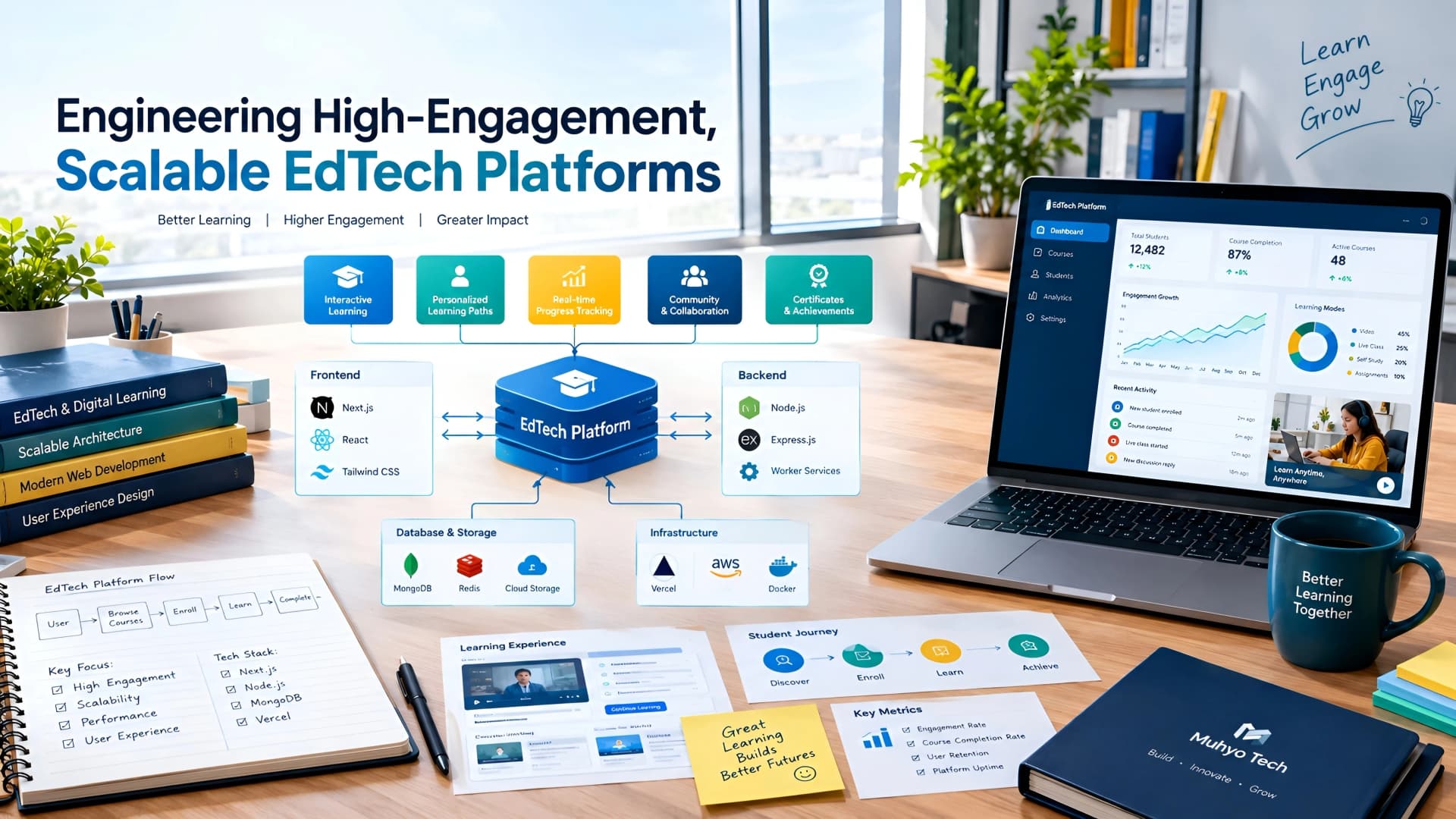
Launching an EdTech platform often starts with a great vision for transforming learning. However, many founders quickly discover that user engagement and content delivery at scale become significant engineering hurdles.
The challenge isn't just about getting users; it's about keeping them engaged, providing seamless access to content, and ensuring the platform grows gracefully without breaking under load. A strong architectural foundation makes all the difference.
The Core Challenge: Balancing Engagement and Scale
Modern EdTech platforms are more than just content repositories. They are dynamic environments demanding real-time interaction, personalized pathways, and robust analytics.
This complexity, combined with the need to serve potentially millions of concurrent users, creates a unique set of engineering problems. Without careful planning, performance bottlenecks and user frustration quickly emerge.
Why Traditional Architectures Fall Short for EdTech
Many initial EdTech ventures opt for monolithic architectures due to their simplicity in early stages. This approach, while easy to start, struggles significantly when features expand and user bases grow.
Scaling becomes a 'lift and shift' problem rather than a targeted expansion. Deployments become riskier, and adapting to new engagement features like live classes or interactive quizzes is difficult.
Foundational Principles for Scalable EdTech Architecture
At Muhyo Tech, our approach to building scalable systems always begins with a few core principles. These guide our architectural decisions from the ground up, especially for high-growth sectors like EdTech.
We prioritize modularity, resilience, and a clear separation of concerns. This ensures that different parts of the system can evolve independently without destabilizing the whole.
Microservices for Flexibility and Isolation
A microservices architecture is often the most suitable pattern for EdTech platforms aiming for significant scale. It breaks down the application into smaller, independently deployable services.
This allows teams to develop, deploy, and scale specific functionalities like user management, content delivery, or assessment engines without impacting other parts of the system. It significantly reduces the blast radius of any single failure.
Event-Driven Architecture for Responsiveness
EdTech platforms thrive on responsiveness, from real-time progress updates to instant feedback. An event-driven architecture, leveraging message queues and streaming platforms, enables decoupled communication between services.
This means actions like 'course completed' or 'quiz submitted' can trigger a cascade of events—updating user profiles, sending notifications, or calculating new recommendations—without direct, blocking calls between services.
Key Architectural Components for High-Engagement EdTech
Building a successful EdTech platform requires more than just a backend. It needs a carefully designed ecosystem of services working in harmony.
We look for robust solutions for content, user data, real-time interactions, and analytics. Each component plays a vital role in the overall user experience and platform scalability.
1. Robust Content Delivery Network (CDN)
Educational content, especially video and interactive simulations, can be very large. Relying on a single server to deliver this content globally leads to slow load times and poor user experience.
A CDN caches content at edge locations worldwide, serving it to users from the nearest server. This dramatically reduces latency and improves content accessibility, a non-negotiable for high-quality EdTech.
2. Scalable Database Solutions
The choice of database is critical for EdTech. We often combine different database types to handle diverse data needs efficiently.
For structured user data and course metadata, a relational database like PostgreSQL or MySQL might be suitable. For flexible, high-volume data like user progress or activity logs, NoSQL databases like MongoDB or Cassandra offer better scalability.
3. Real-time Communication Services
Live classes, collaborative whiteboards, and instant messaging are becoming standard in EdTech. WebSockets or server-sent events (SSE) are essential for building these real-time features.
Integrating dedicated real-time services or using cloud-managed WebSocket APIs simplifies this complex aspect, allowing for interactive EdTech features and engaging learning environments.
4. Personalized Learning Engines
True engagement often comes from personalization. This requires an engine that can analyze user behavior, progress, and preferences to recommend relevant content or adapt learning paths.
Machine learning models, integrated as dedicated microservices, can power these recommendations. This enhances the learning experience and keeps users on the platform longer.
Technology Stack Choices and Tradeoffs
Choosing the right technologies is about understanding their strengths, weaknesses, and how they fit into the overall architecture. There's no one-size-fits-all solution.
Our decisions are always driven by specific project requirements, existing team expertise, and long-term maintenance considerations. We balance innovation with stability.
| Category | Technology Option | Pros | Cons |
|---|---|---|---|
| Backend Framework | Node.js (Express/NestJS) | High concurrency, unified language, large ecosystem. | CPU-bound tasks can be blocking, callback hell (without async/await). |
| Backend Framework | Python (Django/Flask) | Rapid development, rich libraries (ML/AI), mature. | Can be slower for high concurrency, GIL limitations. |
| Backend Framework | Go (Gin/Echo) | Excellent performance, concurrency, strong typing. | Smaller ecosystem than Node/Python, steeper learning curve. |
| Frontend Framework | React/Vue/Angular | Component-based, large communities, rich UIs. | Bundle size, client-side rendering can impact SEO (unless using SSR). |
| Database (Relational) | PostgreSQL | ACID compliance, robust, extensibility, JSON support. | Vertical scaling limits, complex distributed setups. |
| Database (NoSQL) | MongoDB | Flexible schema, horizontal scalability, good for large docs. | Eventual consistency by default, potential for schema drift. |
| Message Broker | Kafka | High throughput, fault-tolerant, stream processing. | Operational complexity, resource-intensive. |
| Message Broker | RabbitMQ | Mature, flexible routing, good for complex queues. | Less scalable for extreme streaming workloads than Kafka. |
Cloud Services for Scalability and Reliability
Leveraging cloud providers like AWS, Google Cloud, or Azure is almost a given for scalable EdTech. They offer managed services that significantly reduce operational overhead.
Services like AWS Lambda (serverless functions), Amazon RDS (managed databases), or Google Kubernetes Engine (container orchestration) provide built-in scalability and high availability. These services allow engineering teams to focus on core product features, not infrastructure.
Ensuring Data Security and Compliance
Handling sensitive user data, especially student information, demands the highest security standards. Compliance with regulations like GDPR, FERPA, or COPPA is not optional; it's fundamental.
A breach can destroy trust and lead to severe legal and financial repercussions. Security must be baked into the architecture, not added as an afterthought.
Security Best Practices in EdTech
- End-to-End Encryption: Encrypt data both in transit (TLS/SSL) and at rest (disk encryption).
- Access Control: Implement robust role-based access control (RBAC) to ensure users only access what they need.
- Regular Security Audits: Conduct frequent penetration testing and vulnerability assessments.
- Secure Coding Practices: Train developers on OWASP Top 10 and integrate security scanning into CI/CD pipelines.
- Data Anonymization: Where possible, anonymize or pseudonymize sensitive user data for analytics and testing environments.
The Development Process: From Vision to Production
Building a complex EdTech platform is an iterative journey. Our development process emphasizes clear communication, continuous feedback, and agile methodologies.
This ensures that the platform evolves in response to real user needs and market demands, rather than being a static, 'big bang' launch.
Agile Development and CI/CD
Adopting an agile approach with short sprints allows for frequent releases and quick iteration. Continuous Integration/Continuous Deployment (CI/CD) pipelines automate testing and deployment.
This dramatically reduces the risk of new features breaking existing ones and ensures a smooth, predictable path to production. It’s crucial for maintaining velocity in a fast-paced market.
Monitoring and Analytics for Continuous Improvement
Once launched, the work isn't over. Comprehensive monitoring of system performance, user behavior, and security metrics is essential.
Integrated analytics tools provide insights into what's working and what isn't, guiding future development. This feedback loop is vital for optimizing user engagement and educational outcomes.
Muhyo Tech's Approach to EdTech Engineering
At Muhyo Tech, we understand that EdTech founders need more than just code; they need a strategic engineering partner. We don't just build systems; we design for resilience, growth, and maintainability.
Our focus is on delivering robust, performant solutions that align with business goals. This means careful consideration of full-stack web app development needs, from user-facing interfaces to complex backend logic.
We also pay close attention to admin dashboard development, ensuring that course creators and administrators have powerful, intuitive tools to manage content, users, and analytics. This empowers platform owners to run their operations smoothly.
Frequently Asked Questions (FAQs)
What architectural patterns are best for scalable EdTech platforms?
Microservices architecture combined with an event-driven approach is generally considered best for scalability and flexibility in EdTech. It allows independent scaling of components and resilient communication.
Which technologies and cloud services support EdTech scalability?
Modern cloud platforms like AWS, GCP, or Azure offer managed services for databases, computing, and content delivery. Technologies like Node.js, Python, PostgreSQL, and NoSQL databases like MongoDB are commonly used for their scalability and flexibility.
How do you ensure data security and compliance in a scalable EdTech system?
Robust security involves end-to-end encryption, strong role-based access control, regular security audits, and adherence to relevant data privacy regulations like GDPR or FERPA. Security should be integrated into every layer of the architecture.
What are the key challenges in developing a highly scalable EdTech solution?
Key challenges include managing high concurrent user loads, delivering large media content globally, ensuring real-time interactivity, personalizing learning experiences, and maintaining stringent data security and compliance standards.
Conclusion: Building for the Future of Learning
Developing a high-engagement, scalable EdTech platform is a complex endeavor, but it's entirely achievable with the right architectural approach. It demands a clear understanding of user needs, careful technology choices, and a commitment to robust engineering.
By focusing on modularity, performance, and security from day one, EdTech founders can build platforms that not only attract learners but keep them engaged and supported through their educational journey. This ultimately leads to better outcomes for everyone involved.