


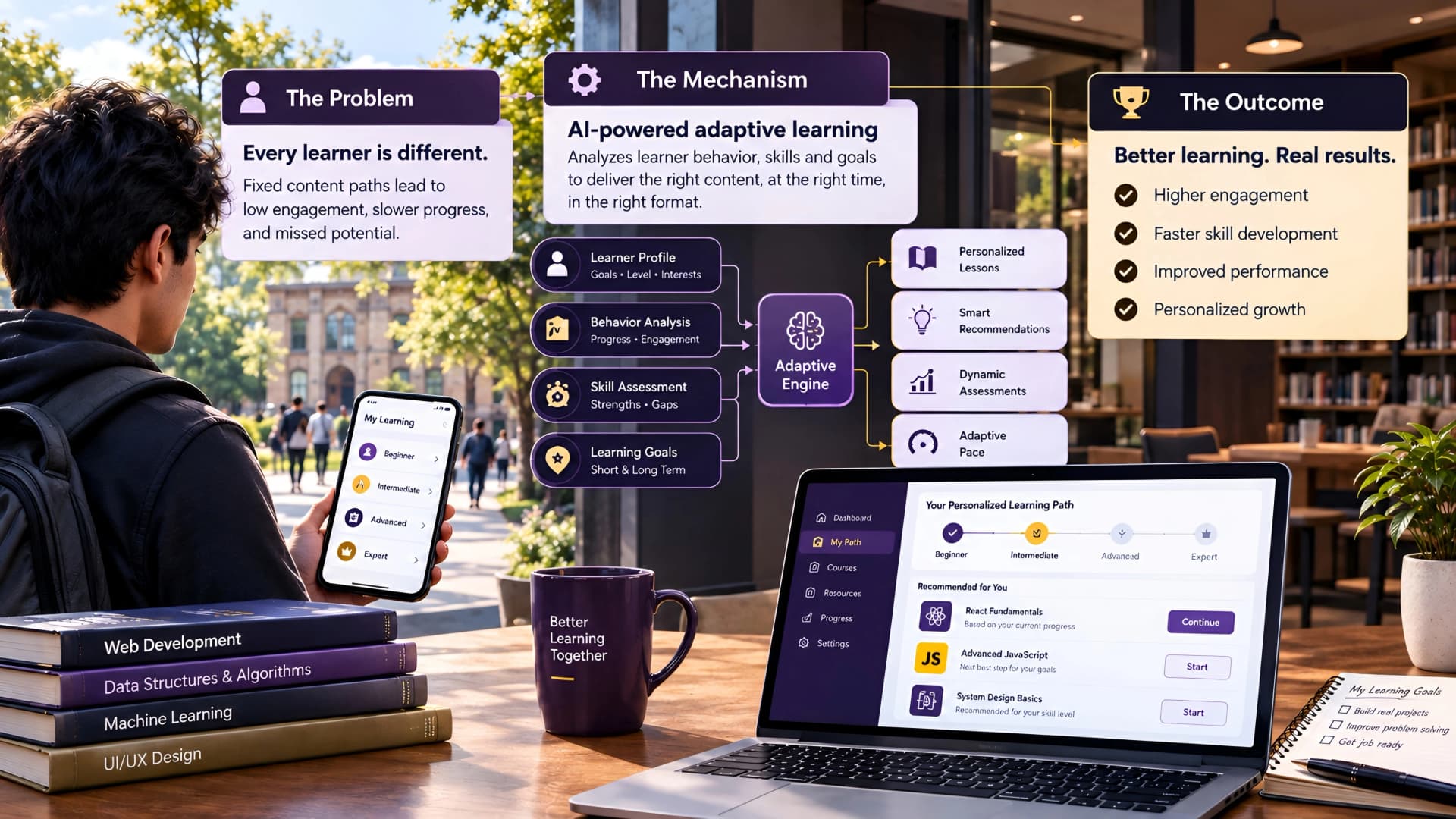
One of the biggest frustrations for course creators and EdTech founders is seeing learners disengage. A one-size-fits-all curriculum, no matter how well-crafted, simply doesn't resonate with every student.
Different learners have varied prior knowledge, learning styles, and paces. This often leads to frustration, drop-offs, and ultimately, suboptimal learning outcomes.
The Core Problem: Generic Content and Disengagement
Imagine a student already proficient in a specific topic being forced to sit through introductory material. Or conversely, a student struggling with fundamental concepts being pushed too quickly into advanced modules. Both scenarios are common.
This lack of personalization directly impacts engagement and retention, which are critical metrics for any EdTech platform. Our goal at Muhyo Tech is always to engineer solutions that tackle these deep-seated user experience issues head-on.
What Defines Adaptive Learning Technology?
Adaptive learning technology dynamically adjusts the educational experience based on a learner's individual performance, interactions, and preferences. It's about moving beyond static content delivery.
This system continuously assesses progress, identifies knowledge gaps, and then presents the most relevant content, activities, or feedback. The aim is to optimize the learning path for each unique user.
Key Components of an Adaptive Learning Platform
Building an adaptive learning system requires a careful orchestration of several interconnected components. This isn't just about adding a feature; it's about a foundational architectural approach.
For a deeper dive into overall EdTech platform architecture, you might find our foundational guide, Engineering High-Engagement, Scalable EdTech Platforms, highly relevant.
1. Learner Profile & Data Collection
At the heart of any adaptive system is a robust learner profile. This module collects data on performance, time spent on tasks, completed modules, quiz scores, and even implicit interactions like rewatching videos.
We typically design these systems with comprehensive database schemas to capture granular user activity. This allows for rich insights without overwhelming the user with explicit surveys.
2. Content Repository with Metadata
The learning content itself needs to be modular and richly tagged with metadata. Each lesson, video, quiz question, or exercise must be associated with specific topics, difficulty levels, prerequisites, and learning objectives.
This structured content is crucial for the adaptive engine to intelligently select and sequence material. Without detailed metadata, the system can't make informed recommendations.
3. Assessment Engine
Continuous assessment is vital, not just for grading, but for diagnosis. This engine provides various types of assessments—quizzes, interactive exercises, projects—and evaluates learner responses.
The results feed directly back into the learner profile, updating their understanding of specific concepts. This creates a feedback loop essential for true adaptation.
4. Adaptation Logic / Recommendation Engine
This is where the 'adaptive' magic happens. Using algorithms, often AI-powered, this engine analyzes the learner profile against the content repository.
It determines the next best piece of content, suggests remedial material, or even skips sections if mastery is demonstrated. Machine learning models can predict areas of difficulty and proactively offer support.
5. User Interface & Experience Layer
The front-end must gracefully present the dynamically generated learning path. This means a responsive, intuitive interface that updates seamlessly as the learner progresses.
It also needs to provide clear feedback and show the learner their progress, making the adaptive nature feel helpful rather than prescriptive. Our approach prioritizes a smooth, distraction-free learning environment.
The Role of AI in Adaptive Learning EdTech
AI, particularly machine learning, plays a transformative role in making adaptive learning truly intelligent. It moves beyond simple rule-based systems to more nuanced, predictive adaptations.
AI algorithms can identify subtle patterns in user behavior and performance that humans might miss. This allows for more precise content recommendations and even personalized feedback.
For example, an AI might detect a learner consistently struggling with a certain type of problem, even if they pass the overall module. It can then recommend targeted practice or alternative explanations.
Engineering an Adaptive Learning System: Our Approach
At Muhyo Tech, when we design adaptive learning systems, we prioritize a scalable, modular architecture. This ensures the platform can grow with your content and user base.
We often leverage modern full-stack frameworks for robust back-ends capable of handling complex data processing, and highly interactive front-ends. Our focus is on building flexible systems.
This means carefully planning database integration for storing vast amounts of user data and content metadata. We also design APIs that allow the adaptation engine to communicate effectively with both the content and the user interface.
Business Value: Enhanced Engagement and Retention
Implementing an adaptive learning system directly addresses core business challenges for EdTech platforms. The most immediate benefit is a significant boost in user engagement and retention.
When learners feel understood and supported, they are more likely to complete courses and return for more. This translates into higher completion rates and increased lifetime value.
Ultimately, by delivering a truly personalized learning journey, EdTech platforms can differentiate themselves. They offer a superior educational experience that leads to better mastery, higher satisfaction, and stronger brand loyalty in a competitive market.
Trade-offs and Considerations
While the benefits are clear, building an adaptive learning system is a significant undertaking. It requires substantial investment in content tagging and infrastructure.
The complexity of the adaptation logic can also be challenging to implement and maintain. We always discuss these trade-offs upfront, ensuring founders understand the scope and long-term implications.
However, the long-term gains in user satisfaction, learning outcomes, and platform stickiness often justify this investment. It's about building a future-proof educational experience.