

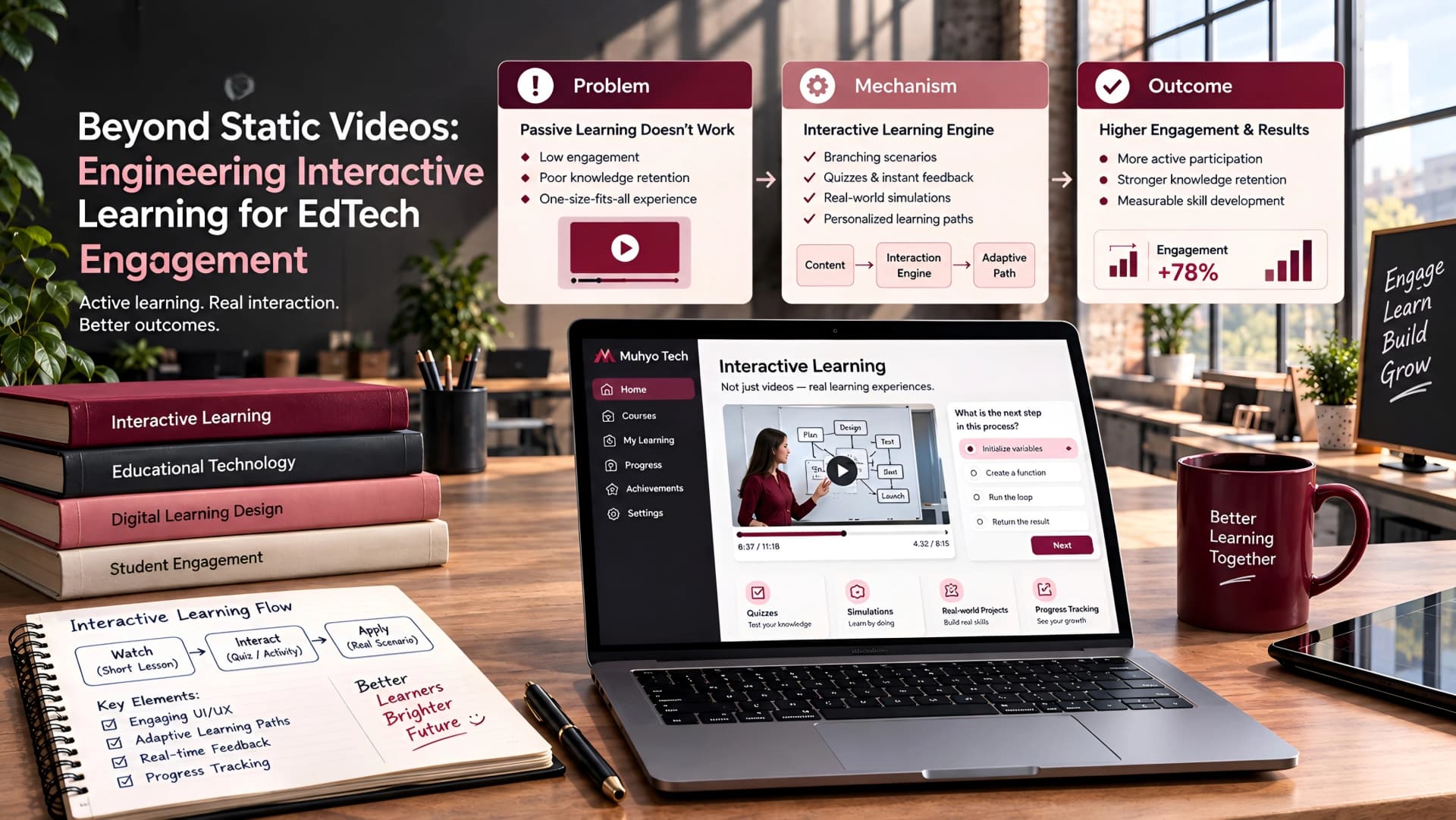
One of the most persistent pains for online course platforms is low completion rates. Founders often invest heavily in high-quality video content, only to see learners drop off after the first few modules. The truth is, passive video consumption, however polished, struggles to hold attention in a world brimming with dynamic digital experiences.
The engineering challenge, then, shifts from merely delivering content to actively engaging the learner. This means moving beyond static videos and integrating rich, interactive elements directly into the learning experience. Our focus at Muhyo Tech often revolves around building systems that make this possible and sustainable.
The Core Problem: Passive Consumption vs. Active Learning
Traditional online courses often mirror lecture halls, just delivered through a screen. Learners watch, listen, and occasionally take notes, but genuine interaction and immediate application are rare.
This passive approach leads to a significant drop in knowledge retention and, consequently, course completion. The brain needs to actively process information, test understanding, and apply concepts to truly internalize them.
Defining Interactive EdTech Features: What Works?
When we talk about interactive EdTech features, we're discussing components that demand a response from the user. These are not just decorative elements but integral parts of the learning loop.
Consider quizzes, branching scenarios, interactive simulations, live Q&A sessions, collaborative whiteboards, or even embedded code editors. Each of these components turns a passive viewer into an active participant, directly addressing the core problem of disengagement.
Architecting for Interactivity: Engineering Considerations
Integrating interactive elements isn't a simple front-end task; it requires thoughtful full-stack engineering. Our approach at Muhyo Tech emphasizes a modular architecture, ensuring these features can scale and remain maintainable.
We typically separate the core content delivery from the interactive components. This allows for specialized APIs for quizzes, real-time communication for live chats, and dedicated microservices for complex simulations. You can learn more about our foundational architectural thinking in our guide on engineering high-engagement, scalable EdTech platforms.
Implementing Quizzes and Assessments
Quizzes are perhaps the most straightforward interactive feature, but they demand robust backend support. We need a system to store questions, manage answer types (multiple choice, fill-in-the-blank, open-ended), and accurately track user responses.
Immediate feedback, score calculation, and the ability to review incorrect answers are crucial for learning. This often involves a dedicated quiz service that communicates with the main learning platform via a well-defined API integration.
Integrating Simulations and Interactive Tools
For more complex subjects, simulations offer a powerful way to apply knowledge in a safe environment. Think of a financial modeling tool, a virtual chemistry lab, or a coding sandbox.
These features often require specialized third-party libraries or even entirely separate applications embedded within the platform. Performance is key here; a slow simulation will quickly frustrate users. We prioritize efficient data transfer and client-side processing where possible.
Real-time Collaboration and Live Features
Live chat, Q&A, and collaborative whiteboards introduce a real-time dimension to learning. These require WebSockets or similar technologies to ensure instant communication between users and instructors.
Scalability becomes a primary concern for these features. A sudden surge in live users during a cohort launch must not bring the system down. We design for concurrent connections and robust error handling to maintain reliability.
Balancing Performance and Maintainability
Every interactive feature adds complexity, impacting both performance and long-term maintainability. A common pitfall is to overload the client-side with too much JavaScript, leading to slow page loads and a sluggish user experience.
At Muhyo Tech, we rigorously test interactive components for performance bottlenecks. We also advocate for clear separation of concerns in the codebase, making it easier to update, debug, or even swap out specific interactive modules without affecting the entire platform. This modularity is a cornerstone of our full-stack web app development approach.
The Business Value: Engagement, Retention, and Trust
Investing in sophisticated interactive EdTech features directly translates to tangible business value. Higher engagement means learners are more likely to complete courses, leading to better satisfaction and stronger testimonials.
Improved knowledge retention means your learners truly gain the skills they sought, enhancing your platform's reputation. Ultimately, a more engaging and effective learning experience fosters trust, encourages repeat business, and strengthens your brand in a competitive market.
Conclusion: Engineering for the Active Learner
Moving beyond static content is no longer a luxury but a necessity for EdTech platforms aiming for high engagement and completion rates. It demands a deliberate engineering effort to integrate interactive elements seamlessly and scalably.
By thoughtfully designing and implementing features like quizzes, simulations, and real-time tools, we can transform passive viewers into active learners. This not only enriches the educational experience but also delivers significant business advantages through enhanced user retention and a more credible, effective platform.