


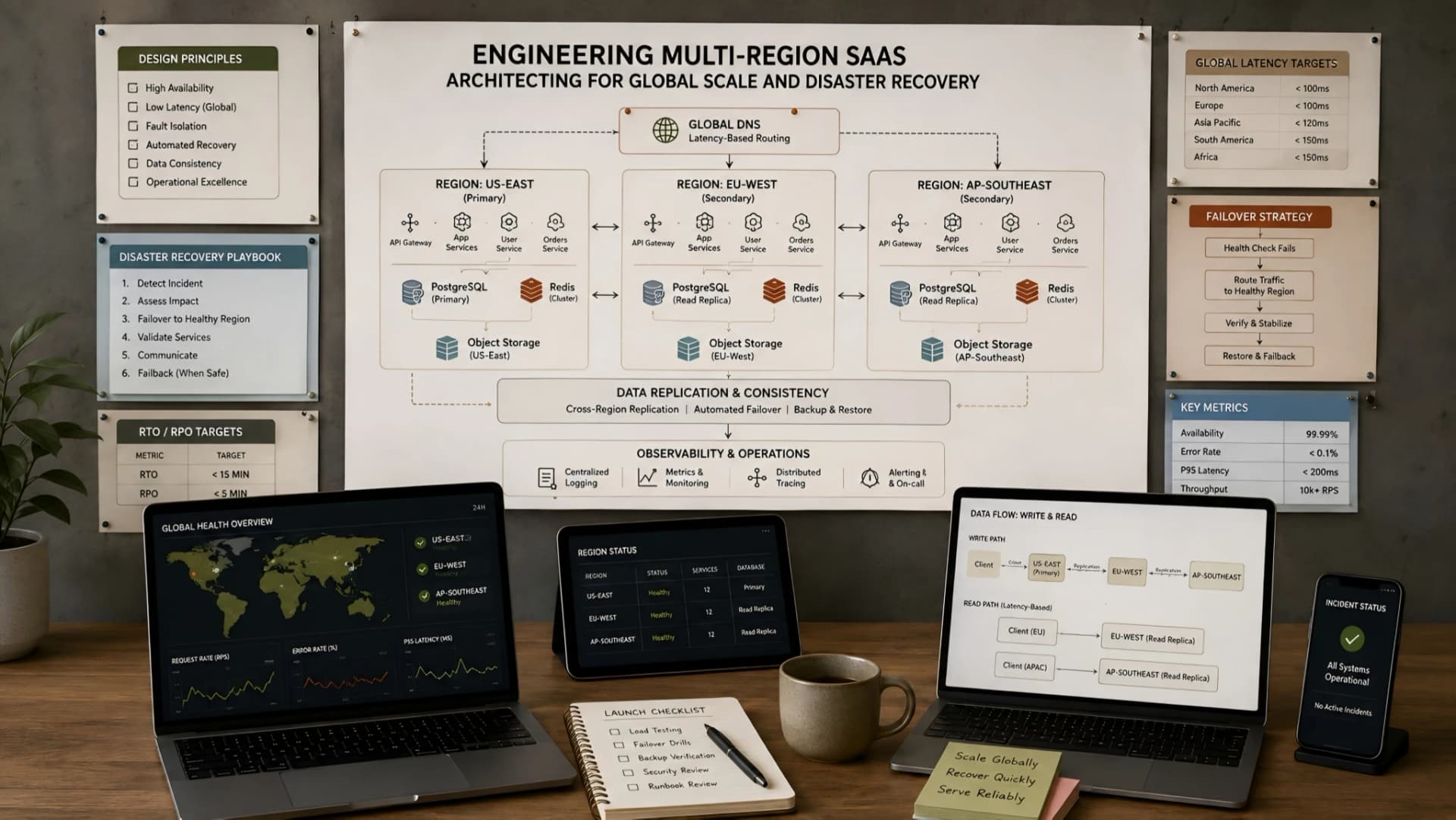
Launching a SaaS product is exhilarating. Watching it grow globally, however, brings a new set of architectural challenges. Suddenly, users in different continents are reporting varying performance, and a regional outage could halt your entire business.
This isn't just about adding more servers; it's about fundamentally rethinking how your application and data are distributed. We often see founders struggle with balancing aggressive growth with the practicalities of engineering for true global resilience.
The Core Problem: Why Multi-Region Matters
Operating a SaaS application from a single cloud region introduces significant vulnerabilities. A localized network issue, a natural disaster, or even a service outage from your cloud provider can render your entire platform inaccessible.
Beyond disaster recovery, user experience suffers. Data traveling across continents introduces latency, making your application feel sluggish for a large segment of your global user base. This directly impacts engagement and retention.
Latency: The Hidden UX Killer
Every millisecond added to a request round-trip accumulates. For users far from your single data center, routine interactions become frustratingly slow.
This isn't just an inconvenience; it can be a competitive disadvantage. A multi-region setup strategically places your application closer to your users, drastically cutting down on these delays.
Single Point of Failure: The Existential Threat
Relying on one region means all your eggs are in one basket. If that region fails, your entire business operation can grind to a halt.
For critical SaaS applications, this level of risk is simply unacceptable. Multi-region architecture is a strategic decision to ensure business continuity and earn user trust.
Multi-Region Strategies: Active-Passive vs. Active-Active
When designing a multi-region architecture, two primary patterns emerge: Active-Passive and Active-Active. Each has distinct tradeoffs in complexity, cost, and recovery objectives.
Choosing the right strategy depends heavily on your application's specific needs, your RTO (Recovery Time Objective), and RPO (Recovery Point Objective).
Active-Passive (Pilot Light / Warm Standby)
In an Active-Passive setup, one region is fully operational (active), while other regions maintain a minimal, ready-to-scale footprint (passive). Data is replicated to the passive regions, often asynchronously.
During a disaster, traffic is rerouted to a passive region, which then scales up to handle the load. This approach is generally less complex and more cost-effective than Active-Active.
- Pros: Lower operational cost, simpler deployment than Active-Active, good for less critical applications.
- Cons: Higher RTO (time to switch over and scale), potential data loss during failover (RPO depends on replication lag).
Active-Active (Multi-Region Resiliency)
An Active-Active architecture runs fully operational instances of your application in multiple regions simultaneously. User traffic is distributed across these regions, typically using global load balancers.
This provides immediate failover capability and optimal latency for users, as they are routed to the nearest healthy region. Data synchronization becomes a critical, complex challenge.
- Pros: Near-zero RTO, excellent fault tolerance, lowest latency for global users, efficient resource utilization.
- Cons: Significantly higher complexity, higher operational costs, challenging data consistency issues (especially with writes).
Key Architectural Components for Multi-Region SaaS
Building a robust multi-region SaaS requires careful consideration of several interconnected components. Each plays a vital role in ensuring availability, performance, and data integrity.
At Muhyo Tech, we emphasize a modular approach, ensuring each layer is designed for resilience and independence, while still integrating seamlessly.
Global Traffic Management
The first step in any multi-region setup is directing users to the correct region. Global DNS services or dedicated global load balancers are essential here.
These services can route traffic based on latency, geographical proximity, or even application health checks. AWS Route 53, Azure Traffic Manager, or Google Cloud Load Balancing are common choices.
Data Replication and Consistency
This is arguably the most challenging aspect of multi-region architecture. Replicating data efficiently and maintaining consistency across geographically dispersed databases is complex.
Choices include asynchronous replication (eventual consistency), synchronous replication (higher latency, stronger consistency), or global database services like Amazon Aurora Global Database, Cosmos DB, or Google Cloud Spanner.
When considering data, we always look for solutions that minimize compromise between consistency and availability. For many SaaS applications, eventual consistency with conflict resolution is a pragmatic choice for non-critical data, while core transactional data might demand stronger guarantees, even if it introduces some latency.
Application Layer Deployment
Your application servers, microservices, and APIs need to be deployed independently in each region. Containerization with Docker and orchestration with Kubernetes are standard practices here.
This allows for consistent deployments and easier scaling within each region. Infrastructure as Code (IaC) tools like Terraform or CloudFormation become indispensable for managing these deployments.
Shared Services and State Management
Some services, like identity management (Auth0, AWS Cognito), caching (Redis), or message queues (Kafka, SQS), might need special multi-region considerations. Global caches or cross-region message queues can improve performance and resilience.
Stateless application design is highly recommended to simplify multi-region operations, pushing state management to robust, replicated database layers.
Designing for Disaster Recovery and Business Continuity
Disaster recovery (DR) is not an afterthought; it's a fundamental design principle for multi-region SaaS. Your architecture should explicitly account for potential failures at every level.
Our approach involves defining clear RTO and RPO targets early in the design phase. These targets dictate the choice of replication strategies and the complexity of your failover procedures.
Defining RTO and RPO
Recovery Time Objective (RTO): The maximum acceptable downtime after an incident. How quickly can your service be fully restored?
Recovery Point Objective (RPO): The maximum acceptable amount of data loss after an incident. How much data are you willing to lose?
These metrics are business-driven. A low RTO and RPO often mean higher architectural complexity and cost, requiring an Active-Active setup.
Automated Failover and Failback
Manual failover processes are slow, error-prone, and introduce human stress during a crisis. Automated failover, triggered by health checks and monitoring, is crucial for achieving low RTOs.
Equally important is a well-tested failback strategy. Restoring services to the primary region after an incident should be as automated and seamless as the failover itself.
Regular DR Drills and Testing
An untested DR plan is no plan at all. Regular, simulated disaster recovery drills are non-negotiable. These exercises identify weaknesses in your architecture, automation, and operational procedures.
Muhyo Tech always incorporates these drills into our deployment pipelines, treating them as critical integration tests for resilience. It's the only way to build confidence in your system's ability to survive a real incident.
Multi-Region Data Storage Strategies Comparison
| Strategy | Description | Pros | Cons | Best For |
|---|---|---|---|---|
| Regional Databases + Cross-Region Replication | Separate database instances in each region with asynchronous or synchronous replication. | Granular control, potentially lower cost for smaller scale. | Complex replication management, potential for data conflicts. | Active-Passive, specific data locality needs. |
| Global Databases (e.g., Aurora Global Database, Spanner, Cosmos DB) | Managed database services with built-in, often multi-master, cross-region replication. | Simplified operations, high availability, strong consistency options. | Higher cost, vendor lock-in, less granular control over replication. | Active-Active, high-transaction global applications. |
| Event Sourcing / CQRS | Capture all changes as a sequence of events, then project to read models. Events can be replicated globally. | Excellent for audit, high scalability, eventual consistency. | High architectural complexity, learning curve. | High-write applications, complex business logic. |
| Edge Caching / CDN | Distribute static and dynamic content closer to users via Content Delivery Networks. | Reduces latency for reads, offloads origin servers. | Not for transactional data, cache invalidation challenges. | Static assets, frequently accessed read-heavy data. |
Operational Challenges and Best Practices
Deploying a multi-region architecture is only half the battle. Operating it effectively introduces its own set of challenges, from monitoring to deployment. Robust operational practices are paramount.
We have learned that proactive monitoring and a strong DevOps culture are critical for success in these complex environments.
Centralized Monitoring and Logging
With services spread across multiple regions, centralized visibility is crucial. Aggregate logs and metrics from all regions into a single platform.
Tools like Datadog, Splunk, ELK Stack, or cloud-native solutions (CloudWatch, Azure Monitor, Google Cloud Logging) provide the necessary insights to diagnose issues quickly.
Consistent Deployment Pipelines
Infrastructure as Code (IaC) and GitOps principles are non-negotiable for multi-region deployments. Your entire infrastructure should be defined in code and version-controlled.
Automated CI/CD pipelines ensure that changes are deployed consistently and reliably across all regions, minimizing configuration drift and human error.
Cost Management
Running services in multiple regions inherently increases cloud costs. Careful resource provisioning, autoscaling, and reserving instances can help manage expenses.
It's important to continuously monitor costs and optimize resource utilization across all deployed regions. Sometimes, an Active-Passive setup for less critical environments can be a smart cost-saving measure.
Security Across Regions
Each region must adhere to the same stringent security standards. This includes consistent network security groups, IAM policies, encryption at rest and in transit, and regular security audits.
Ensure that data sovereignty and compliance requirements for different geographical regions are met, as this can vary significantly.
Making the Decision: When and How to Go Multi-Region
The decision to adopt a multi-region architecture should be driven by clear business needs, not just technical ambition. It's a significant investment in complexity and cost.
Start by evaluating your global user base, your disaster recovery requirements, and your budget. A phased approach is often the most sensible path.
Early Stage: Focus on a Single Robust Region
For startups and new products, optimizing a single, highly available region is often the best first step. Over-engineering for multi-region too early can divert critical resources.
Focus on strong backups, regional redundancy (multi-AZ), and clear recovery plans within that single region first. This builds a solid foundation.
Phased Expansion
Once you have a significant global user base or strict compliance/availability requirements, consider a staged multi-region rollout. You might start with a Pilot Light (Active-Passive) setup for DR.
As your business grows and demands intensify, you can then evolve to a Warm Standby or even a full Active-Active architecture, iteratively increasing complexity and cost.
Muhyo Tech's Approach
We work with founders to analyze their growth projections and risk tolerance. Instead of jumping to the most complex solution, we often design architectures that are 'multi-region ready' from the start.
This means abstracting services, using cloud-agnostic principles where possible, and establishing robust CI/CD and IaC practices. This allows for a smoother transition to multi-region when the time is right, without a complete re-architecture.
Frequently Asked Questions
What are the primary benefits of a multi-region SaaS architecture?
The main benefits include enhanced disaster recovery capabilities, significantly reduced latency for global users, improved fault tolerance, and greater business continuity. It allows your application to remain operational even if an entire cloud region experiences an outage.
How does multi-region architecture impact data consistency?
Maintaining data consistency across multiple regions is one of the biggest challenges. Depending on your chosen replication strategy (synchronous vs. asynchronous) and database technology, you might face tradeoffs between strong consistency and low latency. Global databases or event-sourcing patterns can help manage this complexity.
Is multi-region deployment always necessary for global SaaS products?
Not always, especially for early-stage products. For initial launches, focusing on a highly available single-region setup (e.g., across multiple availability zones) might be sufficient. Multi-region becomes critical as your user base grows globally, and your RTO/RPO requirements tighten due to business impact.
What are the cost implications of going multi-region?
Multi-region architectures inherently increase costs due to running redundant infrastructure, cross-region data transfer fees, and potentially more complex managed services. Careful resource provisioning, right-sizing, and continuous cost monitoring are essential to manage these expenses effectively.