


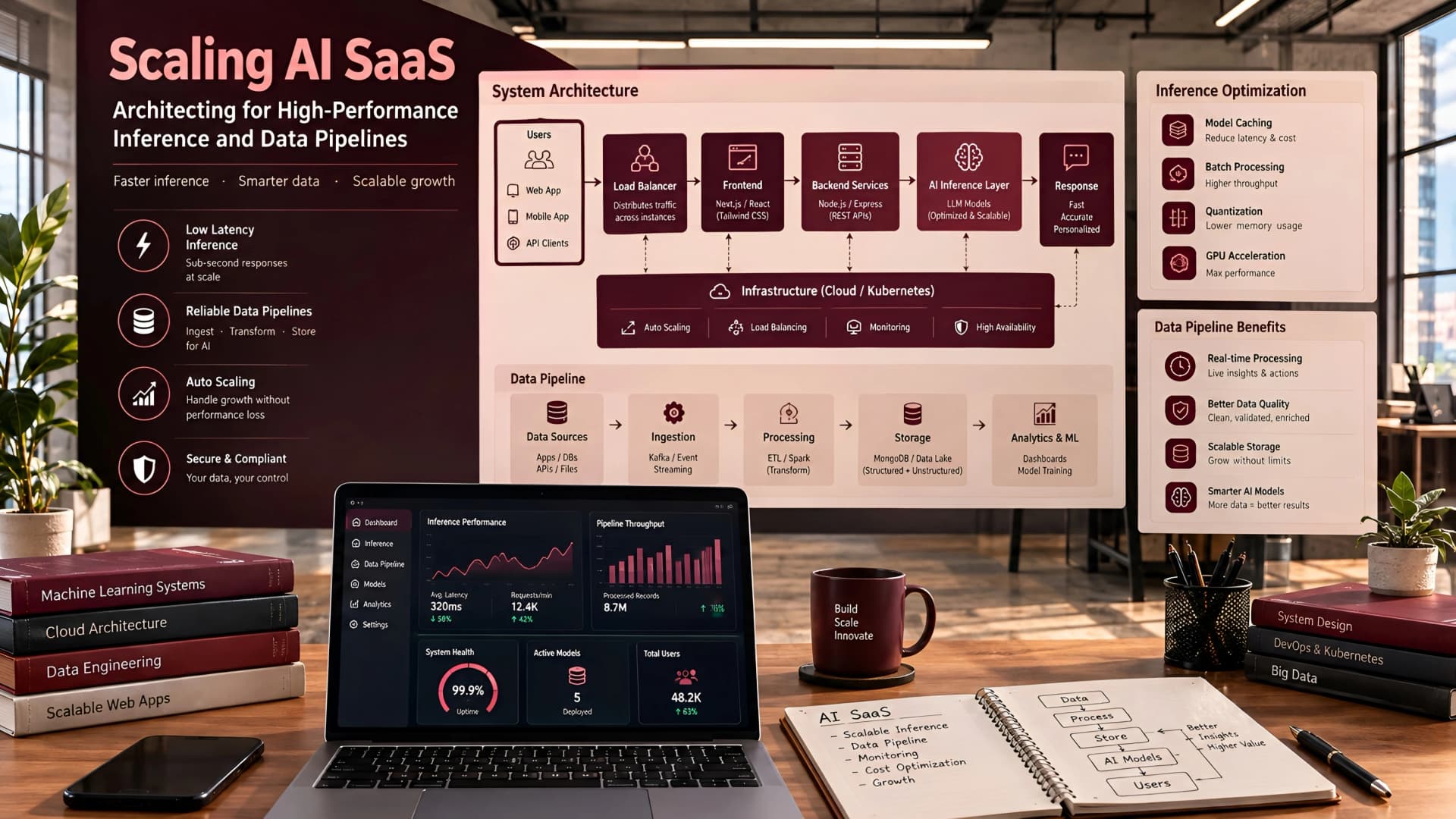
The promise of AI SaaS is undeniable, but the path to delivering reliable, high-performance services at scale is often fraught with engineering challenges. Founders and technical leads frequently face a core dilemma: how do you ensure your AI models perform consistently under fluctuating user loads without breaking the bank?
The answer lies in a meticulously designed architecture that optimizes every stage from data ingestion to model inference and result delivery. At Muhyo Tech, we've seen firsthand how crucial these architectural decisions are for long-term success and operational stability.
The Core Challenge: Efficient AI Inference at Scale
Running AI models, especially complex deep learning networks, is computationally intensive. When thousands of users simultaneously request predictions, the system can quickly buckle if not properly engineered.
This isn't just about raw processing power; it's about intelligent resource allocation, minimizing latency, and ensuring cost-effectiveness. A poorly optimized inference pipeline can lead to slow user experiences, high cloud bills, and frustrated customers.
Understanding Inference Bottlenecks
Typical bottlenecks include slow model loading times, inefficient batching strategies, and suboptimal hardware utilization. Data transfer overhead between different services can also significantly impact overall latency.
Identifying these choke points early in the design phase is critical. Our approach always begins with a deep dive into the expected load patterns and model characteristics.
Cloud-Native Architecture for AI SaaS
Modern AI SaaS platforms thrive on cloud-native principles. This means leveraging services that offer elasticity, managed infrastructure, and a pay-as-you-go model, allowing you to scale resources up or down automatically.
Containerization with Docker and orchestration with Kubernetes are foundational elements. They provide a portable, consistent environment for deploying models and managing their lifecycle.
Serverless Functions for Event-Driven Inference
For sporadic or unpredictable inference requests, serverless functions like AWS Lambda, Azure Functions, or Google Cloud Functions can be incredibly cost-effective. They scale to zero when not in use, only incurring costs during execution.
This model is ideal for micro-SaaS applications or specific AI features that don't require continuous, high-throughput processing. We often integrate these with API gateways for easy external access.
Dedicated GPU Instances for High-Throughput Models
When continuous, high-performance inference is non-negotiable, dedicated GPU instances are often the answer. Services like AWS SageMaker Endpoints, Azure Machine Learning Endpoints, or Google Cloud AI Platform Prediction offer managed solutions for deploying models on GPU-accelerated hardware.
The tradeoff here is cost and complexity. While powerful, these instances require careful monitoring and optimization to ensure they are fully utilized and not over-provisioned.
Optimized Model Deployment Strategies
Simply deploying a model isn't enough; how you deploy it profoundly impacts performance and scalability. Strategies like model quantization, ONNX runtime, and efficient batching are crucial.
Techniques like A/B testing or canary deployments are also vital for safely introducing new model versions without impacting all users simultaneously. This minimizes risk and allows for real-world performance validation.
Model Quantization and Compression
Reducing model size and complexity through quantization (e.g., converting float32 weights to int8) or pruning can significantly speed up inference. Smaller models load faster and require less memory, which translates to lower latency and reduced infrastructure costs.
The key is to balance performance gains with any potential, often minimal, loss in accuracy. This is a critical optimization step in our engineering process.
Batching and Parallelism
Processing multiple inference requests simultaneously (batching) can drastically improve GPU utilization and throughput. However, large batch sizes can increase latency for individual requests.
Finding the optimal batch size is an iterative process, depending on the model, hardware, and acceptable latency. Parallelizing inference across multiple GPU cores or instances further enhances throughput.
Robust Data Streaming and Processing Pipelines
AI models are only as good as the data they consume. Scalable AI SaaS platforms require robust data pipelines for ingestion, preprocessing, and feature engineering, often in real-time.
This involves handling diverse data sources, ensuring data quality, and efficiently transforming data into a format suitable for model inference. Poor data hygiene can lead to degraded model performance and unreliable results.
Event-Driven Data Ingestion with Message Queues
Using message queues like Apache Kafka, AWS Kinesis, or Google Cloud Pub/Sub allows for asynchronous, decoupled data ingestion. This prevents back pressure on upstream systems and ensures data streams are processed reliably.
These systems are essential for handling high volumes of real-time data from various sources, feeding both training pipelines and live inference features.
Data Transformation and Feature Stores
Raw data rarely fits directly into an AI model. Transformation services, often built with Apache Spark, Flink, or serverless compute, clean, enrich, and transform data. Feature stores (e.g., Feast) then serve pre-computed features consistently to both training and inference.
This ensures feature consistency across development and production, a common source of errors in less mature AI systems. We emphasize this consistency in our API integration and database integration work.
Monitoring, Observability, and AIOps
Even the most perfectly designed system will encounter issues. Robust monitoring and observability are non-negotiable for scalable AI SaaS. You need to know not just if your service is up, but how well your models are performing.
This includes tracking inference latency, throughput, error rates, and most importantly, model drift and performance metrics. AIOps tools can automate anomaly detection and even trigger corrective actions.
Key Metrics to Monitor
- Inference Latency: Time taken for a prediction.
- Throughput: Number of predictions per second.
- GPU/CPU Utilization: Hardware resource usage.
- Model Accuracy/Performance: Tracking metrics like F1-score, precision, recall, or custom business KPIs.
- Data Drift: Changes in input data distribution over time.
- Model Drift: Decline in model performance over time.
Tradeoffs and Considerations for Your AI SaaS
No single architecture fits all. Every decision involves tradeoffs between cost, performance, complexity, and development speed. Understanding these is key to making informed choices.
At Muhyo Tech, we emphasize a pragmatic approach. We design systems that meet current business needs while providing a clear path for future scaling, avoiding over-engineering for problems that don't yet exist.
Comparison Matrix: Inference Deployment Strategies
| Strategy | Pros | Cons | Best For |
|---|---|---|---|
| Serverless Functions (e.g., Lambda) | Cost-effective for sporadic use, scales to zero, minimal ops. | Cold starts, limited execution time, CPU-bound. | Micro-SaaS, event-driven, low-volume tasks. |
| Container Orchestration (Kubernetes) | High flexibility, resource control, hybrid cloud, custom hardware. | High operational complexity, significant setup, cost can be high. | Complex workloads, custom ML frameworks, multi-model deployments. |
| Managed ML Endpoints (e.g., SageMaker) | Simplified deployment, auto-scaling, integrated monitoring, GPU support. | Vendor lock-in, higher cost for simple models, less customization. | High-throughput, production ML, ease of use. |
Common Pitfalls to Avoid
- Ignoring Cold Starts: For serverless functions, ensure users don't experience excessive delays.
- Over-provisioning: Running expensive GPUs at low utilization burns money. Implement aggressive auto-scaling.
- Lack of Data Versioning: Without tracking data changes, debugging model performance issues becomes nearly impossible.
- Monolithic Deployments: Tying all AI models into a single service creates a single point of failure and scaling bottleneck.
- Poor Monitoring: Not knowing when model performance degrades is a recipe for unhappy customers.
Muhyo Tech's Engineering Approach to Scalable AI SaaS
Our philosophy centers on building robust, maintainable, and cost-effective AI infrastructures. We start by deeply understanding the business problem and the expected scale, then architect a solution that balances immediate needs with future growth.
This often involves a modular approach, leveraging managed cloud services where appropriate, and custom engineering for unique challenges. Our full-stack web app development expertise ensures the AI backend integrates seamlessly with a responsive, intuitive frontend.
A Production-Ready Architectural Checklist
- Containerization: All models and services are containerized (Docker).
- Orchestration: Use Kubernetes or managed services for deployment and scaling.
- API Gateway: Centralized access point for inference endpoints.
- Asynchronous Processing: Message queues for data ingestion and long-running tasks.
- Feature Store: Consistent feature generation for training and inference.
- Monitoring & Alerting: Comprehensive dashboards for system and model performance.
- Logging: Centralized logging for debugging and auditing.
- CI/CD for ML: Automated deployment pipelines for models and infrastructure.
- Security: IAM roles, network segmentation, data encryption at rest and in transit.
- Cost Management: Regular review of cloud spend and optimization opportunities.
Frequently Asked Questions
How does scalable AI SaaS architecture impact performance and maintenance?
A well-designed scalable architecture directly improves performance by minimizing latency and maximizing throughput, ensuring a smooth user experience. For maintenance, modular cloud-native designs simplify updates, debugging, and allow for isolated service management, significantly reducing operational overhead and risk.
What are common pitfalls when scaling AI SaaS?
Common pitfalls include underestimating data pipeline complexity, ignoring model cold starts, over-provisioning expensive hardware, failing to implement robust monitoring for model drift, and creating monolithic AI services that are difficult to scale or update independently. Addressing these early saves significant headaches later.
How can I implement scalable AI SaaS architecture safely in production?
Start with a clear understanding of your current and projected load, then design a modular, cloud-native architecture using services like container orchestration (Kubernetes), managed ML endpoints, and message queues. Implement strong CI/CD practices, comprehensive monitoring, and A/B testing for safe, iterative deployments.
Final Thoughts on Engineering for AI Scale
Building a truly scalable AI SaaS platform is an intricate engineering endeavor, demanding foresight and a deep understanding of cloud infrastructure, machine learning operations, and data engineering. It’s not about finding a silver bullet, but about making deliberate, informed architectural choices that balance performance, cost, and reliability.
By focusing on robust data pipelines, optimized inference strategies, and comprehensive observability, you can build an AI service that not only meets current demands but is also prepared for the rapid growth and evolution inherent in the AI landscape.