


SaaS products thrive on user engagement and retention. Yet, many struggle to move beyond generic experiences, leaving valuable user data untapped.
The core challenge lies in delivering truly personalized content and features at scale, in real-time. This isn't just about showing relevant items; it's about predicting needs and guiding users proactively.
The Business Imperative for Real-time Personalization
Imagine a user logging into your SaaS platform and immediately seeing features, content, or workflows precisely tailored to their current goals. This isn't a luxury; it's becoming an expectation.
Real-time personalization directly impacts key metrics: higher feature adoption, increased conversion rates for upsells, and significantly improved customer lifetime value (CLTV). Neglecting it means leaving substantial value on the table.
Understanding Real-time Recommendation Engines
A real-time recommendation engine processes user interactions and data streams instantly to generate highly relevant suggestions. Unlike batch processing, which updates recommendations periodically, real-time systems react in milliseconds.
This immediacy is crucial for dynamic SaaS environments where user behavior can change rapidly. Think of a project management tool suggesting collaborators based on current task activity, or a design tool recommending templates based on a user's recent edits.
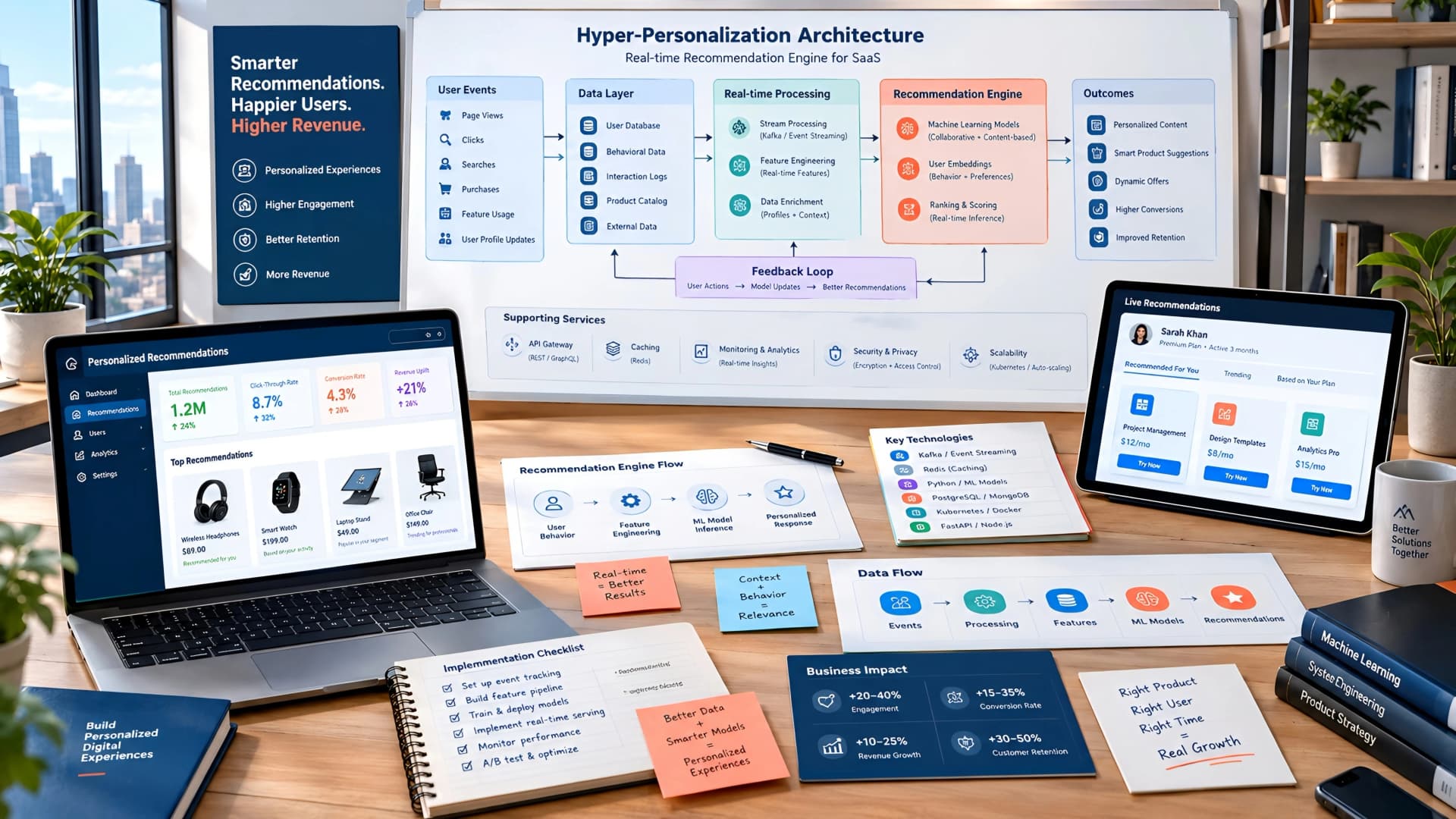
Core Architectural Components: A Blueprint
Building a robust real-time recommendation engine demands a layered architectural approach. We break it down into several interconnected components, each critical for performance and scalability.
At Muhyo Tech, our design philosophy emphasizes modularity and fault tolerance. This allows for independent scaling and easier maintenance of each part.
1. Data Ingestion & Processing Pipeline
This is the engine's fuel line. It captures all relevant user events and data points, from clicks and views to searches and feature usage.
Event Sources: User interactions from front-end applications, backend logs, third-party integrations, and CRM data. These are often streamed via message queues like Apache Kafka or Amazon Kinesis.
Real-time Processing: Stream processing frameworks (e.g., Apache Flink, Spark Streaming) are essential here. They clean, transform, and enrich raw event data, preparing it for the recommendation models.
Feature Store: A critical component that stores pre-computed features (e.g., user's last 5 actions, item's average rating) in a low-latency database (e.g., Redis, Cassandra). This prevents re-computing features for every request, speeding up inference.
2. Machine Learning Model Training & Deployment
This is where the intelligence resides. Models learn patterns from historical and real-time data to make predictions.
Offline Training: Larger datasets are used to train complex models (e.g., deep learning, matrix factorization) periodically. This happens on powerful compute resources, often using frameworks like TensorFlow or PyTorch.
Online Learning (Optional but powerful): Some models can incrementally update their parameters based on new real-time data. This allows for faster adaptation to changing user preferences.
Model Serving: Trained models are deployed as low-latency microservices. REST APIs are common, allowing the application to query the model for recommendations. Containerization (Docker) and orchestration (Kubernetes) are standard for managing these services.
3. Recommendation Serving & Caching Layer
Once recommendations are generated, they need to be delivered quickly and efficiently to the user interface.
Recommendation API: A dedicated API endpoint that takes user context (ID, current page) and returns personalized recommendations. This API orchestrates calls to the feature store and model serving layer.
Caching: Frequently accessed recommendations or user profiles are stored in a fast cache (e.g., Redis). This reduces the load on the ML models and databases, improving response times significantly.
Filtering & Business Rules: Before displaying, recommendations often pass through a filtering layer. This applies business logic, such as removing already purchased items, promoting specific new features, or adhering to content policies.
4. Feedback Loop & A/B Testing
A recommendation engine is never "done." It constantly needs to learn and improve.
User Feedback Capture: Explicit feedback (likes, dislikes) and implicit feedback (clicks, time spent) are crucial. This data feeds back into the data ingestion pipeline to retrain and refine models.
A/B Testing Framework: Essential for evaluating new models, algorithms, or feature sets. Different user segments are exposed to variations, and their engagement metrics are compared to determine the most effective approach.
Build vs. Buy: Weighing the Tradeoffs
This is a common dilemma for SaaS founders and product managers. Should you build a real-time recommendation engine in-house or integrate a third-party SaaS solution?
| Factor | Build In-House | Use Third-Party SaaS |
|---|---|---|
| Initial Cost & Time | High (engineering talent, infrastructure, R&D) | Lower (subscription fees, integration effort) |
| Customization & Control | Full control over algorithms, data, and infrastructure | Limited to vendor's offerings and API capabilities |
| Maintenance & Operations | Significant ongoing effort (monitoring, scaling, updates) | Vendor handles infrastructure, updates, and scaling |
| Data Privacy & Security | Complete control, but full responsibility | Relies on vendor's security and compliance; data sharing implications |
| Integration Complexity | Integrating custom components with existing systems | API-based integration, potentially simpler but rigid |
| Scalability | Requires careful architectural design and engineering to scale | Typically handled by the vendor, often built for scale |
| Unique IP | Potential to develop proprietary recommendation algorithms | No unique IP from the recommendation engine itself |
Our approach at Muhyo Tech often involves a hybrid strategy for early-stage products: start with a well-integrated, configurable SaaS solution for rapid validation. Then, as product needs mature and unique insights emerge, we may incrementally build out custom components where they provide a distinct competitive advantage.
Operational Workflow and Maintainability
A recommendation engine is a living system. Its operational workflow needs to be robust for long-term success.
Monitoring & Alerting: Crucial for tracking model performance, latency, data pipeline health, and infrastructure utilization. Anomaly detection helps catch issues before they impact users.
CI/CD for Models: Just like application code, ML models and their serving infrastructure benefit from continuous integration and deployment. This ensures new models are deployed reliably and safely.
Data Governance: Managing the flow, storage, and access of user data is paramount, especially with evolving privacy regulations. Clear policies and secure practices are non-negotiable.
Cost, Risk, and Staged Decisions
The investment in a real-time recommendation engine can be substantial. Founders need to weigh the costs against the potential gains.
Infrastructure Costs: Compute for training and serving, storage for data lakes and feature stores, and networking for real-time streams all add up. Cloud-native services can manage this, but costs need careful optimization.
Talent Costs: Data scientists, ML engineers, and backend developers are specialized and command high salaries. This is often the largest expense.
Risk Mitigation: Start small. Begin with simpler models (e.g., collaborative filtering) and gradually introduce complexity as you validate the impact. A/B testing is your best friend for de-risking new deployments.
We advocate for a staged approach: validate the hypothesis of personalization's impact with a minimum viable recommendation (MVR) first. This could be a simpler, rules-based system or a basic collaborative filter, before committing to a full-blown real-time architecture.
The Muhyo Tech Standard for Recommendation Systems
When we design recommendation engines, we focus on several key principles:
- Data Freshness & Integrity: Ensuring the most recent user actions are reflected in recommendations with minimal delay, and data quality is maintained throughout the pipeline.
- Scalability & Latency: Architecting for millions of requests per second with sub-100ms response times, using efficient data structures and distributed systems.
- Explainability & Interpretability: Where possible, providing insights into *why* a recommendation was made. This helps with debugging and building user trust.
- Ethical AI & Fairness: Actively monitoring for bias in recommendations and ensuring diverse, fair results that don't perpetuate harmful stereotypes or filter bubbles.
- Robust A/B Testing: Integrating a testing framework from day one to continuously iterate and improve recommendation algorithms based on real user behavior.
Frequently Asked Questions (FAQs)
What are the best real-time recommendation engine SaaS platforms?
Leading platforms include Amazon Personalize, Google Cloud Recommendations AI, and Algolia Recommend. The "best" depends on your existing tech stack, budget, and specific customization needs.
How do real-time recommendation engine SaaS solutions integrate with existing systems?
Most SaaS recommendation engines offer robust APIs and SDKs. Integration typically involves sending user event data to their platform and then calling their API to retrieve recommendations for display in your application.
What is the cost of a real-time recommendation engine SaaS?
Costs vary widely, often based on data volume, API calls, and features used. They can range from a few hundred dollars per month for small-scale usage to tens of thousands for high-traffic, enterprise-level applications.
What are the benefits of using a SaaS real-time recommendation engine over building one in-house?
SaaS solutions offer faster time-to-market, lower operational overhead, and access to advanced algorithms without needing a dedicated ML engineering team. However, they come with less customization and potential vendor lock-in compared to an in-house build.
Conclusion: A Strategic Investment in User Engagement
Implementing a real-time recommendation engine is a significant engineering undertaking, but it’s a strategic investment. It moves your SaaS product from a reactive tool to a proactive, personalized experience.
For founders and product leaders, the path involves clear problem definition, careful architectural planning, and a phased approach. The goal is not just to build a cool feature, but to deeply integrate intelligence that drives tangible business value and user loyalty.
By understanding the blueprint and the critical tradeoffs, you can engineer a system that truly hyper-personalizes your SaaS, keeping users engaged and your business growing.