


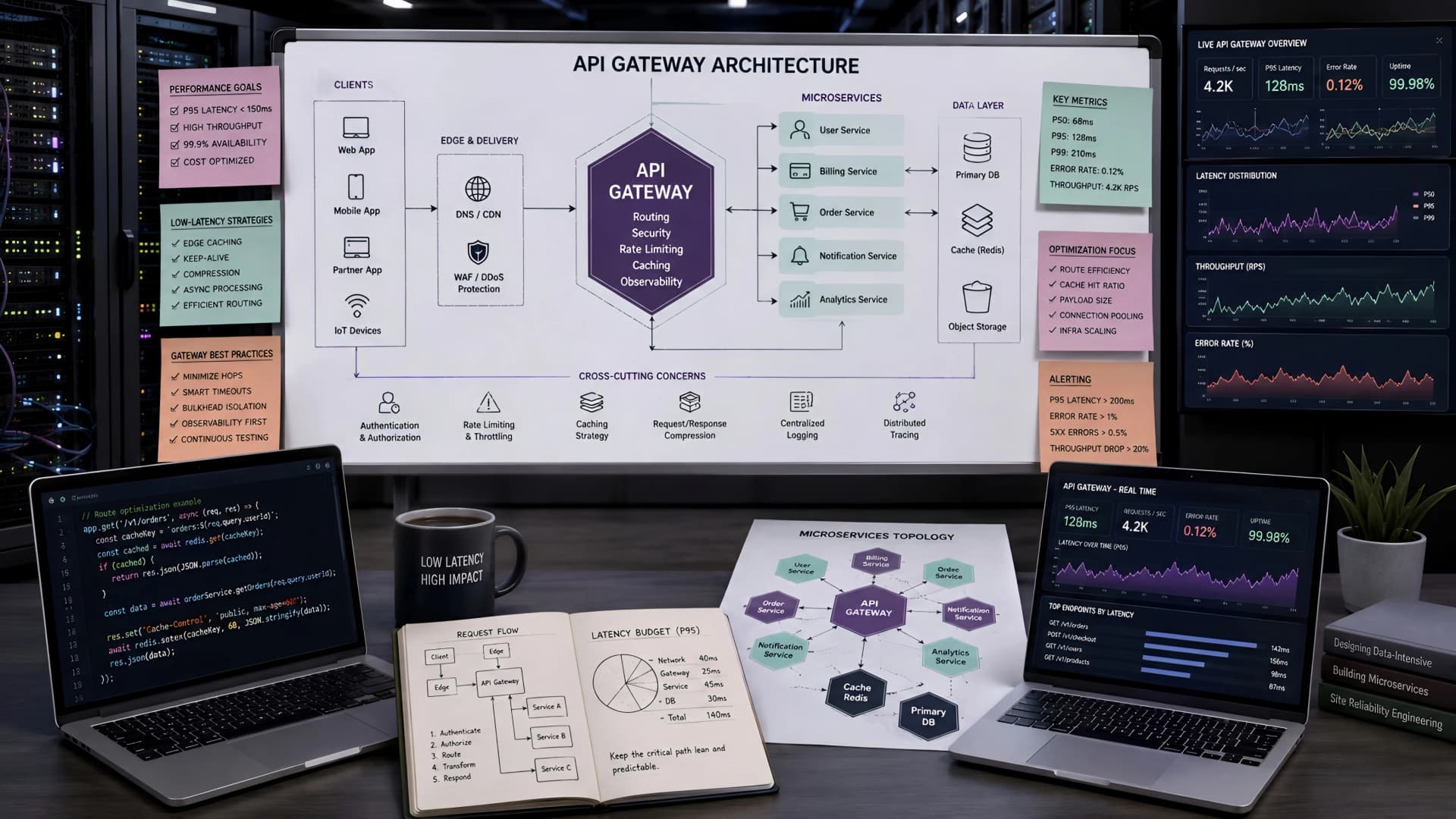
SaaS platforms thrive on responsiveness. When a user clicks, they expect an immediate reaction. In a microservices architecture, however, that expectation often collides with the reality of network hops and processing overhead, especially at the API Gateway.
The API Gateway sits at the front door of your services, managing requests, routing them to the correct backend, and often handling authentication or logging. While crucial for decoupling and security, it can easily become a bottleneck, turning a seemingly fast microservice into a slow user experience.
The Core Challenge: Latency at the Gateway
Microservices inherently introduce more network communication. Each request might traverse multiple services before a response is assembled, and the API Gateway is the first point of contact for every incoming call.
Without careful design, the gateway can add significant latency. This impacts user satisfaction directly and can even lead to increased operational costs if resources are strained handling inefficient requests.
Strategic Caching: Reducing Backend Load and Response Times
One of the most effective ways to optimize API Gateway performance is intelligent caching. By storing frequently accessed responses closer to the client, we can bypass the entire backend microservices chain for many requests.
This reduces latency dramatically and also offloads work from your backend services, freeing them to handle more complex or dynamic requests.
Types of Caching at the Gateway
- Edge Caching: Implemented at the CDN level or geographically closer to users. This provides the fastest possible response for static or highly cacheable content.
- Gateway-Level Caching: The API Gateway itself can store responses for a configured duration. This is ideal for data that changes infrequently but is accessed often, like product catalogs or user profile data.
- Distributed Caching: For more complex scenarios, a shared cache like Redis can be integrated. This allows multiple gateway instances to share cached data, ensuring consistency and resilience.
At Muhyo Tech, we often design caching strategies with clear invalidation policies. Stale data is worse than no data, so understanding the data's freshness requirements is paramount.
Effective Request Throttling and Rate Limiting
Uncontrolled traffic can quickly overwhelm any system, including your API Gateway and backend microservices. Throttling and rate limiting are essential defensive mechanisms.
These controls prevent abuse, protect against DDoS attacks, and ensure fair resource allocation among different users or client applications.
Implementing Throttling and Rate Limiting
- Hard Limits: Define the maximum number of requests per second (RPS) or per minute a client can make.
- Burst Limits: Allow for short bursts of higher traffic but enforce a lower average rate over time.
- Quotas: Set limits on the total number of requests a client can make over a longer period, like a day or month.
These policies should be granular, potentially differing for authenticated versus unauthenticated users, or for premium versus free tiers. This allows us to protect our infrastructure while still providing a good experience for legitimate users.
Intelligent Load Balancing and Routing
An API Gateway isn't just a pass-through; it's a traffic controller. Efficient load balancing and intelligent routing are crucial for distributing requests across multiple instances of your microservices.
This prevents single points of failure and ensures that no single service instance becomes a bottleneck.
Advanced Routing Techniques
- Content-Based Routing: Direct requests to specific services based on headers, query parameters, or URL paths. For example,
/api/v1/usersgoes to the User Service, while/api/v1/productsgoes to the Product Service. - Weighted Routing: Distribute traffic unevenly, sending a larger percentage to newer versions for A/B testing or gradual rollouts.
- Canary Deployments: Route a small percentage of live traffic to a new version of a service to monitor its performance before a full rollout. This significantly reduces deployment risk.
Our approach at Muhyo Tech emphasizes dynamic routing configurations. This allows for seamless updates and quick adjustments without downtime, which is critical for SaaS reliability.
Monitoring and Observability for Performance Insights
You can't optimize what you can't measure. Comprehensive monitoring and observability are non-negotiable for identifying performance bottlenecks in your API Gateway.
This means collecting metrics, logs, and traces to understand how requests flow and where delays occur.
Key Metrics to Monitor
- Latency: Request response times (average, p90, p99).
- Error Rates: Percentage of failed requests (e.g., 5xx errors).
- Throughput: Requests per second (RPS) handled by the gateway.
- Resource Utilization: CPU, memory, and network I/O of the gateway instances.
Integrating these metrics with alerting systems ensures that our engineering teams are notified immediately of any deviations from normal performance baselines. This proactive approach minimizes the impact of issues on end-users.
Security and Authentication Offloading
While often seen as a security feature, offloading authentication and authorization to the API Gateway also has significant performance benefits. Instead of each microservice validating every request, the gateway handles this once.
This reduces redundant processing across your backend services, streamlining their primary function of business logic execution.
Benefits of Gateway Security Offloading
- Reduced Overhead: Microservices don't need to implement their own authentication logic.
- Centralized Policy Enforcement: Security policies are consistent across all services.
- Performance Gain: Less computation per request at the service level means faster overall responses.
We design API integration with security as a first-class citizen, ensuring that performance gains don't come at the cost of vulnerability.
Architectural Considerations and Trade-offs
Implementing an API Gateway involves choices, and every choice has trade-offs. The goal is to select the right tool and configuration for your specific SaaS needs, balancing performance, cost, complexity, and operational overhead.
API Gateway Comparison Matrix
| Feature | Pros | Cons | Best For |
|---|---|---|---|
| Managed Cloud Gateways (e.g., AWS API Gateway, Azure API Management) | High scalability, managed infrastructure, integrated security, rapid deployment. | Vendor lock-in, potentially higher cost for high traffic, less customization. | Startups, teams prioritizing speed & managed ops, serverless architectures. |
| Self-Hosted Gateways (e.g., Kong, Envoy, Nginx) | Full control, high customization, cost-effective for high scale, avoids vendor lock-in. | Requires significant operational expertise, more complex to set up & maintain, responsible for scaling. | Large enterprises, specific performance needs, existing DevOps teams. |
| Sidecar Proxies (e.g., Istio, Linkerd) | Decouples concerns, per-service traffic management, advanced observability. | Adds complexity to microservices deployments, learning curve, potentially higher resource usage. | Service mesh environments, advanced traffic management, polyglot services. |
Our work at Muhyo Tech often involves evaluating these options against client requirements, considering factors like existing infrastructure, team expertise, and long-term scaling projections for their full-stack web applications.
Frequently Asked Questions
How can I reduce latency in my API Gateway for microservices?
To reduce latency, focus on implementing caching for static or frequently accessed data, using efficient load balancing and routing, offloading authentication, and optimizing network paths. Continuous monitoring helps identify and resolve new bottlenecks.
What are the best caching strategies for API Gateways in a microservices architecture?
The best strategies include edge caching via CDN for global reach, gateway-level caching for common responses, and distributed caching (like Redis) for shared, consistent data across multiple gateway instances. Always define clear cache invalidation policies.
How do I implement effective throttling and rate limiting for API Gateway performance?
Implement throttling and rate limiting by setting hard limits on requests per second, allowing for short bursts of higher traffic, and defining long-term quotas. Apply these policies granularly based on user roles or client applications to protect resources and ensure fair usage.
What monitoring tools and metrics are essential for API Gateway performance optimization?
Essential metrics include request latency (average, p90, p99), error rates, throughput (RPS), and resource utilization (CPU, memory, network I/O). Tools like Prometheus, Grafana, ELK Stack, or cloud-native monitoring services help collect, visualize, and alert on these metrics.
Conclusion: Building a Resilient, High-Performance SaaS Foundation
Optimizing API Gateway performance is not a one-time task; it's an ongoing commitment to engineering excellence. It means strategically applying caching, carefully managing traffic with throttling and intelligent routing, and constantly observing your system's behavior.
These efforts directly translate into a more responsive, reliable, and scalable SaaS platform. For founders and CTOs, this means happier users, reduced operational stress, and a stronger competitive position in the market.