


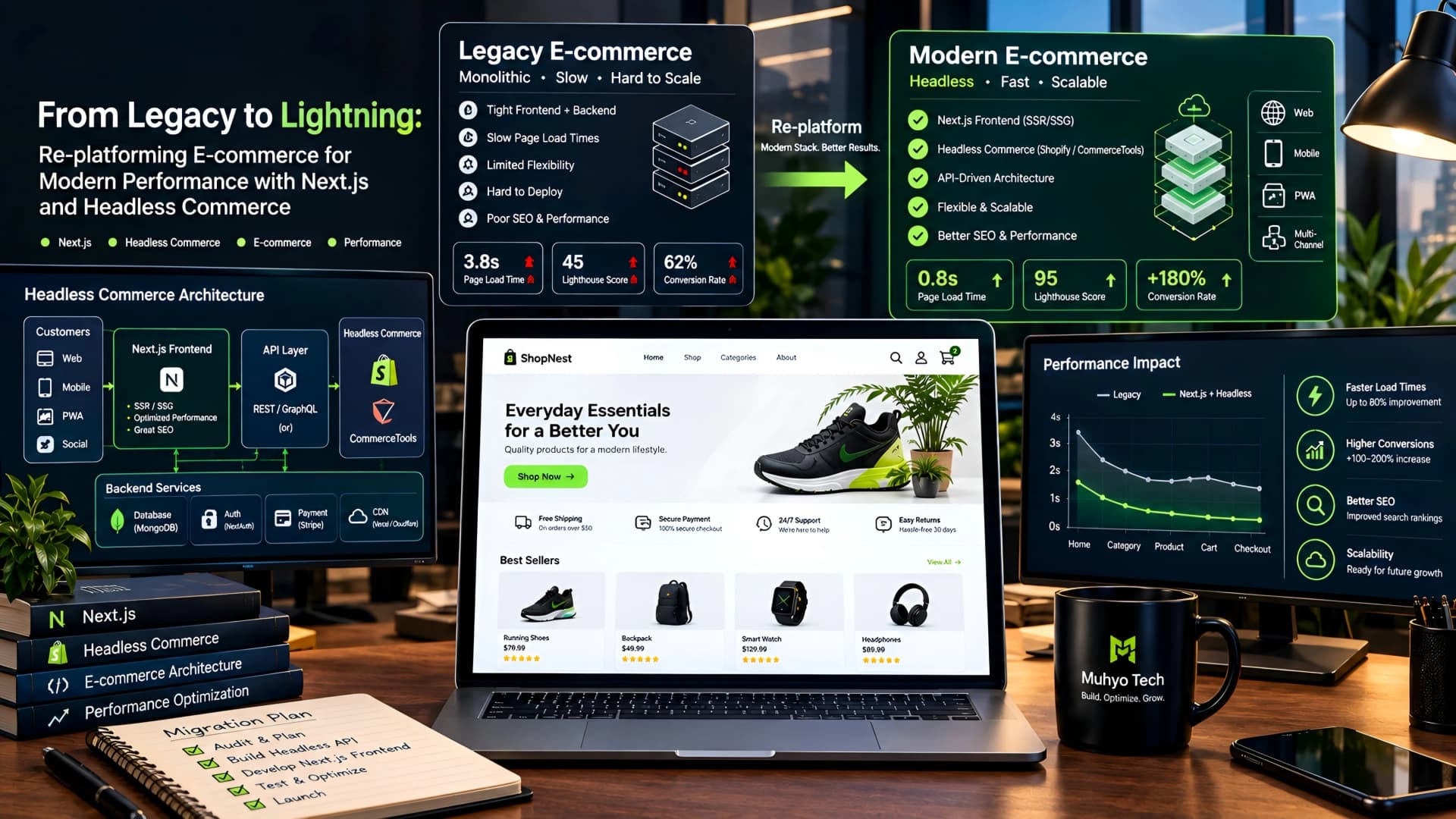
Running an e-commerce store on an aging platform can feel like driving a vintage car in a high-speed race. It might have charm, but it struggles with performance, user experience, and the demands of modern search engines.
The frustration of slow load times, fragile updates, and limited customization options is a common pain point for many online businesses. This often leads to missed opportunities in a competitive digital landscape.
The Core Problem: Outdated E-commerce Platforms
Many traditional e-commerce platforms, while powerful in their day, were not built for the modern web's demands. They often couple the frontend (what users see) tightly with the backend (data, logic, transactions).
This monolithic architecture creates several significant drawbacks. Customization is difficult, updates are risky, and achieving top-tier performance metrics like Core Web Vitals becomes an uphill battle.
Moreover, these platforms can be a significant drag on technical SEO. Slow page speeds and complex rendering processes hinder crawlability and indexation, directly impacting visibility in search results.
Understanding Headless Commerce Architecture
Headless commerce decouples the frontend presentation layer from the backend e-commerce functionalities. This means your product catalog, payment processing, and order management live independently from the user interface.
The frontend, often called the 'head,' then consumes data from the backend 'body' via APIs. This architectural shift provides immense flexibility, allowing businesses to choose the best-of-breed tools for each layer.
For the frontend, modern frameworks like Next.js have emerged as powerful choices. They offer exceptional performance characteristics and a developer experience tailored for dynamic, content-rich applications.
Why Next.js is a Game Changer for Headless E-commerce
Next.js, a React framework, brings a suite of features that are particularly beneficial for e-commerce sites. Its hybrid rendering capabilities are key to delivering both speed and SEO friendliness.
With Next.js, you can choose between Server-Side Rendering (SSR), Static Site Generation (SSG), and Incremental Static Regeneration (ISR). This flexibility allows for optimal content delivery, whether it's frequently updated product pages or stable informational content.
This choice directly impacts initial load times and how search engine crawlers perceive your site. A faster, more consistently rendered experience translates to better crawl budgets and improved indexation.
Next.js Benefits for E-commerce
- Superior Performance: Achieves faster load times through optimized rendering and image handling, leading to better user engagement.
- Enhanced SEO: Provides excellent crawlability and indexation for search engines due to SSR and SSG, which deliver fully rendered HTML.
- Developer Experience: Offers a modern, efficient development workflow, making it easier to build and maintain complex UIs.
- Scalability & Flexibility: Easily integrates with various backend services and APIs, allowing for a highly customizable and scalable e-commerce solution.
- Improved Conversion Rates: A faster, more reliable site experience naturally leads to lower bounce rates and higher conversion potential.
The Migration Process: A Strategic Framework
A headless commerce Next.js migration isn't just a technical swap; it's a strategic re-platforming. It requires careful planning, execution, and a deep understanding of both business and technical requirements.
At Muhyo Tech, we approach these migrations with a structured framework. This ensures minimal disruption, preserves SEO value, and delivers a robust, future-proof solution.
Phase 1: Discovery & Planning
This initial phase is critical for defining the scope and setting realistic expectations. We analyze the existing platform, identify core business requirements, and map out the desired user journeys.
Key activities include API audits, data migration strategies, and a thorough assessment of existing SEO performance. Understanding current traffic patterns and keyword rankings is essential for a smooth transition.
Phase 2: Architecture & Development
Here, we design the new headless architecture, selecting the appropriate e-commerce platform (e.g., Shopify, Commercetools) and connecting it to a custom Next.js frontend.
Development focuses on building a performant, accessible, and responsive user interface. We prioritize clean code, modular components, and robust testing to ensure stability.
Phase 3: Data Migration & Integration
Moving product data, customer information, and order history accurately is a complex task. We establish secure and efficient data migration pipelines, ensuring data integrity and minimizing downtime.
Integrating third-party services like payment gateways, shipping providers, and analytics tools is also crucial. Each integration is carefully tested to ensure seamless functionality.
Phase 4: SEO Preservation & Launch
Preserving SEO equity during a migration is paramount. We implement comprehensive 301 redirects, review sitemaps, and configure canonical tags to guide search engines to the new content.
Pre-launch performance audits and extensive user acceptance testing (UAT) are conducted. The launch itself is a carefully orchestrated event, often involving staged rollouts to monitor performance and address any unforeseen issues.
Common Pitfalls and How to Avoid Them
Even with careful planning, headless migrations can encounter challenges. Being aware of these common pitfalls can help mitigate risks.
Incomplete SEO Migration
Forgetting critical redirects or failing to map old URLs to new ones can lead to significant drops in organic traffic. A detailed redirect strategy and post-launch monitoring are non-negotiable.
Over-engineering the Frontend
While Next.js offers immense flexibility, it's easy to get carried away with custom features that add complexity without clear business value. Prioritize core user journeys and performance.
Ignoring Performance Bottlenecks
A headless architecture doesn't automatically guarantee speed. Poorly optimized images, inefficient API calls, or excessive client-side rendering can still slow down the site. Continuous performance monitoring is key.
At Muhyo Tech, our standard practice includes rigorous SEO audits before, during, and after migration. We prioritize performance from the architectural design phase, ensuring that the benefits of Next.js are fully realized, not just theoretically possible.
Technical Considerations for a Robust Build
Beyond the core migration phases, several technical considerations ensure a resilient and scalable headless e-commerce platform.
- Caching Strategy: Implement aggressive caching at multiple layers (CDN, server, browser) to minimize load times and reduce server strain.
- Image Optimization: Utilize Next.js's
next/imagecomponent for automatic image optimization, lazy loading, and responsive image delivery. - API Security: Secure all API endpoints with proper authentication and authorization. Protect sensitive data and ensure compliance with industry standards.
- Monitoring & Alerting: Set up robust monitoring for performance metrics, server health, and error logs. Establish alerts for critical issues to ensure rapid response.
- Accessibility (A11y): Design and develop with accessibility in mind from the outset. Ensure all users can navigate and interact with your store effectively.
- Testing Automation: Implement unit, integration, and end-to-end tests to catch regressions and ensure stability during future updates and feature additions.
Business Outcomes: Beyond Just a Faster Website
The decision to undertake a headless commerce Next.js migration is an investment with significant returns. The business value extends far beyond simply having a faster website.
Improved site speed and a better user experience lead to higher engagement and lower bounce rates. This directly translates to increased conversion rates, as customers are less likely to abandon slow or frustrating interactions.
Furthermore, the enhanced SEO capabilities mean better visibility in search results, attracting more organic traffic without increased ad spend. The flexibility of the architecture also allows for rapid iteration and deployment of new features, keeping businesses agile and competitive.
Comparison: Headless vs. Monolithic E-commerce
| Feature | Monolithic E-commerce | Headless Commerce (Next.js) |
|---|---|---|
| Performance | Often slower, complex to optimize | Lightning fast, highly optimized |
| SEO | Can be challenging to optimize for modern SEO | Excellent crawlability, strong SEO potential |
| Flexibility | Limited customization, vendor lock-in | High customization, best-of-breed tools |
| Scalability | Scales vertically, can be bottlenecked | Scales horizontally, highly adaptable |
| Developer Experience | Can be cumbersome, steep learning curve | Modern, efficient, enjoyable |
| Cost (Initial) | Potentially lower | Higher (due to custom development) |
| Cost (Long-term) | Higher maintenance, less agile | Lower maintenance, faster feature development |
Making the Decision: Is it Right for You?
A headless commerce Next.js migration is a powerful solution, but it's not a one-size-fits-all answer. It's best suited for businesses experiencing significant growth, those with complex customization needs, or those struggling with the performance and agility of their current platform.
If your e-commerce platform feels like it's holding you back, limiting your ability to innovate, or costing you sales due to poor performance, then exploring a headless architecture is a strategic imperative. The long-term benefits in performance, scalability, and developer velocity often outweigh the initial investment.
Frequently Asked Questions (FAQs)
How long does a typical headless commerce Next.js migration take?
The timeline varies significantly based on the complexity of the existing platform, the number of products, and the required custom features. A comprehensive migration can range from 3-6 months for mid-sized stores to 9-12+ months for larger enterprises.
Will a headless migration negatively impact my current SEO rankings?
If not managed correctly, yes, it can. However, with meticulous planning, comprehensive 301 redirects, proper canonicalization, and continuous monitoring, a headless migration can significantly improve SEO by boosting performance and crawlability.
What are the ongoing maintenance requirements for a Next.js headless store?
Maintenance involves keeping Next.js and its dependencies updated, monitoring API connections, and ensuring the backend e-commerce platform is functioning correctly. While it requires a different skill set than traditional platforms, the modular nature often makes updates less risky.
Is headless commerce more expensive than a traditional e-commerce platform?
The initial development cost for a custom headless setup is typically higher due to the need for custom frontend development and API integrations. However, long-term costs can be lower due to increased developer efficiency, faster feature delivery, and reduced reliance on expensive platform licenses or extensions.