


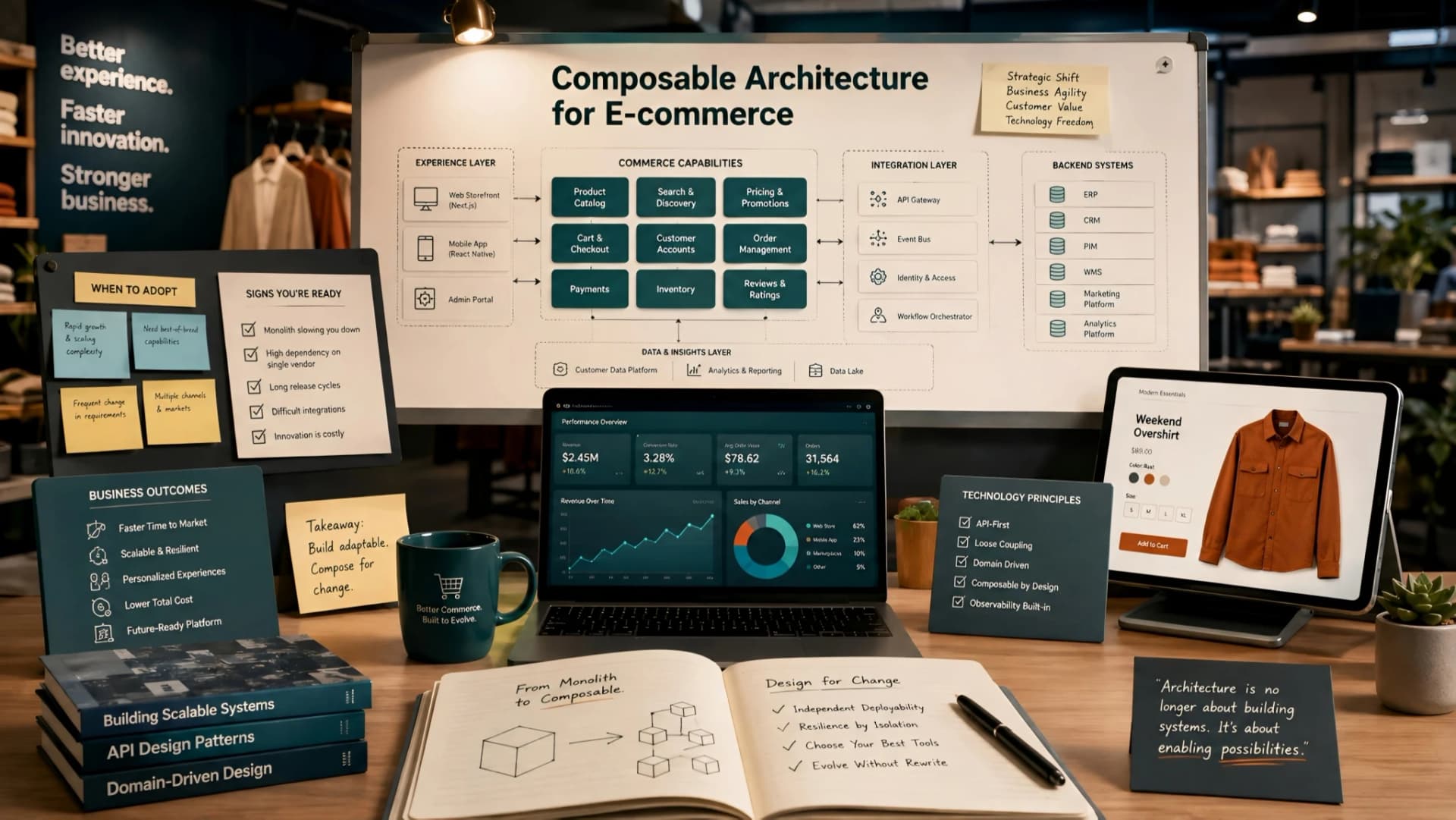
E-commerce platforms are the backbone of modern retail, but traditional monolithic systems often buckle under the pressure of rapid innovation and evolving customer expectations. The pain points are familiar: slow feature releases, difficult integrations, and a constant struggle to scale.
This is where composable commerce offers a compelling alternative. It's not just a trend; it's a strategic architectural shift that demands careful consideration, especially for businesses looking to maintain agility and competitive edge.
Understanding Composable Commerce: Beyond the Buzzwords
At its core, composable commerce is an approach where e-commerce solutions are built by assembling best-of-breed, interchangeable components rather than relying on a single, all-encompassing platform. Think of it as a modular system, where each piece can be independently developed, deployed, and scaled.
This contrasts sharply with monolithic platforms, which often force businesses into a rigid framework. While monoliths offer quick initial setup, they quickly become restrictive when unique features, performance demands, or complex integrations are required.
The Pillars of MACH Architecture
Composable commerce often aligns with the MACH principles: Microservices, API-first, Cloud-native, and Headless. These aren't just technical jargon; they represent a fundamental shift in how digital experiences are built and managed.
Microservices break down large applications into smaller, independent services. API-first ensures all functionalities are accessible via well-defined APIs. Cloud-native designs leverage cloud elasticity and resilience. Headless separates the frontend user experience from the backend commerce logic, offering unparalleled flexibility.
When a Monolith Becomes a Bottleneck: Signs You Need a Change
Identifying the right time to consider a composable architecture involves recognizing critical pain points within your existing e-commerce setup. These aren't just minor inconveniences; they are often systemic issues that impede growth and innovation.
One common indicator is the struggle to integrate new technologies or third-party services. If every new feature requires extensive custom coding or threatens to destabilize your entire system, your monolith is likely holding you back.
Common Pain Points Signaling a Shift
- Slow Time-to-Market: Releasing new features or campaigns takes months, not weeks, due to complex codebases and tightly coupled dependencies.
- Limited Personalization: Delivering highly personalized customer experiences across multiple touchpoints becomes incredibly difficult or impossible with your current platform.
- Scaling Challenges: Your platform struggles with traffic spikes, or scaling specific components (like product catalog) requires scaling the entire system, leading to inefficient resource use.
- Vendor Lock-in: You're beholden to a single vendor's roadmap, pricing, and limitations, making it hard to innovate or switch providers.
- High Maintenance Costs: Maintaining a large, complex monolithic codebase becomes increasingly expensive and risky as technical debt accumulates.
At Muhyo Tech, we often see these issues surface when businesses try to expand into new markets or launch innovative digital products. The engineering effort required to force a monolith into these new roles can be immense and unsustainable.
Evaluating the Business Case for Composable Commerce
A technical decision like adopting composable commerce must be rooted in clear business objectives. It's not about technology for technology's sake; it's about enabling new capabilities and driving competitive advantage.
The business value often stems from increased agility, better customer experiences, and the ability to adapt quickly to market changes. These translate into tangible benefits like higher conversion rates, improved customer loyalty, and reduced operational overhead in the long run.
Key Business Drivers for Adoption
- Enhanced Customer Experience (CX): The ability to create unique, highly tailored frontends for different channels (web, mobile app, IoT) without being constrained by a monolithic template.
- Faster Innovation & Agility: Independently deployable services mean new features can be rolled out rapidly and iteratively, accelerating time-to-market.
- Global Expansion & Localization: Easier adaptation to specific regional requirements, currencies, languages, and payment methods without complex workarounds.
- Reduced Vendor Lock-in: Freedom to choose best-of-breed solutions for specific functionalities (e.g., CMS, search, payment) instead of being tied to a single platform's offerings.
- Optimized Performance: Fine-tuning specific services for performance without impacting others, leading to faster page loads and smoother user interactions.
The Composable Commerce Decision Framework
Making the leap to composable commerce requires a structured approach. It's a significant investment, and understanding the nuances is crucial for success. Our framework helps technical decision-makers weigh the factors carefully.
We look at organizational readiness, existing infrastructure, and the long-term strategic vision. A phased approach, starting with less critical components, often mitigates risk and builds internal expertise.
Step 1: Assess Your Current State & Pain Points
Document your existing e-commerce architecture, identifying all integrations, customizations, and critical functionalities. Pinpoint specific bottlenecks that hinder growth or cause operational inefficiencies.
Understand the capabilities and limitations of your current team. Do you have the skills in-house for microservices, API design, and cloud deployments, or will external expertise be required?
Step 2: Define Your Future Vision & Business Goals
Clearly articulate what you aim to achieve with a new architecture. Is it faster innovation, better personalization, global reach, or reduced operational costs? Specific, measurable goals are essential.
Consider your long-term product roadmap. Will a composable approach better support anticipated growth, new product lines, or emerging digital channels?
Step 3: Evaluate Technical Feasibility & Options
Research available best-of-breed components for various commerce functionalities: Headless CMS, PIM (Product Information Management), OMS (Order Management System), Payment Gateways, and Search engines. Assess their API capabilities and integration ease.
Consider the learning curve for your team and the maturity of potential vendors. A robust ecosystem of tools and support can significantly ease the transition.
Step 4: Pilot & Phased Rollout Strategy
Avoid a 'big bang' migration. Start with a smaller, less critical part of your e-commerce experience (e.g., a new microsite, a specific customer segment's frontend) to test the new architecture and processes.
Develop a clear migration roadmap, prioritizing components based on business impact and technical complexity. This iterative approach allows for adjustments and reduces overall project risk.
Key Components of a Composable Commerce Architecture
A composable architecture is built from distinct, specialized services that communicate via APIs. Understanding these components is essential for designing an effective system.
Each service handles a specific business capability, allowing for independent upgrades and scaling. This modularity is what provides the core flexibility of the composable approach.
- Headless CMS (Content Management System): Manages all content (product descriptions, blog posts, marketing copy) and delivers it via APIs to any frontend.
- PIM (Product Information Management): Centralizes and enriches product data, ensuring consistency across all sales channels.
- OMS (Order Management System): Handles order processing, fulfillment, and inventory across various warehouses and shipping methods.
- Payment Gateway: Manages secure payment transactions, often integrated via APIs.
- Search Engine: Provides fast, relevant product search capabilities, often a specialized service like Algolia or Elastic Search.
- Frontend Framework: The customer-facing layer built with modern frameworks like Next.js, React, or Vue.js, consuming data from the various backend APIs.
- API Gateway: Acts as a single entry point for all API requests, managing routing, security, and rate limiting.
Monolith vs. Composable: A Comparison
Understanding the fundamental differences between these two architectural paradigms is crucial for making an informed decision. Each has its place, depending on business needs and scale.
| Feature | Monolithic Architecture | Composable Architecture |
|---|---|---|
| Flexibility & Agility | Low - tightly coupled, difficult to change | High - independent services, rapid deployment |
| Scalability | Vertical scaling, entire system scales together | Horizontal scaling, individual services scale independently |
| Innovation Speed | Slow - dependencies, complex release cycles | Fast - iterative development, micro-frontends |
| Vendor Lock-in | High - often tied to a single platform | Low - best-of-breed components, interchangeable |
| Initial Cost/Complexity | Lower initial setup cost, higher long-term complexity | Higher initial setup cost, lower long-term complexity |
| Maintenance | Complex, risky updates | Easier, isolated updates |
| Team Structure | Often full-stack teams | Specialized teams for services |
This comparison highlights the core trade-offs. A monolith might be faster to get off the ground for simpler needs, but a composable system offers unparalleled long-term adaptability.
Trade-offs and Challenges of Adopting Composable Commerce
While composable commerce offers significant advantages, it's not a silver bullet. There are inherent complexities and challenges that any organization considering this shift must acknowledge and prepare for.
The distributed nature of microservices introduces new operational overheads, and the initial setup requires a higher level of architectural expertise. Ignoring these challenges can lead to costly failures.
Technical Complexities
- Integration Overhead: Managing numerous integrations between different services can be complex, requiring robust API management and monitoring.
- Data Consistency: Ensuring data consistency across multiple independent services (e.g., product data, inventory) is a significant architectural challenge.
- Operational Complexity: Deploying, monitoring, and debugging a distributed system is inherently more complex than a monolithic one.
- Security: Securing multiple API endpoints and ensuring proper authentication/authorization across services adds layers of complexity.
Organizational & Skill Challenges
- Talent Gap: Finding and retaining engineers with expertise in microservices, cloud-native development, and API design can be difficult.
- Cultural Shift: Moving from a centralized development model to autonomous teams working on independent services requires a significant cultural adjustment.
- Governance: Establishing clear governance models for API standards, service contracts, and deployment pipelines is crucial.
At Muhyo Tech, we emphasize that these challenges are manageable with careful planning and the right expertise. Our approach often involves establishing clear API contracts and robust CI/CD pipelines to streamline development and deployment.
Muhyo Tech's Engineering Approach to Composable Commerce
When approaching a composable commerce project, our team prioritizes a few key principles to ensure both technical excellence and business alignment. We don't just build; we strategize for long-term success.
We believe in starting with a strong architectural foundation, emphasizing maintainability, scalability, and security from day one. This proactive stance prevents common pitfalls down the line.
Our Standards for Success
- API-First Design: Every service is designed with its API as the primary interface, ensuring clean contracts and easy integration.
- Cloud-Native Best Practices: We leverage the full power of cloud platforms for scalability, resilience, and cost-efficiency.
- Robust Observability: Implementing comprehensive logging, monitoring, and tracing across all services to quickly identify and resolve issues.
- Automated CI/CD: Continuous Integration and Continuous Deployment pipelines are essential for rapid, reliable feature delivery and updates.
- Strategic Component Selection: We help clients choose best-of-breed services that align with their specific business needs, avoiding unnecessary complexity.
Our goal is to build systems that are not only powerful but also adaptable, allowing businesses to evolve their e-commerce presence without constant re-platforming. This aligns perfectly with our commitment to e-commerce website development that delivers lasting value.
Frequently Asked Questions
What are the key components of a composable commerce architecture?
Key components typically include a headless CMS, Product Information Management (PIM) system, Order Management System (OMS), various payment gateways, a dedicated search engine, and a modern frontend framework, all connected via robust APIs.
How does composable commerce differ from traditional monolithic commerce platforms?
Composable commerce uses independent, best-of-breed services connected via APIs, offering flexibility and agility. Monolithic platforms are all-in-one solutions that are often less adaptable, with tightly coupled features and slower innovation cycles.
What are the benefits and challenges of adopting a composable commerce strategy?
Benefits include faster innovation, enhanced customer experience, greater scalability, and reduced vendor lock-in. Challenges involve higher initial complexity, increased operational overhead, and the need for specialized technical skills.
What is the MACH architecture and how does it relate to composable commerce?
MACH stands for Microservices, API-first, Cloud-native, and Headless. These principles are foundational to composable commerce, guiding the design and implementation of modular, flexible, and scalable e-commerce systems.
Conclusion: Charting Your Course to Composable Commerce
The decision to adopt a composable commerce architecture is a strategic one, moving beyond mere technical preference to impact long-term business growth and agility. It's a journey that requires careful planning, a clear understanding of your organizational capabilities, and a commitment to modern engineering practices.
While the initial investment in complexity and expertise is higher, the returns in terms of flexibility, speed of innovation, and freedom from vendor lock-in are substantial. For businesses looking to truly own their digital future, composable commerce offers a powerful pathway forward. By following a structured decision framework and embracing best practices, you can successfully navigate this strategic shift and build a resilient, future-proof e-commerce platform.