


Exposing Node.js microservices directly to clients often introduces a host of complexities. You quickly face challenges with security, client-side development, and managing cross-cutting concerns like authentication or rate limiting.
This direct exposure can turn a seemingly simple system into a fragile, difficult-to-maintain monolith of interconnected client calls. We've seen this lead to slower development cycles and increased operational risks.
The Core Problem: Direct Microservice Exposure
Imagine a scenario where a frontend application needs to interact with five distinct Node.js microservices. Without an API Gateway, the client must know the endpoint for each service.
This tight coupling creates a significant burden on client-side development and maintenance. Every change in a microservice's URL or authentication mechanism requires a client update.
Why Direct Exposure Fails at Scale
Direct exposure complicates client code. Clients become responsible for orchestrating multiple calls and handling partial failures across different services.
Security becomes a patchwork. Each microservice needs its own authentication and authorization logic, leading to duplication and potential inconsistencies.
Introducing the API Gateway Pattern
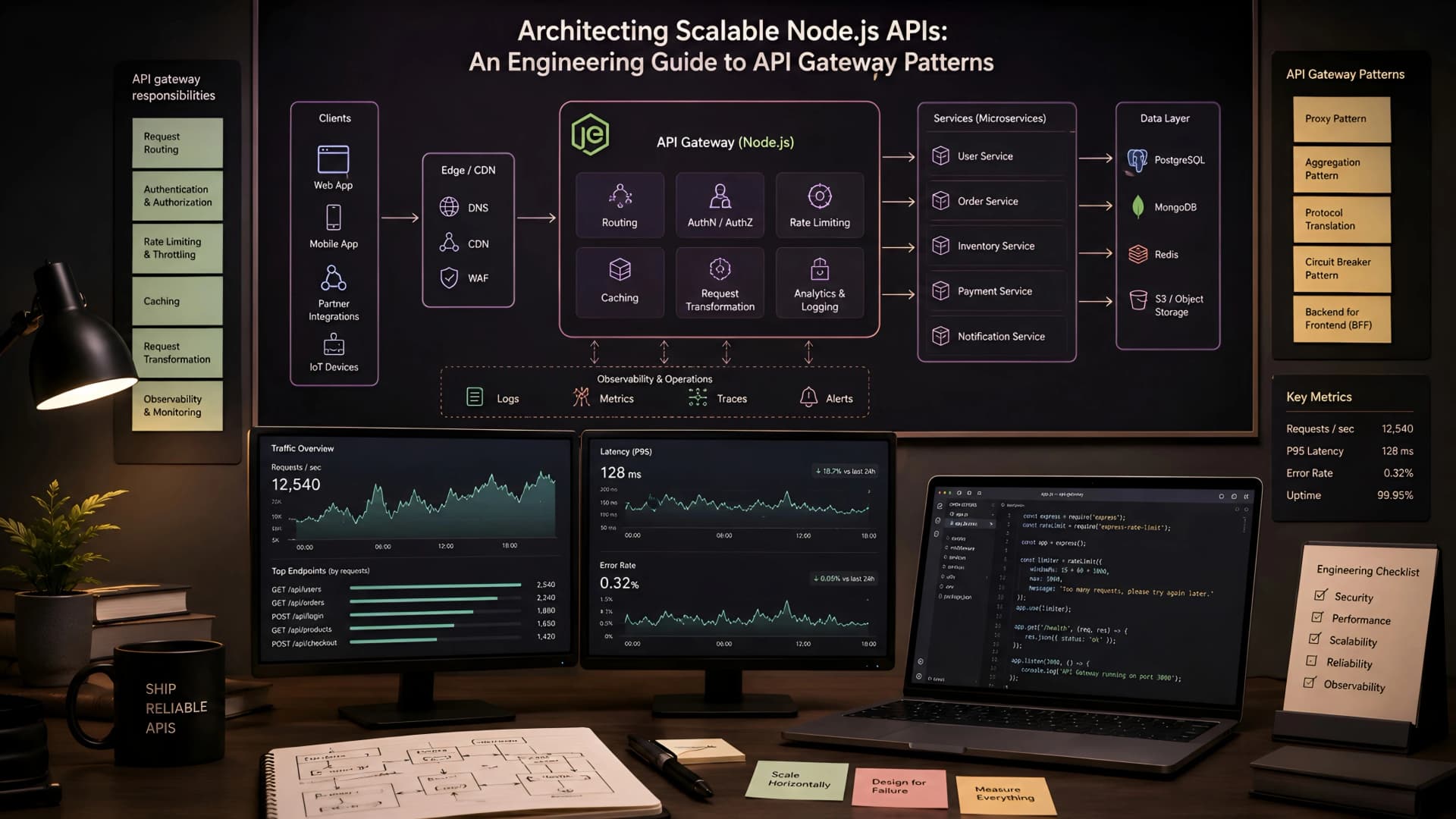
An API Gateway acts as a single entry point for all client requests. It sits in front of your microservices, routing requests to the appropriate backend service.
This pattern provides a centralized location for handling common concerns. These include authentication, rate limiting, logging, and caching.
How an API Gateway Transforms Your Node.js Architecture
The gateway decouples clients from individual microservices. Clients interact only with the gateway, simplifying their codebase.
It centralizes cross-cutting concerns, reducing boilerplate code in your microservices. This makes your services leaner and more focused on their business logic.
Key Benefits of an API Gateway for Node.js Microservices
Implementing an API Gateway offers several distinct advantages. These benefits address common pain points in distributed systems.
They lead to more robust, secure, and maintainable applications, which is crucial for long-term project health.
Simplified Client-Side Development
Clients no longer need to know the intricate details of your microservice landscape. They interact with a single, consistent API.
This reduces client-side complexity and accelerates frontend development. It also minimizes the impact of backend refactoring on client applications.
Enhanced Security and Access Control
The API Gateway becomes the primary enforcement point for security policies. Authentication and authorization can be handled once at the gateway level.
This protects your individual microservices from direct exposure. It ensures a consistent security posture across your entire API surface.
Centralized Cross-Cutting Concerns
Rate limiting, caching, logging, and monitoring can all be managed within the gateway. This prevents code duplication across your services.
It also provides a unified view of API traffic and performance. This makes operational tasks significantly easier.
Improved Scalability and Resilience
Gateways can implement load balancing and circuit breaker patterns. This distributes traffic efficiently and prevents cascading failures.
They can also provide API versioning and transformation. This allows for seamless evolution of your backend services without breaking existing clients.
Architecting Your Node.js API Gateway: Practical Considerations
Designing an effective API Gateway requires careful thought. It's not just about picking a tool; it's about defining its role and capabilities.
At Muhyo Tech, we focus on making architectural choices that balance immediate needs with future scalability and maintainability.
Choosing the Right Technology Stack
For Node.js environments, popular choices include custom Express.js or Fastify applications, or specialized API Gateway solutions like Ocelot (for .NET, but the concept applies), Kong, or Apache APISIX.
A custom Node.js gateway provides maximum flexibility. However, it requires more development and maintenance effort.
Implementing Routing and Orchestration
The gateway needs to intelligently route incoming requests to the correct microservice. This can involve simple path-based routing or more complex logic based on headers or query parameters.
Sometimes, a gateway might need to orchestrate calls to multiple microservices to fulfill a single client request. This is often called API composition.
Authentication and Authorization Strategies
Centralizing authentication at the gateway is a best practice. The gateway can validate tokens (JWT, OAuth) and pass user context to downstream services.
Authorization can also be handled here, checking user roles or permissions before forwarding requests. This offloads security logic from individual microservices.
Rate Limiting and Throttling
Protecting your backend services from abuse or overload is critical. The gateway can implement rate limiting based on IP address, API key, or user ID.
This ensures fair usage and maintains service stability. It prevents a single client from monopolizing resources.
Caching for Performance
Implementing a caching layer within the gateway can significantly improve API response times for frequently requested data. This reduces the load on your backend services.
Careful cache invalidation strategies are essential to ensure data freshness. Stale data can be worse than slow data.
Comparison of API Gateway Implementation Approaches
When deciding how to implement an API Gateway for Node.js, you have several options. Each comes with its own set of tradeoffs.
Understanding these differences helps in making an informed decision that aligns with your project's specific requirements and team's expertise.
| Feature | Custom Node.js Gateway (e.g., Express/Fastify) | Managed Cloud Gateway (e.g., AWS API Gateway, Azure API Management) | Open-Source Gateway (e.g., Kong, Apache APISIX) |
|---|---|---|---|
| Flexibility & Customization | Highest; full control over logic | Moderate; configuration-driven, limited custom code | High; plugin-based, extensible |
| Operational Overhead | High; self-managed, requires DevOps expertise | Low; managed by cloud provider | Moderate; self-managed, but with robust features |
| Cost Model | Development & infrastructure costs | Usage-based pricing (requests, data transfer) | Infrastructure costs, optional enterprise support |
| Learning Curve | Medium; standard Node.js development | Medium; specific cloud platform knowledge | Medium-High; specific gateway configuration & ecosystem |
| Features Out-of-the-Box | Basic; everything built from scratch | Rich; authentication, caching, WAF, monitoring | Rich; plugins for auth, rate limiting, traffic management |
| Vendor Lock-in | Low | High | Low |
| Best For | Unique requirements, high control, small to medium scale | Rapid deployment, serverless, large scale, cloud-native | Complex needs, hybrid cloud, large scale, open-source preference |
Choosing the Right Approach for Your Project
For projects with unique business logic requirements or very specific performance needs, a custom Node.js gateway might be ideal. It offers unparalleled control.
If you're already deeply invested in a cloud ecosystem and prioritize speed of deployment and reduced operational burden, a managed cloud gateway is often the best fit.
Open-source solutions like Kong or Apache APISIX provide a powerful middle ground, offering extensive features and extensibility without vendor lock-in, though they require self-management.
Common Pitfalls and How to Avoid Them
While API Gateways offer significant advantages, they also introduce new complexities. Awareness of common pitfalls is key to a successful implementation.
Ignoring these can lead to performance bottlenecks, increased development time, or even a new single point of failure.
Over-orchestration at the Gateway
Avoid turning your API Gateway into a 'super-service' that does too much. Excessive business logic or complex data transformations should ideally reside in microservices.
The gateway's role is primarily routing, security, and cross-cutting concerns. Keep it lean and focused.
Single Point of Failure
A poorly designed or deployed API Gateway can become a critical bottleneck. Ensure high availability through redundancy and load balancing.
Implement robust monitoring and alerting for your gateway to detect issues early. This protects your entire system.
Performance Bottlenecks
Every request passes through the gateway, adding latency. Optimize gateway performance by minimizing processing overhead.
Use efficient Node.js frameworks and avoid blocking operations. Implement caching strategically to reduce downstream calls.
Security Misconfigurations
The API Gateway is your first line of defense. Incorrectly configured authentication, authorization, or rate limiting can expose your backend.
Regular security audits and adherence to best practices are paramount. Treat your gateway's security with the utmost seriousness.
Muhyo Tech's Approach to API Gateway Architecture
At Muhyo Tech, we approach API Gateway implementation with a focus on maintainability, security, and long-term scalability. Our goal is always to deliver robust systems that simplify future development.
We prioritize clear separation of concerns, ensuring the gateway enhances, rather than complicates, the microservice architecture.
Prioritizing Performance and Reliability
We leverage lightweight Node.js frameworks like Fastify for custom gateways. This ensures high throughput and low latency, which are critical for responsive APIs.
Our deployments incorporate containerization and orchestration (Kubernetes, Docker Swarm) for automatic scaling and high availability, making the gateway resilient to failures.
Balancing Customization with Managed Services
We often recommend a hybrid approach. This involves using managed cloud API Gateways for external-facing APIs where their features align, and custom Node.js gateways for internal or specialized traffic.
This allows us to tailor the solution precisely to the project's needs, optimizing for both developer experience and operational efficiency.
Security-First Design Principles
Security is integrated from day one. We implement robust authentication using industry standards like JWT and OAuth 2.0, with careful attention to token validation and expiration.
Rate limiting and input validation are standard practices, protecting services from malicious attacks and ensuring stable operations.
Building a Production-Ready Node.js API Gateway Checklist
Launching an API Gateway into production requires more than just code. This checklist covers essential considerations for a robust deployment.
- High Availability: Deploy multiple gateway instances behind a load balancer.
- Scalability: Configure auto-scaling based on traffic metrics (CPU, requests per second).
- Monitoring & Logging: Implement comprehensive logging (request/response, errors) and integrate with monitoring tools (Prometheus, Grafana).
- Security Hardening: Use TLS/SSL, implement Web Application Firewall (WAF), enforce strong authentication and authorization.
- Rate Limiting: Configure appropriate rate limits to protect backend services.
- Caching: Implement caching for static or frequently accessed data to reduce latency.
- Error Handling: Design consistent error responses and fallbacks for service unavailability.
- API Versioning: Plan for how you will handle API versioning (e.g., via headers, URL paths).
- Documentation: Provide clear API documentation (OpenAPI/Swagger) for clients and internal teams.
- Automated Testing: Develop unit, integration, and end-to-end tests for the gateway.
Frequently Asked Questions (FAQs)
What is the primary benefit of using an API Gateway with Node.js microservices?
The primary benefit is simplified client-side development and centralized management of cross-cutting concerns. It acts as a single, consistent entry point for clients, handling tasks like authentication, rate limiting, and routing away from individual microservices.
Can an API Gateway become a performance bottleneck?
Yes, an API Gateway can become a performance bottleneck if not designed and optimized correctly. Every request passes through it, adding potential latency. Proper optimization, like using efficient frameworks, caching, and horizontal scaling, is crucial to mitigate this risk.
Should all microservices interact through the API Gateway?
Generally, external client requests should always go through the API Gateway. Internal microservice-to-microservice communication, however, often bypasses the gateway for efficiency. The decision depends on your architecture and specific security/monitoring needs for internal calls.
What are the alternatives to an API Gateway for microservices?
Alternatives include direct client-to-microservice communication (suitable for very small, simple systems), or using a service mesh (like Istio or Linkerd) for advanced traffic management, security, and observability at the network level, often in conjunction with a lightweight API Gateway.
Conclusion: Empowering Your Node.js Microservices
Architecting scalable Node.js APIs with an API Gateway pattern is a strategic decision that pays dividends in maintainability, security, and operational efficiency. It simplifies client interactions and centralizes crucial engineering concerns.
By carefully considering the technology, implementing robust security, and avoiding common pitfalls, you can build a resilient and high-performing system. This approach ensures your web applications and digital services remain agile and scalable for the long term. This is the kind of practical engineering we integrate into our MERN Stack web development and full-stack web app development projects, delivering systems that stand the test of time.