


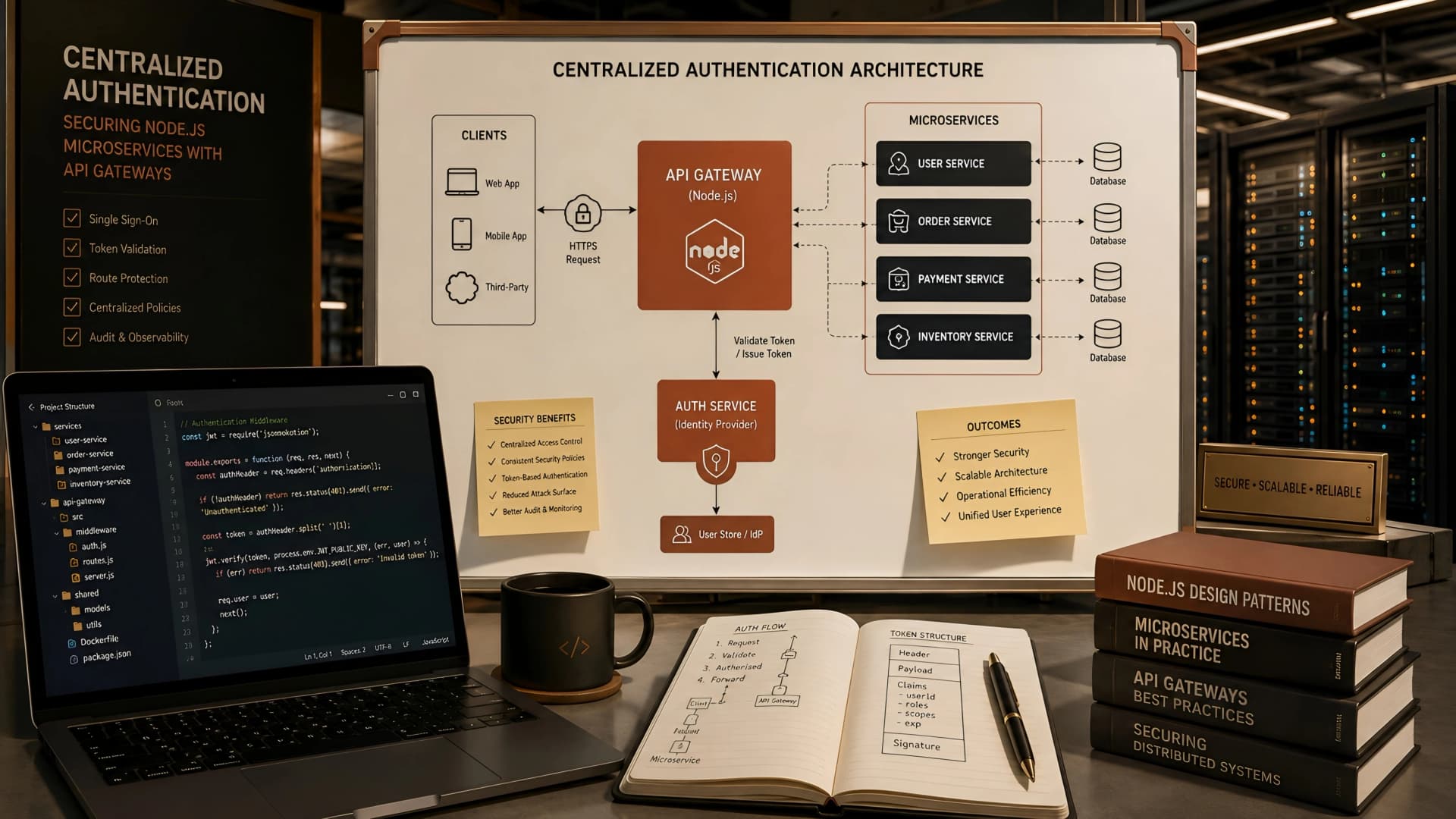
When building microservice architectures with Node.js, managing authentication and authorization across every individual service can quickly become a significant headache. Each new service demands its own security implementation, leading to duplicated effort, potential inconsistencies, and a higher risk of security vulnerabilities.
This decentralized approach complicates updates and makes auditing a nightmare. We’ve seen this pain firsthand: a new developer joins, adds a service, and inadvertently introduces a subtle flaw in the security middleware.
The Pain of Distributed Security
Imagine a system with five distinct Node.js microservices. Each needs to validate a JSON Web Token (JWT), extract user roles, and then decide if the request should proceed. Doing this five times means five chances for error, five places to update when your token structure changes, and five separate sets of tests.
This kind of distributed security logic creates a heavy manual operational workload. It bogs down development cycles and makes rapid iteration difficult, a problem we specifically address when designing scalable systems for clients.
Centralizing Security with an API Gateway
The API Gateway pattern offers a powerful solution to this problem, especially for Node.js microservices. Instead of scattering security logic, we consolidate it at the entry point of our system – the API Gateway.
This means the gateway handles JWT validation, token decryption, and initial authorization checks before any request even reaches a downstream microservice. It acts as a security enforcement point, offloading critical concerns from individual services.
How It Works: A Step-by-Step Approach
Our typical approach involves a dedicated API Gateway service, often built with Node.js using frameworks like Express or Fastify, or a specialized gateway like Kong or Ocelot. For the core foundational concepts, you might want to revisit our Architecting Scalable Node.js APIs: An Engineering Guide to API Gateway Patterns article.
When a request arrives at the API Gateway, here’s the flow:
- Token Extraction: The gateway intercepts the incoming request and extracts the authentication token, typically from the
Authorizationheader. - Token Validation: It then validates the token's signature, checks its expiration, and ensures it hasn't been tampered with. This often involves a shared secret or a public key from an Identity Provider.
- User Context Enrichment: Once validated, the gateway can extract user ID, roles, and other relevant claims from the token payload. This information is then passed downstream, usually as custom headers or part of the request context.
- Authorization Check (Gateway Level): For broad access control, the gateway can perform initial authorization based on common roles or request paths. For example, ensuring only 'admin' roles can access certain API groups.
- Request Forwarding: If all checks pass, the gateway forwards the request to the appropriate downstream microservice, enriched with validated user context.
Engineering Choices and Trade-offs
Implementing Node.js API Gateway authentication involves several engineering decisions, each with its own trade-offs.
We often choose between a custom Node.js gateway for maximum flexibility or a pre-built solution like Kong for speed and out-of-the-box features. A custom Node.js gateway allows fine-grained control over security logic and integration with specific identity providers, which is crucial for complex business requirements.
Building a custom gateway gives us the precision to tailor security policies exactly to a client's unique needs. This often means a slightly longer initial setup but pays dividends in long-term maintainability and auditability.
Performance is a key consideration. While adding a gateway introduces an extra hop, the performance impact is often negligible compared to the benefits of centralized security. Caching validated tokens or user permissions at the gateway can further optimize response times.
Benefits for Business and Development
Centralizing authentication and authorization at the API Gateway provides tangible business value:
- Simplified Security Management: Security updates and policy changes are applied in one place, reducing the risk of inconsistencies and errors across services. This dramatically lowers the operational workload.
- Consistent Access Control: Every service benefits from the same, enforced security policies. This ensures that even newly deployed services automatically adhere to the system's security standards.
- Reduced Development Overhead: Developers building new microservices no longer need to write boilerplate authentication and authorization code. They can focus purely on the business logic, accelerating feature delivery.
- Enhanced Security Posture: A single, well-audited security layer is generally more robust than multiple, potentially inconsistent implementations.
- Faster Time-to-Market: With security concerns largely handled, teams can launch new services and features more quickly and with greater confidence.
Muhyo Tech's Approach to API Security
At Muhyo Tech, when we design and develop MERN stack web applications or full-stack web apps, we prioritize secure, scalable architectures from the outset. Centralized API Gateway authentication is a cornerstone of this philosophy.
We look for patterns that minimize repetitive work, enhance reliability, and provide clear security boundaries. This approach not only strengthens the application's defense but also frees up development resources to focus on core features that drive business value.
This engineering standard extends to how we handle API integrations. Ensuring secure and efficient communication between disparate systems is paramount, and a robust API Gateway is often the linchpin.
Conclusion
The complexity of securing a growing number of Node.js microservices can be daunting. By implementing centralized authentication and authorization at the API Gateway, we transform a distributed security headache into a streamlined, consistent, and more robust solution.
This architectural pattern simplifies development, strengthens your security posture, and ultimately helps deliver more reliable and scalable web applications. It's an investment in architectural clarity that pays off in operational efficiency and peace of mind.