


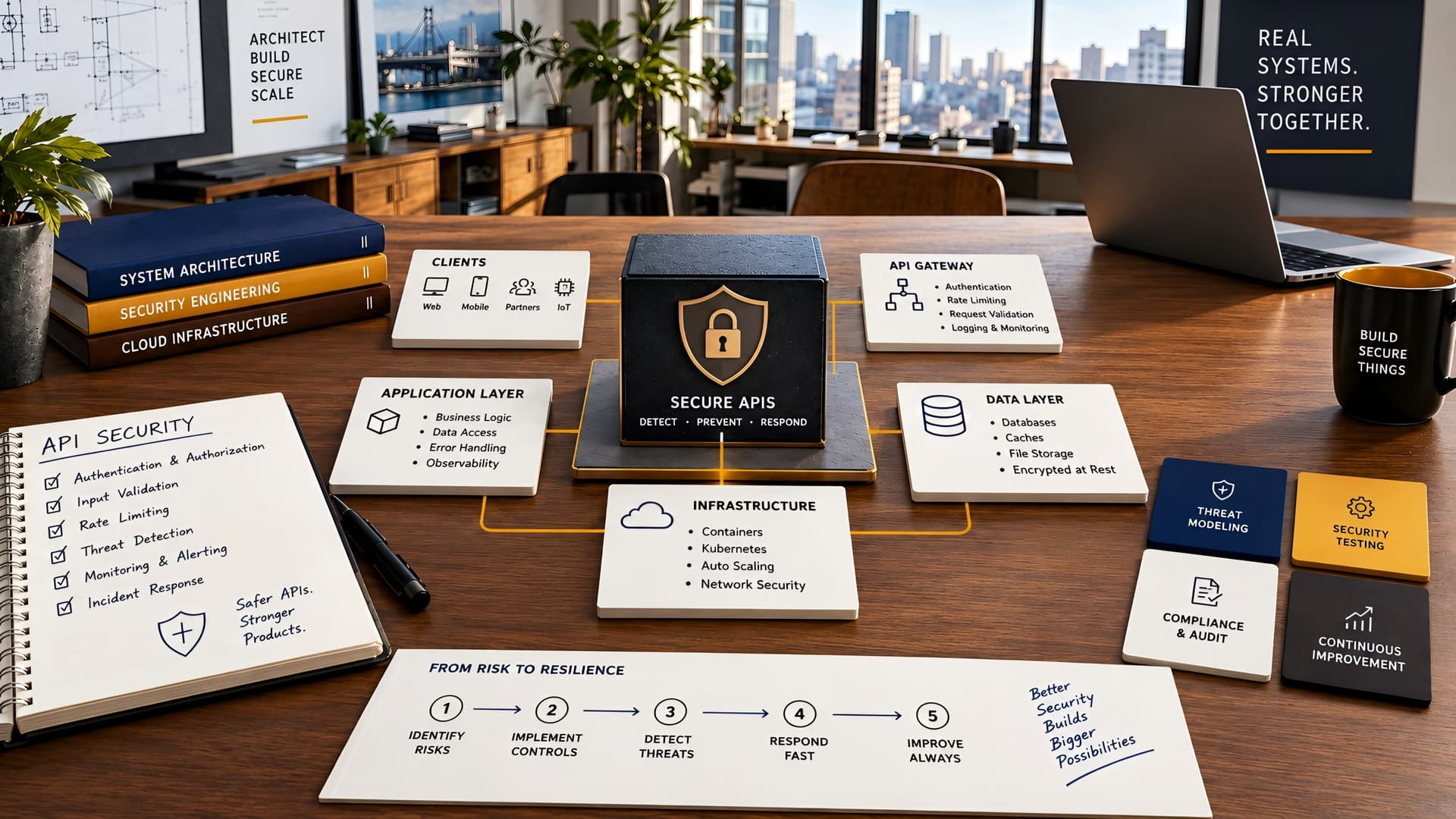
APIs are the backbone of modern web applications, connecting services, mobile apps, and third-party integrations. Yet, this interconnectedness makes them prime targets for cyberattacks, leading to data breaches, service disruptions, and severe reputational damage.
Securing your APIs isn't merely a technical task; it's a critical business imperative. A robust security posture protects sensitive data, ensures system resilience, helps comply with regulatory standards, and builds trust with users and partners.
Understanding the API Threat Landscape
Before we can build secure APIs, we must understand the vulnerabilities they face. Attackers constantly probe for weaknesses, ranging from simple misconfigurations to sophisticated injection attacks.
Common threats include injection flaws, broken authentication, sensitive data exposure, and insufficient rate limiting. Each of these can be exploited to gain unauthorized access, steal data, or disrupt services.
The Foundation: Robust Authentication and Authorization
Authentication verifies the identity of a user or service attempting to access an API. Authorization, on the other hand, determines what actions that verified identity is permitted to perform.
These two pillars form the absolute core of API security. Without them, any other security measure is largely ineffective.
Authentication Mechanisms
Choosing the right authentication method is crucial for balancing security with usability. Each option has its own strengths and ideal use cases.
At Muhyo Tech, we often evaluate factors like client type (browser, mobile, server-to-server), required security level, and integration complexity when recommending an approach.
API Keys
API keys are simple tokens used to identify the calling application or user. They are easy to implement and manage for public APIs or when rate limiting is the primary concern.
However, API keys offer limited security; they are typically static and can be easily compromised if leaked. They are best suited for non-sensitive data or public-facing APIs where the key itself isn't a secret.
OAuth 2.0 and OpenID Connect
OAuth 2.0 is an industry-standard protocol for authorization, allowing third-party applications to obtain limited access to an HTTP service. OpenID Connect (OIDC) builds on OAuth 2.0 to provide identity verification.
These protocols are ideal for consumer-facing applications, single sign-on (SSO), and delegating access securely. They involve multiple parties and flows (e.g., authorization code, client credentials), which can be complex but offer superior security and flexibility.
JSON Web Tokens (JWTs)
JWTs are compact, URL-safe means of representing claims to be transferred between two parties. They are often used with OAuth 2.0 or as a standalone token for stateless authentication.
While JWTs are excellent for stateless API architectures, their security relies heavily on proper signing and verification. Storing them securely on the client-side (e.g., HTTP-only cookies) is paramount to prevent XSS attacks.
Authorization Strategies
Once authenticated, an API needs to decide what resources a user or service can access and what operations they can perform.
Granular authorization prevents over-privileged access, a common vulnerability that attackers exploit.
Role-Based Access Control (RBAC)
RBAC assigns permissions to roles, and users are then assigned one or more roles. This simplifies management, especially in systems with many users and varying access levels.
For example, an 'admin' role might have full CRUD (Create, Read, Update, Delete) access, while a 'viewer' role only has read access. We often implement RBAC in admin dashboards and business applications.
Attribute-Based Access Control (ABAC)
ABAC grants permissions based on attributes of the user, resource, and environment. This offers much finer-grained control than RBAC, suitable for complex access policies.
An example might be allowing access to a document only if the user is in the 'marketing' department, the document's 'status' is 'draft', and the request originates from within the company network.
Input Validation and Data Sanitization
One of the most critical and often overlooked aspects of API security is rigorous input validation. APIs receive data from external sources, and without proper checks, this data can become a vector for attacks.
Every piece of data entering your API should be treated as untrusted until proven otherwise. This includes URL parameters, request headers, and especially the request body.
Preventing Injection Attacks
Injection attacks, such as SQL injection, NoSQL injection, and command injection, occur when untrusted data is sent to an interpreter as part of a command or query. Proper validation and parameterized queries are essential.
For example, never construct SQL queries by directly concatenating user input. Always use prepared statements or ORM frameworks that handle parameterization automatically.
Schema Validation
Define clear schemas for all API inputs and outputs using tools like OpenAPI (Swagger) specifications. Enforce these schemas at the API gateway or within your application logic.
This ensures that incoming data conforms to expected types, formats, and constraints, rejecting malformed requests early in the process.
Output Encoding
Just as important as validating input is encoding output. When displaying user-generated content or returning data that might be rendered in a browser, proper output encoding prevents Cross-Site Scripting (XSS) attacks.
Encode all data sent to clients, especially if it's going into HTML, JavaScript, or URL contexts. This neutralizes any malicious scripts that might have been injected.
Rate Limiting and Throttling
APIs are susceptible to various forms of abuse, including brute-force attacks, Denial of Service (DoS), and data scraping. Rate limiting and throttling are crucial defenses against these.
Rate limiting restricts the number of requests a user or IP address can make within a given timeframe. Throttling is a more general term for controlling the flow of requests.
Implementing Rate Limits
Consider implementing rate limits at multiple layers: at the API Gateway, within the application code, and even at the infrastructure level. This creates a layered defense.
Use HTTP status codes like 429 Too Many Requests to inform clients when they've exceeded limits. Provide clear headers (e.g., X-RateLimit-Limit, X-RateLimit-Remaining, X-RateLimit-Reset) to help clients manage their requests.
Choosing a Strategy
Different rate-limiting strategies exist, such as fixed window, sliding window, and token bucket. The choice depends on your specific needs for accuracy, resource usage, and traffic patterns.
For critical endpoints, more aggressive rate limits are appropriate. For less sensitive or read-heavy endpoints, higher limits might be acceptable.
API Gateway and Edge Security
An API Gateway acts as a single entry point for all API requests. It can offload many security concerns from your backend services, centralizing control and simplifying management.
Edge security, typically handled by Web Application Firewalls (WAFs) or CDN providers, provides another layer of defense against common web attacks.
Benefits of an API Gateway
- Centralized Authentication/Authorization: Handle token validation and basic access checks before requests reach your microservices.
- Rate Limiting: Implement global or per-API rate limits.
- Traffic Management: Routing, load balancing, and circuit breakers.
- Monitoring and Logging: Collect request data for security auditing and anomaly detection.
- Threat Protection: Basic WAF capabilities, IP whitelisting/blacklisting.
Web Application Firewalls (WAFs)
WAFs protect APIs and web applications from common web vulnerabilities like SQL injection, XSS, and broken authentication. They operate at the application layer (Layer 7) and can filter, monitor, and block malicious HTTP traffic.
Integrating a WAF provides an immediate layer of defense, especially against OWASP Top 10 vulnerabilities. While not a silver bullet, it significantly reduces the attack surface.
Secure Communication and Data Protection
Data transmitted over networks, whether in transit or at rest, must be protected from eavesdropping and tampering. Encryption is the cornerstone of this protection.
Neglecting data encryption is a critical oversight that can lead to severe data breaches.
HTTPS (TLS) Everywhere
All API communication must occur over HTTPS, using strong TLS (Transport Layer Security) protocols. This encrypts data in transit, preventing man-in-the-middle attacks and ensuring data integrity.
Always enforce strict HSTS (HTTP Strict Transport Security) policies to ensure browsers only connect via HTTPS, even after initial HTTP redirects.
Data Encryption at Rest
Sensitive data stored in databases, file systems, or object storage should be encrypted at rest. This protects data even if the underlying infrastructure is compromised.
Many cloud providers offer built-in encryption for storage services. For databases, consider column-level encryption for highly sensitive fields.
Vulnerability Management and Continuous Monitoring
Security is not a one-time setup; it's an ongoing process. APIs are constantly exposed to new threats, and vulnerabilities can emerge from new code, dependencies, or changing threat landscapes.
A proactive approach to vulnerability management and continuous monitoring is essential for maintaining a strong security posture.
Regular Security Audits and Penetration Testing
Conduct regular security audits, code reviews, and penetration testing by independent security experts. These exercises simulate real-world attacks and uncover vulnerabilities that automated tools might miss.
Treat findings from these tests with urgency and integrate remediation into your development cycles. This is a standard practice we emphasize at Muhyo Tech for all our full-stack web app development projects.
Static and Dynamic Application Security Testing (SAST/DAST)
Integrate SAST and DAST tools into your CI/CD pipeline. SAST analyzes source code for vulnerabilities without executing it, while DAST tests the running application from the outside.
These automated tools help catch common vulnerabilities early in the development process, reducing the cost and effort of remediation later on.
Logging, Monitoring, and Alerting
Comprehensive logging of API requests, responses, and security events is crucial. Monitor these logs for suspicious patterns, unusual traffic volumes, or failed authentication attempts.
Set up alerts for critical security events to ensure rapid response. Tools like SIEM (Security Information and Event Management) systems can aggregate logs and detect anomalies across your infrastructure.
Common API Security Mistakes to Avoid
Even with good intentions, developers and architects can fall into common traps that compromise API security. Awareness is the first step to prevention.
Avoiding these pitfalls saves significant time and prevents costly breaches down the line.
- Over-privileged API Keys: Granting an API key access to more resources than it needs. Always apply the principle of least privilege.
- Ignoring Input Validation: Trusting client-side validation alone or not validating all input types, leading to injection flaws.
- Sensitive Data in URLs: Passing sensitive information like API keys or user IDs directly in URL query parameters, which can be logged or cached.
- Weak Error Messages: Revealing too much information in error messages (e.g., stack traces, database errors) that attackers can use to map your system.
- Lack of Rate Limiting: Exposing APIs to brute-force attacks or DoS without proper request throttling.
- Outdated Dependencies: Failing to regularly update libraries and frameworks, leaving known vulnerabilities unpatched.
- Broken Object Level Authorization: Allowing a user to access an object they shouldn't have access to by simply changing an ID in the request.
Building Security into Your Development Lifecycle
Security should not be an afterthought or a separate phase at the end of development. It must be integrated into every stage of the software development lifecycle (SDLC).
This "shift-left" approach ensures that security considerations are embedded from design to deployment, reducing vulnerabilities and improving overall system resilience.
Security by Design
Start with security requirements during the API design phase. Threat modeling, where potential threats and vulnerabilities are identified and mitigated early, is a powerful technique.
Consider the data flows, trust boundaries, and potential attack surfaces before writing any code. This proactive stance is far more effective than trying to patch vulnerabilities later.
Secure Coding Practices
Educate developers on secure coding practices, including defensive programming, proper error handling, and secure configuration management. Provide clear guidelines and code examples.
Regular training and awareness programs are vital to keep security top of mind for the entire development team.
The Business Value of a Secure API Strategy
Investing in API security offers tangible business benefits beyond merely avoiding breaches. It builds a foundation for long-term growth and operational stability.
Secure APIs lead to greater customer trust, reduced operational risk, and a stronger competitive edge.
| Business Benefit | How API Security Delivers |
|---|---|
| Enhanced Customer Trust | Demonstrates commitment to protecting user data, fostering loyalty and confidence. |
| Reduced Financial & Reputational Risk | Prevents costly data breaches, fines, legal liabilities, and damage to brand image. |
| Operational Resilience | Protects against service disruptions and DoS attacks, ensuring business continuity. |
| Compliance & Regulatory Adherence | Helps meet standards like GDPR, HIPAA, and PCI DSS, avoiding penalties. |
| Faster Innovation & Integration | Confidently build new features and integrate with partners, knowing your core is secure. |
At Muhyo Tech, we understand that strong security underpins reliability and scalability. Our approach to API integration always prioritizes these robust security practices, ensuring that the systems we build are not just functional but also resilient against the evolving threat landscape.
Frequently Asked Questions
What is the most critical aspect of API security?
While all aspects are important, robust authentication and authorization are arguably the most critical. If an attacker can bypass identity verification or gain unauthorized access, other defenses can become irrelevant.
How often should APIs be audited for security?
APIs should undergo security audits and penetration testing at least annually, or more frequently if significant changes are made. Continuous integration of SAST/DAST tools and regular code reviews are also essential for ongoing vigilance.
Can an API Gateway replace application-level security?
No, an API Gateway provides a crucial layer of edge security and can centralize common security tasks. However, it cannot replace application-level validation, authorization logic, or secure coding practices within your backend services. A layered security approach is always best.
What is the OWASP API Security Top 10?
The OWASP API Security Top 10 is a list of the most critical security risks to APIs, compiled by the Open Web Application Security Project. It serves as a foundational guide for developers and security professionals to identify and mitigate common API vulnerabilities. Regularly referencing this list helps maintain a strong security posture.
Conclusion
Securing your APIs is a multifaceted challenge that demands continuous attention and a proactive engineering mindset. From strong authentication and authorization to meticulous input validation, rate limiting, and ongoing monitoring, each layer contributes to a resilient and trustworthy system.
By embedding security into every stage of your development lifecycle and staying vigilant against emerging threats, you not only protect your data and users but also build a foundation for reliable, scalable, and trusted digital services. This commitment to robust security is a hallmark of the engineering standards we uphold at Muhyo Tech, ensuring peace of mind for our partners.