


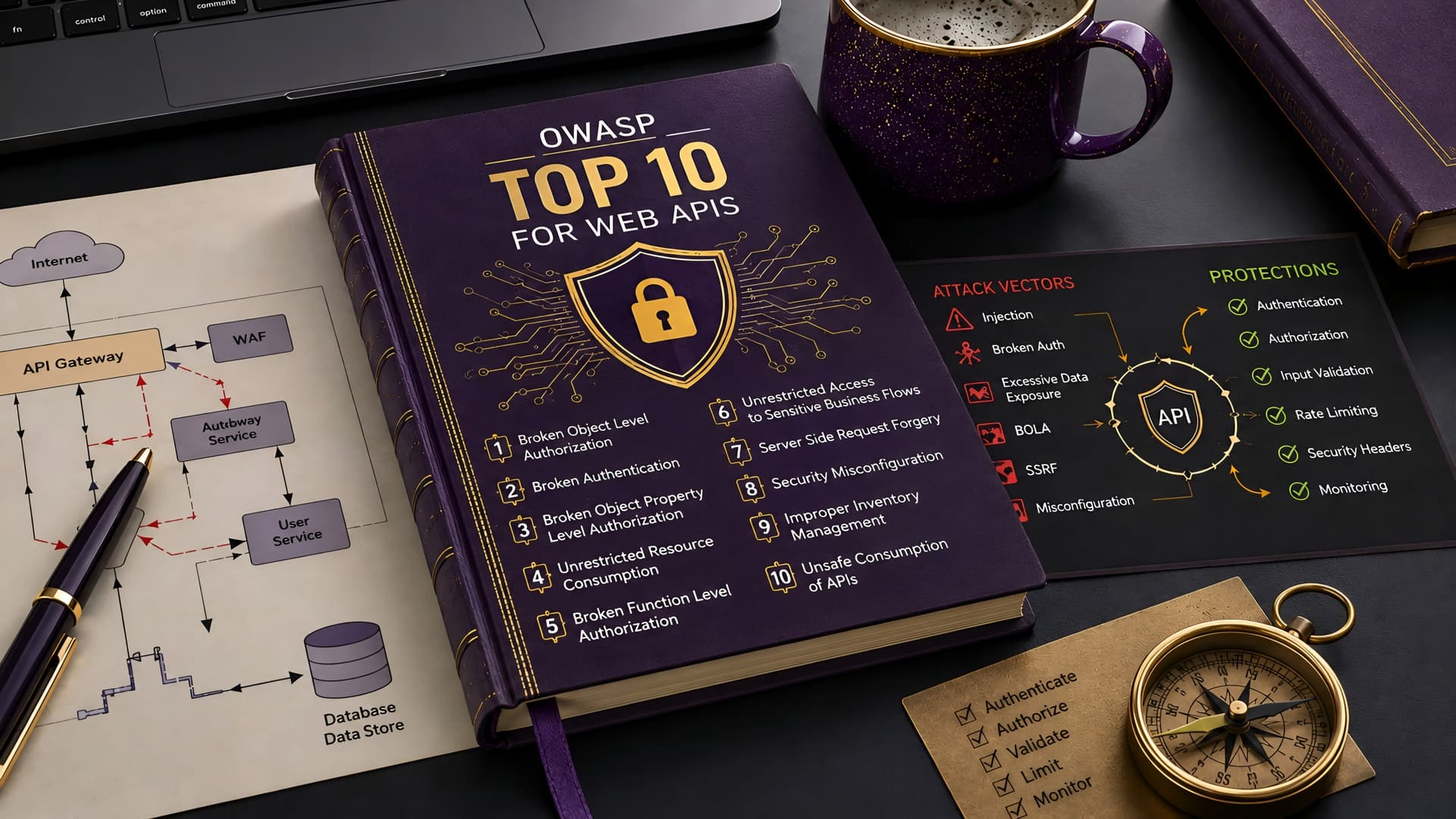
When building web applications, APIs are the backbone of almost every interaction. Yet, their exposure to the internet makes them prime targets for malicious actors. Ignoring common attack vectors is not an option in today's threat landscape.
Many developers, even experienced ones, can overlook critical security gaps, leading to vulnerabilities that are well-documented and easily exploitable. This is why understanding the OWASP API Security Top 10 is absolutely essential for anyone designing or maintaining APIs.
Understanding the OWASP API Security Top 10
The OWASP Foundation, a non-profit dedicated to improving software security, provides a crucial resource: the OWASP API Security Top 10. This list highlights the most critical security risks to web APIs, offering a clear roadmap for defense.
It's not just a theoretical exercise; these are the vulnerabilities we consistently see exploited in the wild. Our approach at Muhyo Tech always involves integrating these principles into our API security best practices from the initial design phase.
1. Broken Object Level Authorization (BOLA)
BOLA is often the most critical API vulnerability, allowing attackers to access or modify resources they shouldn't. This happens when an API endpoint does not properly validate if the authenticated user has permission to interact with a specific object ID.
Imagine a user changing an order ID in a URL to view or cancel someone else's order. To mitigate BOLA, every API call accessing an object must perform robust authorization checks against the user's permissions for that specific object.
2. Broken Authentication
Authentication mechanisms are the gates to your API. Weaknesses here can let attackers bypass authentication or assume the identity of other users. This includes weak passwords, insecure token generation, or flawed session management.
Implement strong, multi-factor authentication (MFA) whenever possible and ensure secure token handling. Regularly audit authentication flows and enforce strict password policies to prevent credential stuffing or brute-force attacks.
3. Broken Object Property Level Authorization
This vulnerability arises when an API allows users to infer or modify object properties that should be protected. An attacker might manipulate a request to add or change fields not intended for their role, like elevating their own privileges.
Always validate the request payload against an expected schema and filter out any unauthorized properties. Explicitly define which fields can be created, read, updated, or deleted by specific user roles at the API endpoint level.
4. Unrestricted Resource Consumption
APIs can be overwhelmed by requests designed to consume excessive resources, leading to denial of service (DoS) or performance degradation. This could involve large file uploads, complex queries, or an uncontrolled number of requests.
Implement rate limiting to restrict the number of requests a client can make within a time window. Set maximum limits for request body size, query complexity, and the number of records returned in a single response to prevent resource exhaustion.
5. Broken Function Level Authorization
Similar to BOLA, this vulnerability occurs when an API fails to enforce proper authorization for different user roles or groups accessing specific functions. An ordinary user might gain access to administrative functions simply by discovering the endpoint.
Design your API with a clear hierarchy of roles and permissions, and enforce these checks at every function call. Use a centralized authorization module that validates user roles against the requested API endpoint and method.
6. Unrestricted Access to Sensitive Business Flows
Attackers can exploit business logic flaws when critical workflows lack sufficient protection. This could involve repeatedly making requests to a 'forgot password' endpoint to harvest usernames, or automating purchases without proper checks.
Protect sensitive business flows with anti-automation mechanisms like CAPTCHAs, transaction limits, and behavioral analysis. Ensure that multi-step processes are treated as atomic transactions with state validation at each step.
7. Server Side Request Forgery (SSRF)
SSRF vulnerabilities occur when an API fetches a remote resource without validating the user-supplied URL. An attacker can trick the server into making requests to internal networks or other services, potentially exposing sensitive data.
Always validate and sanitize all user-supplied URLs to ensure they point to expected domains and protocols. Use allowlists for permitted domains and block access to internal IP ranges to prevent the server from accessing unintended resources.
8. Security Misconfiguration
This category covers a broad range of security oversights due to improper configuration. Default settings, exposed error messages, outdated software, or misconfigured cloud storage buckets all fall under this umbrella.
Regularly review and harden all security configurations across your entire stack, from servers to API gateways. Disable verbose error messages in production and ensure all components are kept up-to-date with security patches.
9. Improper Inventory Management
Managing API versions, deprecated endpoints, and documentation is critical. Outdated or shadow APIs can become forgotten attack vectors. An attacker might find an old, unpatched version of an API still running and exploit it.
Maintain a comprehensive inventory of all API endpoints and versions. Securely deprecate and remove old APIs, ensuring no forgotten entry points remain active. Provide accurate and up-to-date API documentation to developers and consumers.
10. Unsafe Consumption of APIs
This often overlooked vulnerability focuses on how your API consumes other APIs or third-party services. If your API relies on external services that are insecure, it can inherit their weaknesses, creating a chain of vulnerability.
Thoroughly vet all third-party APIs and services your application consumes for their security posture. Implement robust input validation, output encoding, and error handling for all data received from external sources, treating it as untrusted.
Implementing Robust API Security at Muhyo Tech
At Muhyo Tech, these OWASP guidelines form the bedrock of our API development standards. We emphasize a 'security-by-design' approach, integrating these considerations from the initial architectural discussions.
This proactive stance helps our clients launch more secure web applications with stronger reliability. It minimizes the risk of costly breaches and ensures their digital services remain trustworthy and resilient. For us, secure API API integration and full-stack web app development isn't just a feature; it's a fundamental commitment.
Continuous Vigilance and Evolution
API security is not a one-time task; it's an ongoing process. The threat landscape is constantly evolving, and so too must our defenses. Regularly review your APIs against the latest OWASP guidance and conduct penetration testing.
By understanding and actively mitigating the OWASP API Security Top 10, developers can significantly reduce their attack surface. This commitment to security translates directly into more stable, reliable, and trustworthy web applications for everyone involved.