


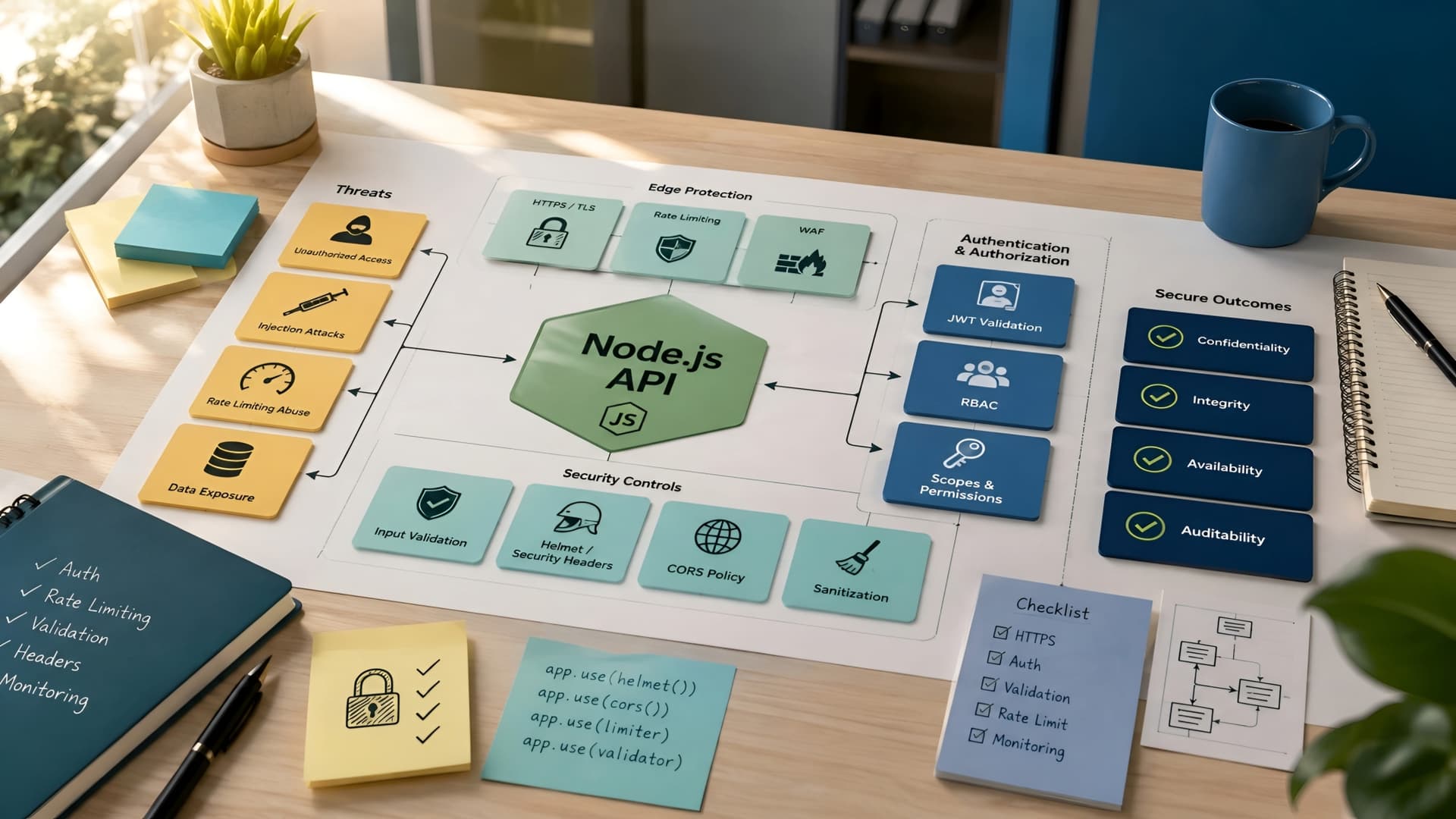
Building a robust API is only half the battle; securing it is the other, often more challenging, half. Many development teams, focused on features and functionality, can inadvertently leave critical vulnerabilities open.
At Muhyo Tech, we’ve learned that a proactive approach to Node.js API security prevents headaches, data breaches, and a loss of user trust down the line. It's about building resilience from the ground up.
The Core Problem: Exposed Endpoints and Common Attack Vectors
Node.js APIs power everything from mobile backends to complex web applications. This broad exposure means they become prime targets for various attacks, often falling into categories defined by OWASP Top 10.
Common issues include SQL injection, broken authentication, excessive data exposure, and insecure deserialization. Each of these can lead to unauthorized access, data manipulation, or system compromise if not properly addressed.
Securing Node.js applications demands a multi-layered defense. For a broader perspective on overall application hardening, consider our comprehensive guide on Fortifying Your Node.js Applications: An Engineering Guide to Web Security Best Practices.
Implementing Robust Authentication and Authorization
The first line of defense for any API is controlling who can access what. This involves both authentication (verifying identity) and authorization (determining permissions).
We often rely on industry-standard solutions like JSON Web Tokens (JWTs) for stateless authentication. JWTs allow clients to prove their identity with each request without needing server-side session storage, which improves scalability.
JWTs and Refresh Tokens
When implementing JWTs, short-lived access tokens are crucial. These tokens minimize the window of opportunity for attackers if a token is compromised.
Alongside access tokens, we use longer-lived refresh tokens, securely stored and used only to request new access tokens. This two-token strategy enhances security without sacrificing user experience.
OAuth 2.0 for Third-Party Access
For scenarios involving third-party applications, OAuth 2.0 is the go-to protocol. It enables delegated authorization, allowing users to grant limited access to their resources without sharing their credentials directly.
Understanding OAuth flows like Authorization Code Grant or Client Credentials Grant is vital for secure integration. We design these flows carefully to match the application's specific security requirements.
Input Validation and Sanitization: Preventing Injection Attacks
Untrusted input is a primary vector for injection attacks, whether it's SQL, NoSQL, or command injection. Every piece of data received from a client must be treated with suspicion.
Strict input validation ensures that data conforms to expected formats and types. Sanitization then removes or escapes potentially malicious characters before the data is processed or stored.
Using Validation Libraries
Libraries like Joi or express-validator for Node.js provide powerful schema-based validation. They allow us to define precise rules for request bodies, query parameters, and headers.
This systematic approach catches malformed or malicious input early, long before it can interact with the database or file system. It's a fundamental step in our secure coding practices.
Rate Limiting and Throttling: Combating Brute Force and DoS
APIs are susceptible to brute-force attacks on login endpoints and denial-of-service (DoS) attempts that overwhelm server resources. Rate limiting is an essential defense mechanism.
By restricting the number of requests a user or IP address can make within a given timeframe, we mitigate these risks. This ensures fair usage and protects the API from abuse.
Implementing with Middleware
Middleware like express-rate-limit can be easily integrated into Node.js applications. We configure it to apply different limits based on endpoint sensitivity, for example, stricter limits on authentication routes.
This proactive measure helps maintain API availability and performance, preventing costly downtime. It's about building resilient systems that can withstand unexpected load.
Secure Header Configuration: Hardening the HTTP Layer
HTTP headers often contain metadata that, if not properly configured, can expose vulnerabilities. Setting appropriate security headers adds another layer of protection.
Headers like Content-Security-Policy (CSP), X-Frame-Options, X-Content-Type-Options, and Strict-Transport-Security (HSTS) are critical. They help prevent common attacks like XSS, clickjacking, and insecure communication.
CSP and HSTS
A strong CSP can significantly reduce the risk of cross-site scripting (XSS) attacks by specifying which dynamic resources are allowed to load. HSTS enforces secure (HTTPS) connections, preventing downgrade attacks.
At Muhyo Tech, configuring these headers is a standard part of our deployment checklist. It ensures that the browser itself helps enforce security policies, reducing client-side attack surface.
Logging, Monitoring, and Alerting: Early Detection is Key
Even with robust preventative measures, no system is entirely immune to attacks. Comprehensive logging and monitoring are crucial for detecting and responding to security incidents quickly.
Detailed logs of API requests, authentication attempts, and errors provide forensic data. Monitoring tools can then analyze these logs for suspicious patterns or anomalies.
Setting Up Alerts
When unusual activity is detected, automated alerts notify the operations team immediately. This allows for swift investigation and mitigation, minimizing potential damage.
Our approach involves integrating logging with centralized systems and configuring alerts for key security events. This proactive detection capability is vital for maintaining API integrity and trust.
The Business Value of a Secure API
Investing in Node.js API security isn't just about preventing breaches; it delivers tangible business value. A secure API leads to stronger reliability, preventing costly downtime and maintaining customer trust.
It also reduces long-term maintenance risk by building a stable foundation. Founders and business owners benefit from knowing their data and operations are protected, allowing them to focus on growth without constant security worries.
Our Approach to API Security
At Muhyo Tech, we integrate these security practices throughout the entire development lifecycle. From initial architecture design to deployment and ongoing maintenance, security is a continuous consideration.
We believe that a well-secured API is a cornerstone of any successful digital product, whether it's a modern web application or a specialized AI-driven service. It safeguards your business and its users, enabling confident innovation.