


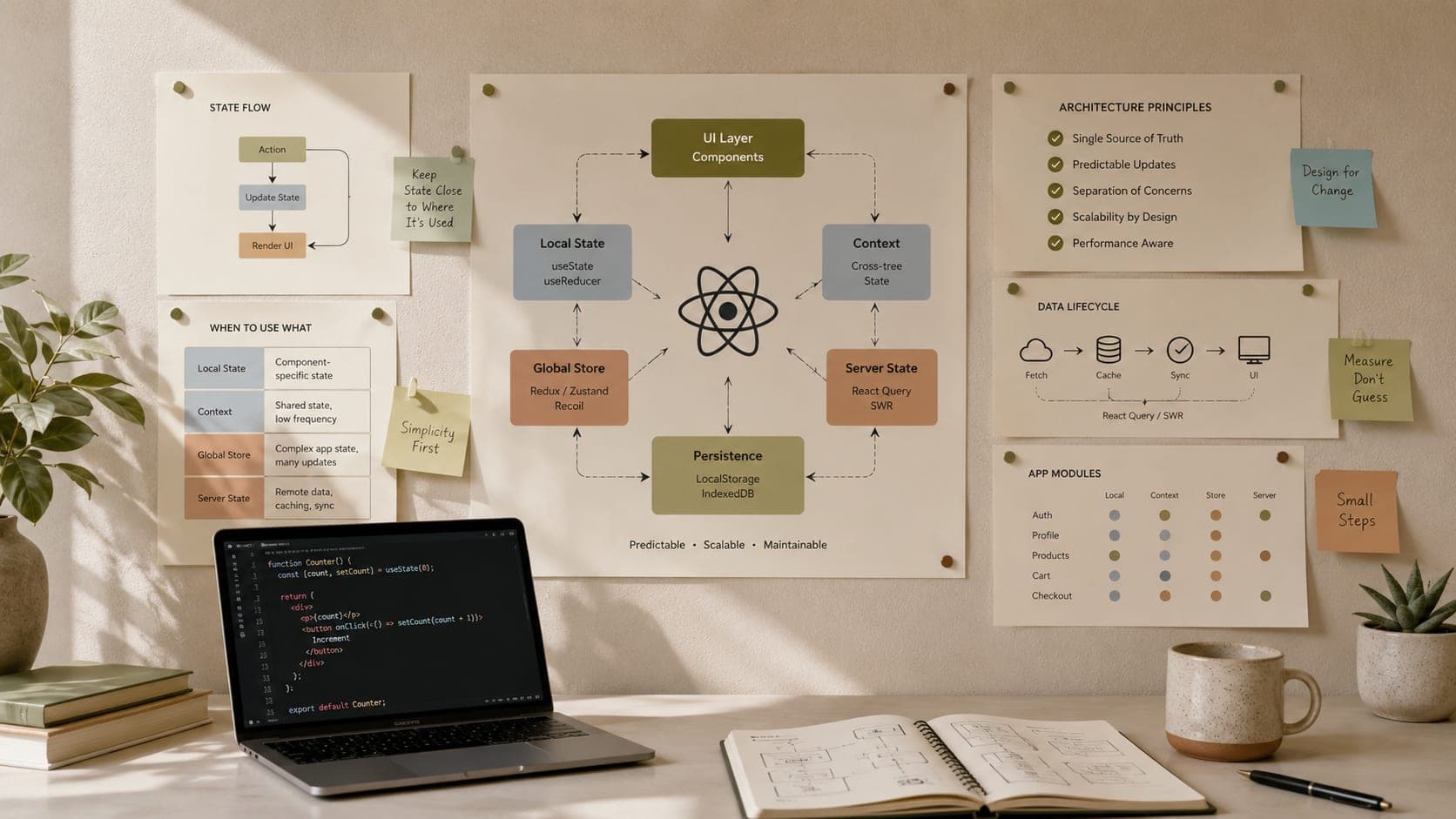
Building a robust React application often feels like orchestrating a complex symphony. Data flows through components, user interactions trigger updates, and suddenly, what seemed simple becomes a tangled mess of props and callbacks.
This 'prop drilling' and inconsistent data across an application are common pains we see, leading to frustrating bugs and sluggish performance. Effective React state management isn't just a technical detail; it's a foundational pillar for maintainable, scalable web applications.
The Core Problem: Unmanaged State in Growing Applications
Imagine a scenario where your e-commerce site grows from a few pages to hundreds, with complex shopping carts, user profiles, and real-time inventory updates. Without a clear strategy, components start managing their own versions of truth, leading to desynchronized data and unpredictable behavior.
Developers spend more time debugging state inconsistencies than building new features. This overhead directly impacts project timelines, introduces technical debt, and ultimately undermines the reliability of the application, affecting user trust and business operations.
What is React State Management and Why Does It Matter?
React state management refers to the organized way data is stored, updated, and accessed across different components in a React application. It’s about creating a predictable flow of information, ensuring every part of your UI reflects the current, correct data.
For us at Muhyo Tech, a solid state management strategy is critical for building web apps that are not just functional but also resilient and easy to evolve. It allows our teams to collaborate effectively, reduce bugs, and deliver features faster, which translates directly to business value.
The Impact on Performance and User Experience
Poor state management can trigger unnecessary re-renders, slowing down your application. When state updates are chaotic, the browser works harder than it needs to, leading to a choppy user experience.
A well-architected state layer minimizes these re-renders, keeping your application snappy and responsive. This focus on performance is something we prioritize in our website speed optimization efforts, ensuring a smooth journey for every user.
Understanding Local vs. Global State
Before diving into specific solutions, it's essential to distinguish between local and global state. This distinction guides which tools you'll need.
Local Component State (useState and useReducer)
Local state is data managed within a single component, typically using React's useState or useReducer hooks. It's ideal for UI-specific concerns like form input values, modal visibility, or toggle states that don't need to be shared widely.
These hooks are simple, built-in, and perfectly sufficient for most isolated component logic. Over-engineering local state into a global solution is a common pitfall that adds unnecessary complexity.
Global Application State
Global state, on the other hand, is data that needs to be accessed or modified by multiple, often unrelated, components across your application. Examples include authenticated user data, shopping cart contents, theme settings, or fetched data that populates several parts of the UI.
Managing global state effectively prevents prop drilling and centralizes data, making it easier to reason about your application's overall data flow. This is where dedicated state management patterns and libraries truly shine.
React's Built-in Solution: Context API
The Context API provides a way to pass data deeply through the component tree without manually passing props at every level. It's React's answer to global state for moderate complexity.
Context provides a way to share values like these between components without having to explicitly pass a prop through every level of the tree.
— React Documentation
How Context API Works
You create a Context object using React.createContext(), then use a Provider component to wrap the part of your component tree that needs access to the context's value. Any descendant component can then consume this value using the useContext hook.
This approach simplifies prop management for global data. We often use Context for things like theme settings or user authentication status, where updates are less frequent and performance isn't hyper-critical.
Pros and Cons of Context API
- Pros: Built-in to React, easy to understand for simpler global state, avoids prop drilling.
- Cons: Can lead to performance issues with frequent updates if not optimized (e.g., by splitting contexts), re-renders all consumers on every provider value change, less tooling for debugging compared to libraries like Redux.
External Libraries for Advanced State Management
When Context API reaches its limits, especially in large-scale applications with frequent, complex state interactions, external libraries offer more robust solutions. We evaluate these based on project needs, team familiarity, and long-term maintainability.
Redux: The Established Heavyweight
Redux is a predictable state container for JavaScript apps. It enforces a strict unidirectional data flow, making state changes explicit and debuggable. It's often paired with React via the react-redux library.
Redux excels in large applications requiring centralized, consistent state management, complex async operations, and extensive debugging capabilities. Its ecosystem, including Redux Toolkit, simplifies much of the previous boilerplate.
Key Redux Concepts
- Store: Holds the entire application state.
- Actions: Plain JavaScript objects describing what happened.
- Reducers: Pure functions that take the current state and an action, and return a new state.
- Dispatch: The method used to send actions to the store.
- Selectors: Functions used to extract specific pieces of state from the store.
Zustand: The Minimalist Contender
Zustand is a small, fast, and scalable state management solution using a simplified API based on React hooks. It's designed to be unopinionated and boilerplate-free, making it very appealing for many projects.
Its minimal setup and direct hook-based approach often make it our go-to for projects that need global state but don't require the full complexity of Redux. It's particularly effective for full-stack web app development where quick iterations are key.
Why Zustand is Gaining Traction
- Simplicity: Very little boilerplate, easy to learn.
- Performance: Only re-renders components that actually use the updated state.
- Flexibility: Works well with async operations and doesn't impose strict patterns.
- Small Bundle Size: Adds very little to your application's total size.
Jotai: Primitive and Atomic State
Jotai is another minimalist state management library that focuses on atomic state. It provides a flexible and performant way to manage state by allowing you to define small, independent pieces of state (atoms) that can be combined and derived.
This approach is powerful for fine-grained control over re-renders and complex derived state. We consider Jotai for highly optimized applications where precise control over component updates is paramount.
Jotai's Atomic Philosophy
- Atoms: Fundamental units of state.
- Selectors: Functions to derive state from other atoms.
- Performance: Only components subscribed to an atom re-render when that atom changes.
- Composability: Atoms can easily be combined to form more complex state.
Custom Hooks for Reusable State Logic
Beyond dedicated libraries, React's custom hooks provide an elegant way to encapsulate and reuse stateful logic. While not a global state solution in themselves, they can abstract away complex local state or even integrate with Context for more targeted global state needs.
We often use custom hooks to manage form logic, data fetching with caching, or UI interactions like modals and dropdowns. This keeps our components lean and focused on rendering, while the logic lives in a reusable, testable hook.
Choosing the Right State Management Strategy: A Decision Framework
Selecting the best approach for React state management isn't a one-size-fits-all decision. It depends heavily on your project's scale, complexity, team size, and performance requirements.
At Muhyo Tech, we apply a pragmatic framework to make these choices. It helps us balance developer experience with long-term application health, crucial for our Next.js website development projects.
Key Considerations
- Application Size and Complexity: Small apps might only need
useStateand Context. Large, enterprise-level apps often benefit from Redux or Zustand. - Team Experience: A team familiar with Redux might prefer it, even if a simpler solution could work. Learning curves impact project velocity.
- Frequency and Complexity of State Updates: High-frequency, interdependent updates often point towards more structured solutions like Redux or Jotai for performance.
- Debugging Needs: Redux DevTools offer unparalleled debugging capabilities. Other libraries rely more on standard React DevTools.
- Bundle Size: Minimalist libraries like Zustand and Jotai add less to your application's bundle size than Redux.
- Asynchronous Operations: How well does the solution handle data fetching, debouncing, and other side effects? Redux has middleware (Thunks, Sagas), while others integrate seamlessly with
async/await.
Comparison Table: React State Management Options
| Feature | useState/useReducer | Context API | Redux (with Toolkit) | Zustand | Jotai |
|---|---|---|---|---|---|
| Learning Curve | Very Low | Low | Moderate-High | Low | Low |
| Boilerplate | Minimal | Low-Moderate | Moderate (reduced with RTK) | Minimal | Minimal |
| Global State? | No (Local Only) | Yes (Simple) | Yes (Complex) | Yes (Flexible) | Yes (Atomic) |
| Performance Control | Manual | Limited (re-renders all consumers) | Good (Selectors) | Excellent (fine-grained) | Excellent (atomic updates) |
| Debugging Tools | React DevTools | React DevTools | Redux DevTools (powerful) | React DevTools | React DevTools |
| Bundle Size | N/A (built-in) | N/A (built-in) | Larger | Small | Small |
| Use Cases | Local component state | Theming, auth, simple global state | Large-scale apps, complex async | Medium-large apps, less boilerplate | Fine-grained updates, derived state |
Common Pitfalls and Best Practices
Even with the right tools, missteps in state management can lead to problems. We've learned a few key lessons over many projects.
Common Mistakes to Avoid
- Over-globalizing State: Not every piece of data needs to be global. Use local state where appropriate to keep your application simpler.
- Prop Drilling When Unnecessary: If you find yourself passing props through many layers of components, it's a sign to consider Context or a global state library.
- Ignoring Performance: Frequent, unoptimized state updates can severely degrade performance. Profile your application and use memoization or selectors effectively.
- Inconsistent Naming Conventions: Clear, consistent naming for actions, reducers, and state slices is crucial for maintainability, especially in larger teams.
Best Practices for Robust State Management
- Start Simple: Begin with
useStateanduseReducer. Introduce Context API for simple global needs. Only bring in libraries like Zustand, Jotai, or Redux when complexity genuinely demands it. - Colocate State: Keep state as close as possible to the components that use it.
- Isolate Side Effects: Handle data fetching and other asynchronous operations outside of your components where possible, often in custom hooks or dedicated services.
- Use Selectors: With Redux or similar patterns, use selectors to derive data and prevent unnecessary re-renders.
- Test Your State Logic: Ensure your state updates behave as expected under various scenarios. This improves reliability and reduces bugs.
- Embrace Immutability: Always return new state objects or arrays instead of mutating existing ones. This is fundamental to React's rendering model and prevents subtle bugs.
Connecting State Management to Business Value
While state management might seem like a purely technical concern, its impact on business outcomes is significant. A well-managed state layer directly contributes to the overall success of a digital product.
For our clients, this translates into faster feature delivery because developers spend less time untangling spaghetti code. It means fewer bugs in production, leading to higher user satisfaction and less operational stress. It also provides a clear path for future scaling, ensuring the application can grow with the business without needing a costly rewrite.
The Muhyo Tech Approach to State Management
At Muhyo Tech, we don't prescribe a single state management solution. Instead, we analyze the specific needs of each project, focusing on the long-term maintainability, performance goals, and the team's existing skill set. We often start with React's built-in tools, then progressively introduce more specialized libraries as complexity warrants.
Our goal is always to build scalable, reliable web applications that deliver tangible value. By making informed decisions about React state management, we ensure the underlying architecture supports robust full-stack web app development and a smooth user experience, from the smallest portfolio site to complex enterprise platforms.
Frequently Asked Questions About React State Management
Q: When should I move from Context API to Redux?
A: Consider Redux when your application's global state becomes highly complex, with frequent interdependent updates, numerous asynchronous actions, and a strong need for predictable state changes and extensive debugging tools. Context is great for simpler, less frequently updated global data like themes or user authentication.
Q: Can I use multiple state management libraries in one React app?
A: Yes, it's perfectly acceptable to use a combination. For example, you might use Redux for core application state, Context for themes, and Zustand for specific feature-level global state. The key is to justify each choice and avoid unnecessary complexity.
Q: How does state management affect application performance?
A: Poor state management can lead to excessive re-renders, causing performance bottlenecks. Efficient state management, through techniques like memoization, selectors, and atomic updates (as in Jotai), minimizes re-renders and keeps your application fast and responsive.
Final Thoughts: A Foundation for Future Growth
Mastering React state management is a continuous journey. As applications evolve and grow, so too must your approach to managing their data. By understanding the available tools—from React's built-in hooks and Context API to powerful libraries like Redux, Zustand, and Jotai—you can make informed decisions that lay a strong foundation for your application's future.
Remember, the best solution is the one that fits your project's unique demands, enables your team to build efficiently, and ensures your application remains performant, maintainable, and scalable for years to come. This careful architectural planning is a hallmark of our engineering philosophy at Muhyo Tech.