


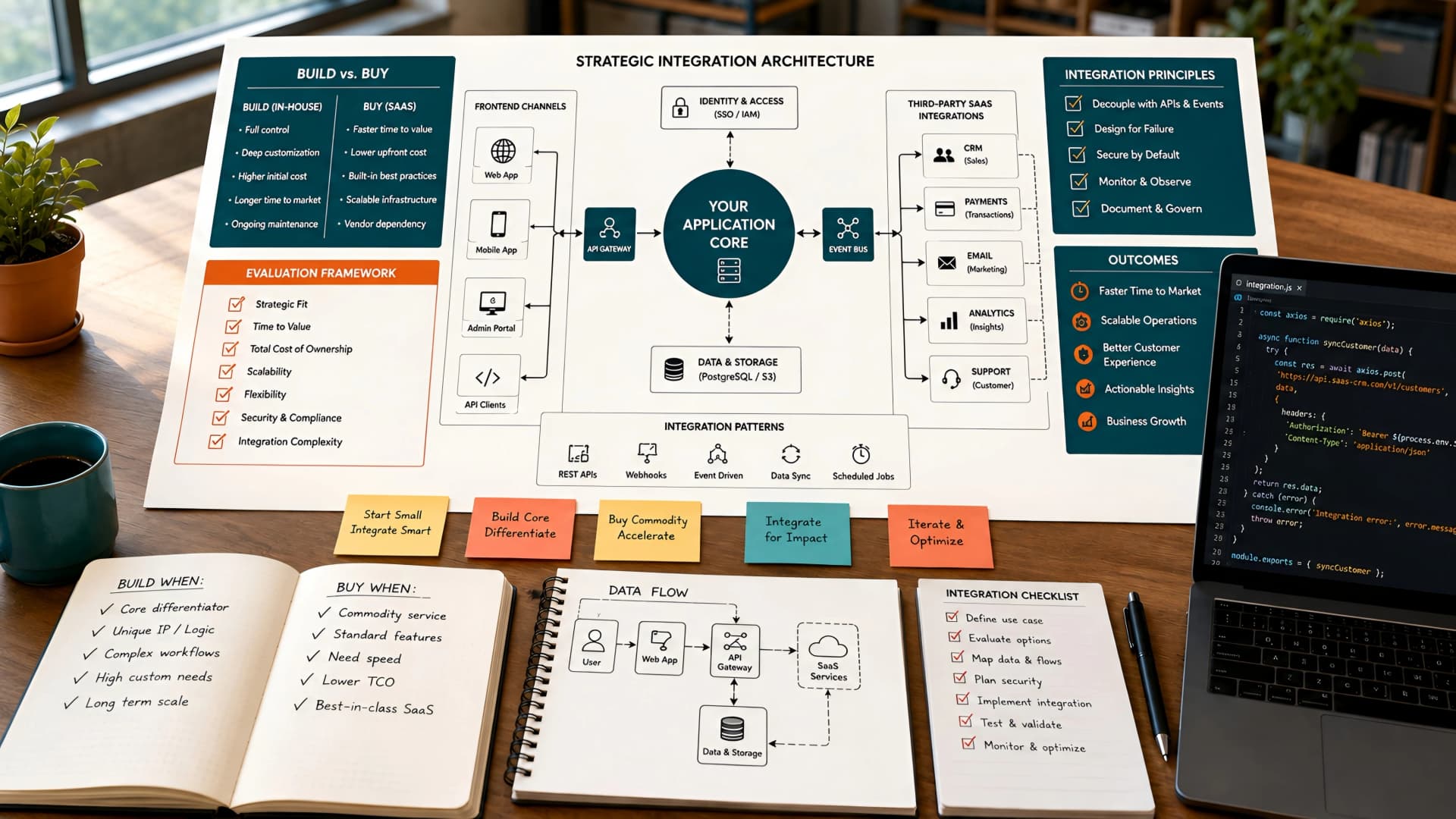
Every SaaS founder eventually confronts the 'build vs. buy' dilemma for core product functionalities. Do you dedicate precious engineering cycles to build a feature from scratch, or do you license an existing solution?
While valid, this binary choice often overlooks a powerful third path: strategically engineering integrations with best-of-breed third-party services. This approach accelerates feature delivery and product value without incurring the full costs or long-term maintenance burden of a complete build or the rigidity of a full buy-in.
The Strategic Imperative of SaaS Integrations
Modern SaaS products rarely exist in a vacuum. They thrive within an ecosystem, often needing to connect with payment gateways, CRM systems, analytics platforms, communication tools, or identity providers.
These integrations aren't just about linking systems; they're about extending your product's capabilities, reducing time-to-market for new features, and providing a seamless, integrated experience for your users. Ignoring this reality can lead to feature stagnation or bloated internal development.
Identifying Integration Opportunities: Beyond Obvious Needs
Before any code is written, a clear strategic assessment is essential. We look beyond immediate feature gaps to understand customer workflows, market trends, and long-term product vision.
This means asking: What pain points do our customers experience that a third-party service could alleviate? What critical data flows are needed to unlock new value? How can we enhance our core offering without diluting our focus?
The 'Why' Behind Each Integration
Every integration should serve a clear purpose, tied directly to business value. Is it to reduce operational costs, improve user experience, expand market reach, or enhance data insights?
Without a strong 'why,' an integration can quickly become technical debt, consuming resources without delivering proportional returns. We aim for integrations that either solve a known customer pain or unlock significant new product capabilities.
A Framework for Strategic Integration Decisions
At Muhyo Tech, our approach to SaaS integrations follows a structured framework. This helps product teams and engineers navigate the complexities and make informed decisions.
We evaluate potential integrations across several key dimensions, balancing immediate gains with long-term architectural health.
1. Functional Fit and User Experience
Does the third-party service truly solve the problem for our users? How seamlessly can its functionality be embedded into our product's UI and workflow?
A clunky, jarring integration can degrade the overall user experience, regardless of how powerful the underlying service is. We prioritize solutions that feel like a natural extension of our own application.
2. Technical Viability and API Robustness
This is where engineering due diligence truly shines. We examine the third-party API documentation for clarity, completeness, and consistency.
Key considerations include API rate limits, authentication mechanisms, data models, error handling, and webhooks for real-time updates. A poorly designed or unreliable API is a major red flag, indicating potential maintenance headaches down the line.
3. Security and Data Privacy
Integrating with external services means extending your security perimeter. We meticulously assess the vendor's security posture, compliance certifications (e.g., SOC 2, ISO 27001), and data handling policies.
Understanding how data is transmitted, stored, and processed by the third party is paramount to protecting user trust and ensuring regulatory compliance. Data minimization—only sharing what's absolutely necessary—is a core principle we advocate.
4. Scalability and Performance
Will the integration scale with our growth? We consider the performance implications under load, potential bottlenecks, and how the third-party service handles high request volumes.
It's crucial to understand their infrastructure, uptime guarantees, and disaster recovery plans. An integration that becomes a single point of failure or performance drain can severely impact your own product's reliability.
5. Cost-Benefit Analysis and Licensing Models
Beyond the direct monetary cost of the third-party service, we factor in engineering effort for integration, ongoing maintenance, and potential future migration costs. Licensing models (per-user, per-transaction, tiered) also need careful evaluation.
A seemingly inexpensive service might become costly at scale, or require significant engineering work to integrate properly. We always look at the total cost of ownership over a realistic timeframe.
6. Vendor Stability and Support
The longevity and responsiveness of the third-party vendor are critical. We assess their market position, funding, product roadmap, and the quality of their support channels.
A strong, stable vendor reduces the risk of an integration becoming obsolete or unsupported, forcing costly re-engineering efforts. Accessible and knowledgeable support is invaluable when issues arise.
Engineering Best Practices for Robust Integrations
Once a strategic decision is made, the engineering phase demands meticulous attention to detail. Our team follows several best practices to ensure integrations are not just functional, but also resilient and maintainable.
Loose Coupling and Abstraction Layers
We design integration points with loose coupling in mind. This means building an abstraction layer or an API gateway that insulates our core application from direct dependencies on the third-party service.
Should the third-party API change, or if we decide to switch vendors, only the abstraction layer needs modification, not the entire application. This significantly reduces maintenance overhead and future migration risk.
Idempotency and Error Handling
Network requests are inherently unreliable. We implement idempotent operations wherever possible, ensuring that repeated requests (due to retries, for example) do not lead to duplicate data or unintended side effects.
Robust error handling, including retries with exponential backoff, circuit breakers, and comprehensive logging, is crucial. This prevents transient issues with the third-party service from cascading into our own application's failures.
Monitoring and Alerting
Integrations are potential points of failure. We implement proactive monitoring for API response times, error rates, and key operational metrics of the integrated service.
Automated alerts notify our team immediately if an integration experiences issues, allowing for rapid diagnosis and resolution. This minimizes downtime and maintains a high level of service availability for our users.
Data Synchronization and Consistency
When data needs to flow between systems, ensuring consistency is paramount. We design clear strategies for data mapping, transformation, and conflict resolution.
This often involves message queues or event-driven architectures to handle asynchronous updates and ensure eventual consistency across all integrated systems. Thorough testing of these data flows is non-negotiable.
Common Pitfalls and How to Avoid Them
Even with a solid framework, integration projects can stumble. Recognizing common pitfalls helps us steer clear of them.
- Underestimating Maintenance: Integrations are not 'set and forget.' APIs evolve, credentials expire, and services have downtime. Budget for ongoing maintenance and monitoring.
- Ignoring Security Implications: Rushing security reviews or failing to implement proper access controls can expose sensitive data.
- Poor Documentation: Lack of internal documentation on how an integration works, its dependencies, and known quirks makes future debugging and handovers difficult.
- Vendor Lock-in: Becoming overly reliant on a single vendor for critical functionality without a clear exit strategy can be risky.
- Feature Creep: Trying to integrate every possible feature of a third-party service, rather than focusing on core value, adds unnecessary complexity.
The Business Value of Engineered Integrations
When executed strategically, well-engineered integrations deliver substantial business value beyond just technical elegance. They directly impact a SaaS product's market position and growth trajectory.
Accelerated Feature Delivery and Time-to-Market
By leveraging existing, proven functionalities from third-party services, product teams can bring new features to market significantly faster. This agility allows for quicker iteration and response to customer demands.
Instead of months of development, a new capability might be integrated in weeks, giving a competitive edge.
Reduced Development Costs and Resource Allocation
Building complex features like advanced analytics, sophisticated payment processing, or global SMS delivery from scratch is incredibly resource-intensive. Integrations allow teams to focus on their core product's unique value proposition.
This strategic allocation of engineering talent to differentiate your product, rather than re-inventing the wheel, is a powerful cost-saver.
Enhanced Product Ecosystem and Customer Stickiness
A product that seamlessly connects with other tools in a user's workflow becomes indispensable. Integrations create a richer, more comprehensive ecosystem around your SaaS offering.
This stickiness reduces churn, increases customer lifetime value, and can even attract new users who are already invested in the integrated tools.
Mitigated Risk and Improved Reliability
By relying on specialized, battle-tested third-party services, you often benefit from their dedicated expertise in areas like security, scalability, and compliance. This offloads significant risk from your own engineering team.
A well-chosen integration can offer higher reliability and better security than a hastily built in-house solution, especially for non-core functionalities.
The Muhyo Tech Approach: Partnership in Precision
At Muhyo Tech, we don't just write code; we partner with founders and product leaders to navigate these strategic decisions. Our engineering standards prioritize not just functionality, but also long-term maintainability, security, and scalability.
This means carefully evaluating integration partners, designing resilient architectures, and implementing robust monitoring, ensuring that every integration contributes positively to your product's growth and stability.
Conclusion: Integrations as a Core Growth Strategy
The 'build vs. buy' dilemma for SaaS features is often incomplete. Strategic integrations offer a potent third path, allowing SaaS companies to rapidly enhance their product, reduce costs, and strengthen their market position.
By applying a rigorous framework and adhering to engineering best practices, integrations transform from technical necessities into powerful drivers of product growth and customer satisfaction.
Frequently Asked Questions
Q: How do I decide if a feature should be integrated or built in-house?
A: Evaluate the feature's criticality to your core intellectual property, its complexity, and the availability of robust third-party solutions. If it's a generic, non-differentiating but essential function with a strong external vendor, integration is often preferred. If it's core to your unique value proposition, building it in-house gives you full control.
Q: What are the biggest risks of poor SaaS integration?
A: Poor integrations can lead to significant technical debt, security vulnerabilities, unreliable data, degraded user experience, and increased operational costs. They can also create vendor lock-in if not architected with flexibility in mind.
Q: How can I ensure an integration remains secure over time?
A: Regularly review vendor security practices, use least-privilege access for API keys, encrypt all sensitive data in transit and at rest, and implement robust logging and monitoring. Stay informed about security updates from the third-party vendor.
Q: Should I use an Integration Platform as a Service (iPaaS) or build custom integrations?
A: iPaaS solutions can accelerate simpler integrations, especially for non-technical users or standard data flows. For complex, deeply embedded, or highly customized integrations that are core to your product experience, building custom solutions with careful engineering oversight often provides greater control, flexibility, and performance.