


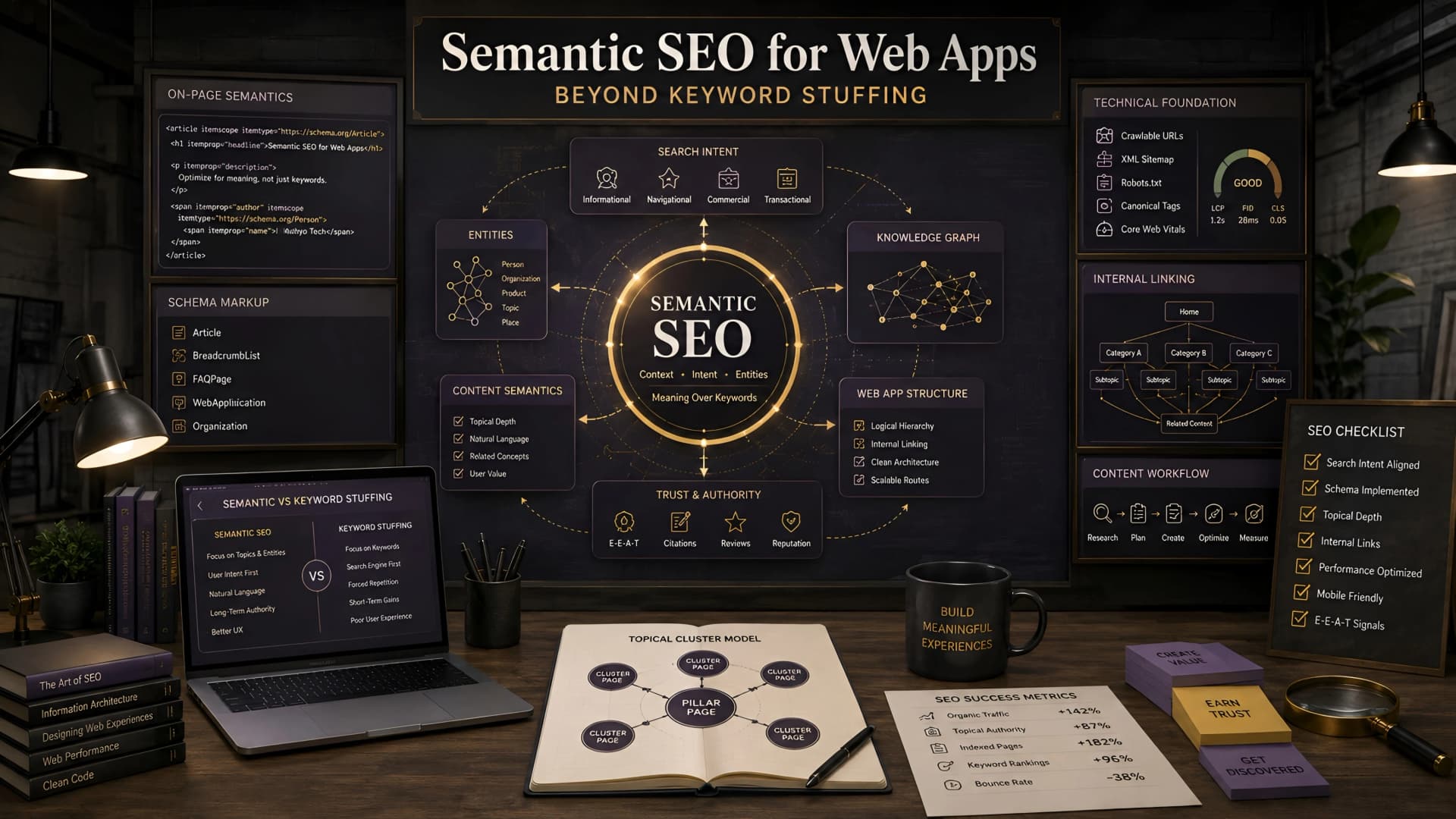
For years, SEO felt like a game of keywords. Stuff them, sprinkle them, optimize their density. This approach, however, increasingly misses the mark in an era of sophisticated search engines.
Today, search isn't just about matching words; it's about understanding context, intent, and relationships between concepts. This shift demands a more intelligent, engineering-led approach: semantic SEO, especially critical for complex web applications.
The Evolution of Search: From Keywords to Concepts
The traditional SEO playbook often focused on optimizing for exact-match keywords. Developers and content creators would meticulously research terms and try to integrate them into content, meta tags, and URLs.
While keywords still play a role, modern search engines like Google use advanced algorithms, machine learning, and natural language processing to grasp the deeper meaning behind a user's query. They aim to understand entities—people, places, things, and concepts—and the relationships between them, forming what's often called a Knowledge Graph.
Why Web Applications Struggle with Traditional SEO
Web applications, by their very nature, often present dynamic content, complex interactions, and user-generated data. This makes them particularly challenging for traditional keyword-centric SEO.
Many web apps deliver highly specific answers or facilitate intricate workflows that don't neatly fit into broad keyword categories. Without a semantic layer, search engines might struggle to fully crawl, index, and understand the true value and purpose of these dynamic pages.
What is Semantic SEO? An Engineering Perspective
Semantic SEO is about optimizing your web application's content and underlying structure to help search engines understand its meaning, context, and entities, not just its keywords. It's about building a richer, more interconnected web of information.
This means moving beyond superficial keyword checks and into deep structural and content enhancements. We're essentially building bridges between our application's data and the search engine's understanding of the world.
The Core Pillars of Semantic Optimization
At Muhyo Tech, our approach to semantic SEO for web applications revolves around several key engineering pillars:
- Structured Data Implementation: Using Schema.org vocabulary to explicitly define entities and their relationships.
- Content Entity Recognition: Designing content and databases to clearly represent key entities rather than just keyword strings.
- Knowledge Graph Integration: Contributing to and aligning with search engine knowledge graphs where possible.
- Topical Authority & Clustering: Organizing content around comprehensive topics rather than isolated keywords.
- User Intent Alignment: Ensuring content directly addresses the user's underlying need, not just their typed query.
Implementing Structured Data: The Foundation
Structured data, specifically using Schema.org vocabulary, is the most direct way to communicate semantic meaning to search engines. It's a standardized markup that you embed in your HTML.
This markup helps search engines understand the type of content (e.g., an Article, Product, Event, Recipe) and specific properties of that content (e.g., author, price, date, ingredients). It moves from implicit understanding to explicit declaration.
Choosing the Right Schema Types
The first step is identifying the most relevant Schema.org types for your web application's content. A blog post might use Article, an e-commerce product page Product, and a service listing Service.
Don't just stick to the basics. Explore more specific types like SoftwareApplication, WebPage, FAQPage, or HowTo to accurately represent your app's unique features and content.
Technical Implementation: JSON-LD Preferred
While Microdata and RDFa exist, JSON-LD (JavaScript Object Notation for Linked Data) is generally the preferred method for implementing structured data. It's cleaner, easier to manage, and less intrusive to your HTML.
<script type="application/ld+json">{ "@context": "https://schema.org", "@type": "SoftwareApplication", "name": "Muhyo Tech Project Planner", "operatingSystem": "Windows, macOS, Linux", "applicationCategory": "DeveloperApplication", "aggregateRating": { "@type": "AggregateRating", "ratingValue": "4.8", "ratingCount": "25" }, "offers": { "@type": "Offer", "price": "0", "priceCurrency": "USD" }, "url": "https://www.muhyo.tech/services/project-planner"}</script>This example explicitly tells search engines that this page describes a software application, its name, supported OS, category, rating, and even its offer details. This clarity helps search engines display rich snippets and understand the page's core entity.
Entity Recognition and Content Clustering
Beyond structured data, semantic SEO requires a deeper look at how content is created and organized within your web application. This involves identifying key entities and grouping related content.
Instead of just writing articles around keywords, we design content around topics and the entities that define them. This means thinking about the relationships between different pieces of information.
Building a Robust Entity Graph
Within your web application's database and content management system, consider how entities are represented. Can you link related products, services, or articles explicitly?
For instance, if you have an e-commerce app selling camera equipment, instead of just listing 'Nikon D850', you might tag it with 'DSLR Cameras', 'Full-Frame Sensors', 'Nikon', 'Photography'. These tags become entities that can be semantically linked.
Content Hubs and Spoke Models
Organize your content into 'hubs' (pillar pages) that cover broad topics comprehensively, and 'spokes' (cluster pages) that delve into specific sub-topics or entities. This creates a clear topical hierarchy for search engines.
A pillar page on 'Web Application Security' might link to cluster pages on 'OWASP Top 10', 'API Security Best Practices', and 'Database Encryption'. This structure helps establish topical authority.
Optimizing for the Knowledge Graph
Search engines actively build and maintain knowledge graphs, vast networks of interconnected entities and facts. Optimizing for this means making your web application's information easily digestible and contributable to these graphs.
This isn't just about structured data; it's about the factual accuracy, consistency, and clear definition of entities across your entire site.
Consistent Entity Identification
Ensure that named entities (like product names, brand names, or specific services) are consistently referred to across your web application. Variations can confuse search engines.
Use canonical URLs for entity pages and employ sameAs properties in Schema.org markup to link to external authoritative sources (e.g., Wikipedia pages, official company profiles) where appropriate. This helps disambiguate entities.
Leveraging Public Data and APIs
If your web application uses or displays public data, consider how that data aligns with existing knowledge graphs. Can you incorporate IDs or references from sources like Wikidata or DBpedia?
This approach strengthens the semantic connections of your application's data. It helps search engines validate and integrate your information into their broader understanding of the world.
Tradeoffs and Challenges in Semantic SEO
While the benefits of semantic SEO are clear, implementing it effectively in a web application involves engineering tradeoffs and potential challenges.
It's not a 'set it and forget it' solution; it requires ongoing maintenance and a deep understanding of both your application's data model and evolving search engine standards.
Increased Development Complexity
Implementing advanced structured data and content clustering requires more development effort upfront. It means thinking about data modeling and content architecture in a new light.
Automating Schema.org generation for dynamic content can be complex, requiring careful templating and validation processes. This is where a robust CI/CD pipeline and thorough testing become crucial.
Maintenance Overhead and Validation
Schema.org vocabularies evolve, and search engine guidelines for structured data can change. This means your semantic SEO implementation needs regular auditing and updates.
Tools like Google's Rich Results Test and Schema Markup Validator are essential for debugging and ensuring your markup remains valid and effective. Our team integrates these checks into our deployment workflows.
Potential for Misinterpretation
Incorrectly implemented structured data can be worse than no structured data at all. Semantic errors can confuse search engines, leading to penalties or simply ignored markup.
Thorough testing in staging environments and careful monitoring of search console reports are non-negotiable to catch and correct issues before they impact live visibility.
Building a Production-Ready Semantic SEO Architecture
For web applications, semantic SEO isn't just a marketing task; it's an architectural consideration. We integrate it into the very design of the application from the ground up.
This involves collaboration between content strategists, UX designers, and backend developers to ensure that data, content, and presentation layers all contribute to semantic clarity.
Architectural Checklist for Semantic SEO
- Data Layer Design: Structure your database to support clear entity relationships and properties. Avoid monolithic text fields where structured data is more appropriate.
- CMS/Admin Panel Integration: Provide clear fields and guidelines in your CMS for content editors to input semantic data (e.g., specific product attributes, event dates, author details) that can be mapped to Schema.org.
- Automated Schema Generation: Implement backend logic or templating engines to dynamically generate JSON-LD markup based on your application's data model.
- Client-Side Rendering (CSR) & Server-Side Rendering (SSR) Considerations: Ensure structured data is present in the initial HTML response for SSR/SSG apps, or correctly rendered and available for crawlers in CSR applications.
- Validation & Monitoring: Integrate structured data validation into your CI/CD pipeline. Regularly monitor Google Search Console's 'Enhancements' reports for errors.
- Internal Linking Strategy: Design an internal linking structure that reinforces topical relationships and guides crawlers through your content clusters.
- Performance Impact Assessment: While JSON-LD is lightweight, ensure that the rendering of structured data doesn't introduce performance bottlenecks, especially for large datasets.
Muhyo Tech's Approach to Scalable Semantic SEO
At Muhyo Tech, we prioritize building web applications with inherent semantic intelligence. This means:
- Early-Stage Data Modeling: We design database schemas with semantic SEO in mind, ensuring clear entity definitions and relationships.
- Automated Markup Generation: We develop robust systems to automatically generate and update JSON-LD based on content changes, reducing manual effort and errors.
- Performance-First Integration: Semantic markup is integrated without compromising loading speeds, ensuring a fast and crawlable experience.
- Continuous Validation: Our deployment pipelines include checks for structured data validity, catching issues before they reach production.
Measuring the Impact and Future-Proofing Your Strategy
While semantic SEO doesn't directly promise 'rankings,' its impact on crawlability, indexation, and the search engine's understanding of your web app translates into tangible benefits.
It's about building a more resilient, understandable, and discoverable digital asset that can adapt to future algorithm changes.
Key Metrics to Monitor
- Rich Results Visibility: Track the appearance of your content in rich snippets, carousels, and knowledge panels via Google Search Console.
- Impression & Click-Through Rate (CTR) for Branded/Entity Queries: Semantic clarity often leads to better performance for specific, complex queries.
- Crawl Budget Efficiency: A well-structured, semantically rich site can help search engines crawl and index your most important content more efficiently.
- User Engagement Metrics: While indirect, better understanding by search engines can lead to more relevant traffic, potentially improving bounce rates and time on site.
Adapting to Future Search Trends
Semantic SEO is not a trend; it's an alignment with the fundamental direction of search engines. As AI and machine learning continue to advance, the ability of search engines to understand complex language and entities will only grow.
By investing in semantic optimization now, you are building a future-proof foundation for your web application's discoverability. You're moving from simply being found to being truly understood.
Frequently Asked Questions (FAQs)
How do I safely implement semantic SEO in a live web application?
Start with a clear audit of your existing content and data models. Implement structured data incrementally, focusing on high-value pages first. Use staging environments for testing and Google's Rich Results Test for validation before deploying to production. Monitor Google Search Console closely for any errors or warnings post-deployment.
What are common pitfalls when scaling semantic SEO for large web apps?
Scaling issues often arise from a lack of automation, inconsistent data entry, and neglecting validation. Ensure your CMS supports structured data input, automate JSON-LD generation where possible, and integrate validation into your CI/CD process. Without these, manual errors and maintenance burden will quickly become unmanageable.
Does semantic SEO impact web application performance?
Generally, the impact of JSON-LD on performance is negligible, as it's typically a small script block. However, poorly optimized data retrieval for dynamic Schema generation or excessive markup could theoretically add overhead. Prioritize efficient data fetching and minimal, relevant markup to avoid performance bottlenecks. Always measure and optimize.
How does Muhyo Tech approach semantic SEO in its development projects?
At Muhyo Tech, semantic SEO is baked into our engineering process from the outset. We begin with a robust data model that defines entities clearly, then build automated systems to generate and maintain accurate structured data. Our focus is on creating web applications that are inherently understandable by search engines, leading to long-term discoverability and reduced maintenance risk.
Conclusion: Engineering for Understanding
The era of simple keyword optimization is fading. For web applications, a truly effective SEO strategy must be rooted in semantics—helping search engines understand the 'what' and 'why' behind your content, not just the 'words'.
This requires a sophisticated engineering approach: meticulous structured data, intelligent content organization, and a commitment to clarity. By embracing semantic SEO, you build a more robust, discoverable, and future-proof web application that connects more deeply with its intended audience.