


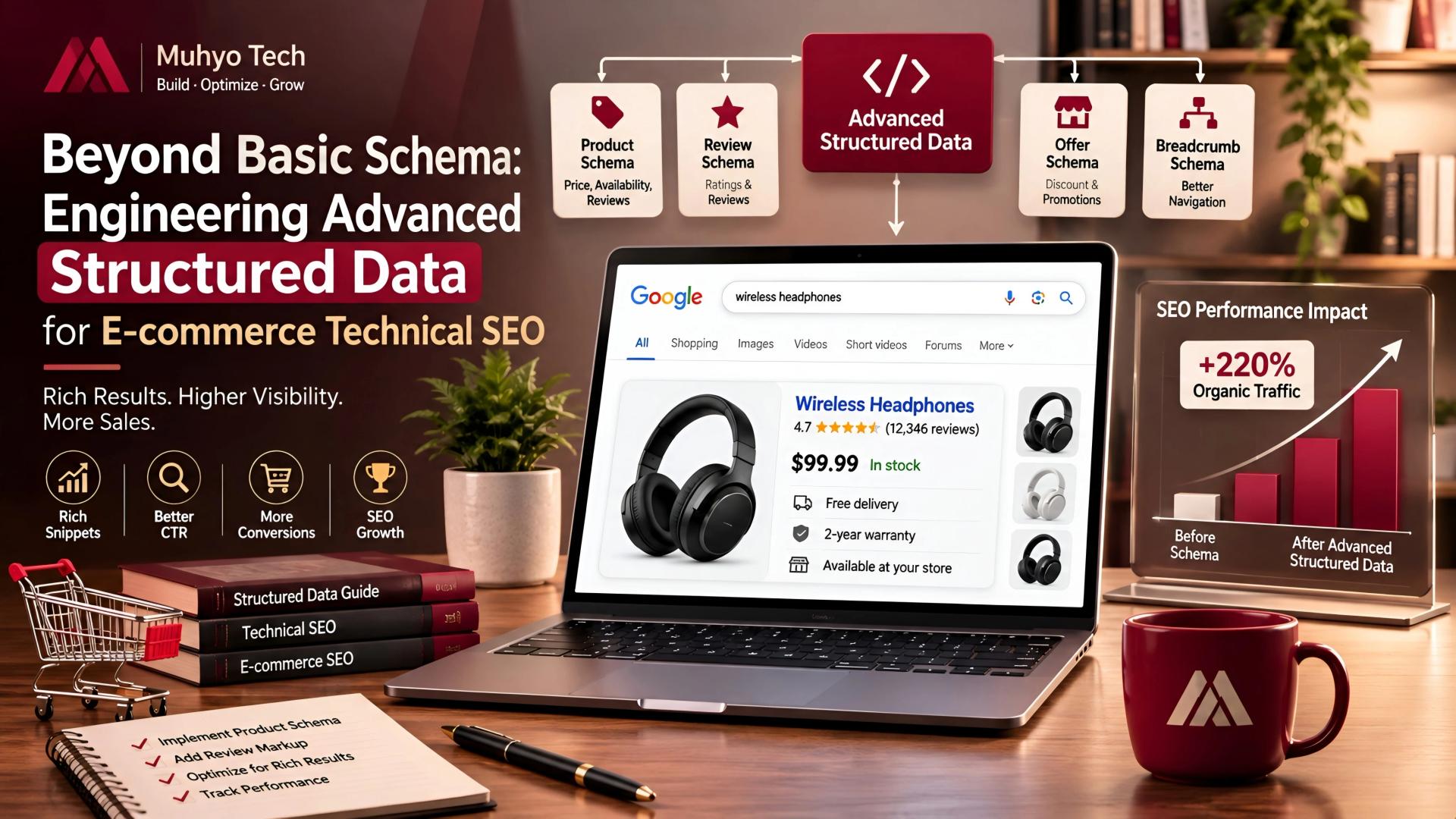
Many e-commerce sites start with basic Product schema, a good first step. However, this often leaves significant opportunities on the table for complex product catalogs and unique selling propositions.
We see this gap frequently: a technically sound website that could be providing much richer context to search engines. This missed signal can mean lower visibility and fewer rich results, directly impacting how potential customers discover and perceive your offerings.
The Foundation: Why Richer Context Matters
Search engines like Google strive to understand the content of web pages as accurately as possible. Structured data, implemented using schema.org vocabulary, acts as a standardized vocabulary for search engines to interpret your content.
For e-commerce, this means going beyond just identifying a product to detailing its price, availability, reviews, shipping options, and even how to use it. This deeper understanding can lead to enhanced search listings, known as rich results.
Moving Past Single Schema: The Power of Combination
The real power emerges when we combine multiple schema types on a single page. Think of a complex product with variations, installation guides, and customer questions.
A single Product schema is insufficient. We need to layer Offer, AggregateRating, HowTo, FAQPage, and potentially even VideoObject schema to paint a complete picture for search engines.
Engineering the Combined Schema Layer
Our approach at Muhyo Tech involves meticulous planning before implementation. We map out all relevant entities and their relationships to ensure the structured data accurately reflects the page content.
This often means creating a primary `Product` entity and linking it to `Offer` entities for different prices or variants, `AggregateRating` for reviews, and `HowTo` for assembly or usage instructions.
| Schema Type | Purpose | E-commerce Use Case |
|---|---|---|
| Product | Identifies the main item. | Essential for any product page. |
| Offer | Details pricing, currency, availability. | Crucial for variants, sales, and stock status. |
| AggregateRating | Summarizes user reviews. | Displays star ratings in search results. |
| HowTo | Provides step-by-step instructions. | For assembly, setup, or usage guides. |
| FAQPage | Answers common questions. | Addresses pre-purchase queries directly. |
| VideoObject | Describes embedded videos. | For product demos or tutorials. |
| BreadcrumbList | Indicates page hierarchy. | Improves site navigation understanding. |
| Organization/LocalBusiness | Identifies the business itself. | For brand information and physical store details. |
Handling Dynamic Content and Variations
E-commerce sites are inherently dynamic. Product availability, pricing, and reviews change frequently.
Implementing structured data for this requires robust backend logic. We ensure that the schema markup is generated server-side or via client-side scripts that reliably fetch and display the latest information.
Real-World Scenario: Product with Multiple Options
Consider a custom-built PC. A single `Product` schema might not cover all configurations. We would use a parent `Product` schema and then potentially link to multiple `Offer` schemas, each representing a different bundle or configuration with its own price and availability.
This ensures that search engines can understand the range of options without overwhelming a single schema definition. It's about creating a clear, logical structure that mirrors the user experience.
Integrating Local Business Schema
For e-commerce businesses with physical storefronts, integrating `LocalBusiness` schema is vital. This helps customers find your brick-and-mortar locations, hours, and contact information.
We often implement this on contact pages, footers, or even dedicated store locator pages. It's about bridging the online and offline customer journey.
Connecting Online Presence to Physical Stores
When a user searches for a product and their location is known, a well-marked `LocalBusiness` schema can help surface your nearest store. This is crucial for click-and-collect or local purchasing intent.
We ensure that the `LocalBusiness` schema is correctly linked to the `Organization` schema for the main brand, creating a cohesive digital identity.
The Engineering Approach to JSON-LD
JSON-LD (JavaScript Object Notation for Linked Data) is the recommended format for implementing structured data. It's human-readable and easy for machines to parse.
Our engineering standards dictate that JSON-LD should be embedded directly in the `
` or `` of the HTML, typically generated dynamically by the backend system.Production-Ready Implementation Checklist
- Define all relevant schema types for each page template.
- Map data fields to specific schema properties.
- Implement server-side generation for dynamic content.
- Validate schema using Google's Rich Results Test and Schema Markup Validator.
- Monitor performance impact of additional script sizes.
- Establish a maintenance plan for schema updates and evolving search engine guidelines.
Common Pitfalls and How to Avoid Them
Implementing advanced structured data isn't without its challenges. One common mistake is duplicating schema across pages or incorrectly linking entities.
Another pitfall is using outdated or non-existent schema properties, which can lead to errors or warnings in validation tools.
Pitfall 1: Incorrect Nesting
Nesting `Offer` schemas directly within another `Offer` schema, for example, is a common error. The `Offer` should typically be a property of the `Product` schema.
We carefully structure our JSON-LD to ensure logical relationships, often using `@id` and `@type` to define and link entities correctly.
Pitfall 2: Stale Data
If your website shows a product as 'out of stock' but the schema still lists it as 'in stock' with an offer, search engines will be confused. This can lead to distrust and penalties.
Robust backend integration and real-time data synchronization are key. Our systems are designed to pull live inventory and pricing data to populate the schema accurately.
Pitfall 3: Over-Optimization
While more schema is generally better, stuffing irrelevant information into structured data can backfire. The schema must accurately represent the *visible* content of the page.
We adhere strictly to schema.org guidelines and Google's Webmaster Guidelines, ensuring that structured data provides genuine value and context, not just an attempt to manipulate search results.
Performance and Maintenance Considerations
Adding more structured data increases the size of your HTML payload. While JSON-LD is efficient, poorly implemented or excessively large blocks can impact page load times.
We optimize schema generation by only including necessary properties and ensuring the data is clean and well-formatted. Regular performance audits are part of our ongoing maintenance strategy.
Scalability of Schema Management
As an e-commerce business grows, so does its product catalog and the complexity of its structured data. Managing this at scale requires a well-architected system.
Our backend solutions are built with scalability in mind, allowing for efficient generation and updating of structured data across thousands or millions of product pages without performance degradation.
Frequently Asked Questions
Q: How often should I update my structured data?
A: You should update structured data whenever the information on the page changes. For e-commerce, this includes price, availability, reviews, and any descriptive content. For dynamic data, ensuring real-time synchronization is ideal.
Q: Can too much structured data hurt my SEO?
A: While not a direct ranking factor, incorrect or irrelevant structured data can confuse search engines and potentially lead to rich result eligibility being revoked. Focus on accuracy and relevance to the page's visible content.
Q: Which is better, JSON-LD or Microdata?
A: Google recommends JSON-LD for most structured data implementations. It's easier to manage and implement separately from your HTML, especially on dynamic e-commerce sites.
Q: How do I test my structured data implementation?
A: Use Google's Rich Results Test for a quick check on eligibility for rich results, and the Schema Markup Validator for a more in-depth validation against schema.org standards.
Conclusion: Engineering for Discoverability
Implementing advanced structured data is a critical engineering task for any serious e-commerce business. It's about providing search engines with the clearest possible understanding of your products and brand.
By moving beyond basic schema and embracing a comprehensive, well-engineered approach, you unlock significant potential for richer search visibility, improved user engagement, and ultimately, more qualified organic traffic.