


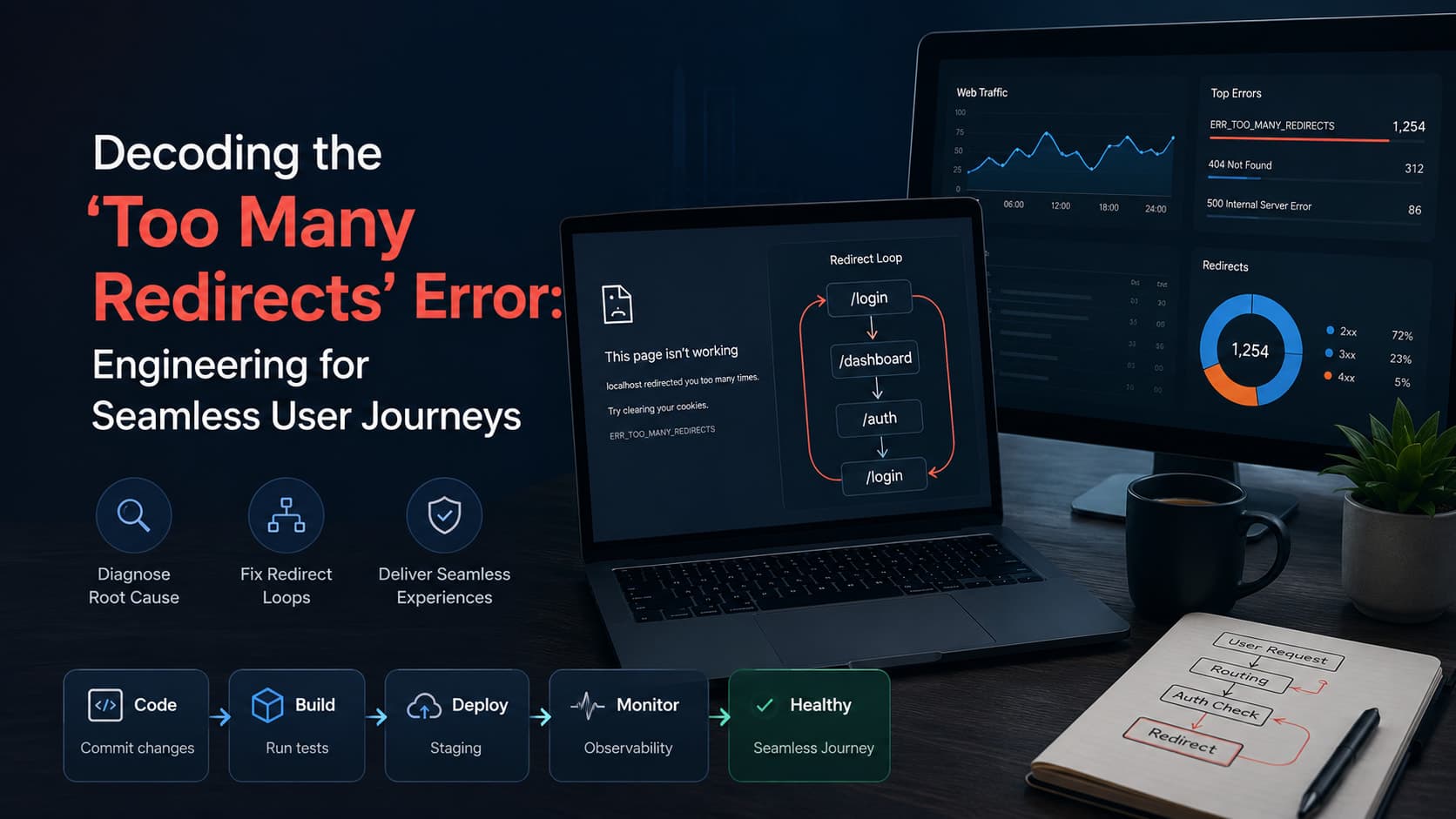
Few things are as frustrating as trying to access a website only to be met with a browser error: 'Too Many Redirects'. It's a digital dead-end, a silent signal that something fundamental has gone wrong behind the scenes.
For users, it means immediate abandonment. For business owners, it's lost opportunity and damaged credibility. As engineers, we see it as a puzzle demanding a precise, systematic solution.
The Pain Point: Why 'Too Many Redirects' Hurts
Imagine a customer clicking a link from a search result or an email campaign, eager to explore your product or service. Instead of content, they get a blank page with an error message. Their journey stops cold.
This isn't just a minor inconvenience; it's a critical breakdown in user experience. Each redirect loop consumes server resources and delays loading, but the ultimate cost is user trust and potential revenue.
Beyond the immediate user impact, search engines like Google penalize sites with persistent redirect issues. This can significantly degrade your SEO, pushing your valuable content down in search results and making it harder for new users to find you.
Understanding the Loop: What Causes Redirect Errors?
A redirect tells a user's browser that the requested resource has moved to a new location. It's a standard and necessary part of web management, used for everything from moving old pages to new URLs to enforcing HTTPS.
The 'Too Many Redirects' error, often displayed as ERR_TOO_MANY_REDIRECTS or HTTP ERROR 310, occurs when a browser gets stuck in an infinite loop. It's like being sent from room A to room B, then room B sends you back to room A, endlessly.
Common culprits often include misconfigured server settings, incorrect .htaccess rules, or conflicting WordPress plugins. Sometimes, it's a simple mistake during a URL migration or an SSL certificate setup.
Another frequent cause is the interplay between different layers of a web application. A CDN might redirect to a load balancer, which redirects to a web server, which then, due to a configuration error, redirects back to the CDN.
Our Engineering Approach: Diagnosing and Fixing the Loop
At Muhyo Tech, when we encounter a redirect loop, our first step is always systematic diagnosis. We don't just guess; we trace the exact path the request is taking.
Browser developer tools are invaluable here. We examine the network tab to see the sequence of HTTP requests and responses. This often reveals the exact URLs involved in the loop and the HTTP status codes (e.g., 301, 302, 307).
Server logs provide another critical layer of insight. Apache or Nginx access logs can show us which redirects are being initiated from the server side. This helps differentiate between client-side and server-side redirect issues.
For WordPress sites, plugin conflicts are a common source. We systematically disable plugins to isolate the culprit. For custom applications, we review recent code changes, especially those touching routing, authentication, or URL normalization.
Our goal is to identify the precise point where the loop begins and ends. Is it an Nginx configuration sending traffic back to itself? Is it a CMS plugin fighting with a CDN? Pinpointing this is key.
Proactive Measures: Engineering for Redirect Resilience
Prevention is always better than a cure, especially with something as disruptive as a redirect loop. Our engineering philosophy emphasizes building systems that minimize the chances of these errors appearing in the first place.
Consistent URL Structures and HTTPS Enforcement
We ensure all websites strictly enforce HTTPS from the outset. This means configuring web servers (Nginx, Apache) to redirect all HTTP traffic to HTTPS, usually with a 301 permanent redirect. This eliminates one common source of loops: partial HTTPS adoption.
For any site, we standardize URL structures. Whether it's always using a trailing slash or always omitting it, consistency prevents ambiguity that can lead to conflicting redirect rules.
Careful Implementation of 301 Redirects
When migrating content or restructuring a site, 301 redirects are essential for SEO. However, they must be implemented thoughtfully.
We map old URLs directly to their new counterparts, avoiding chained redirects (where URL A redirects to B, and B redirects to C). While browsers can handle a few chains, too many can cause performance issues or trigger loops.
We also audit existing redirect chains periodically. Tools can help identify these longer chains, allowing us to consolidate them into single-step redirects for better performance and reliability.
Thorough Testing and Monitoring
Before any major deployment involving URL changes or server configuration updates, comprehensive testing is non-negotiable. This includes automated tests for key URLs and manual checks for critical user flows.
Post-deployment, we implement monitoring tools that alert us to high volumes of redirect errors. Services like Google Search Console also provide invaluable insights into crawl errors, including redirect issues, which can be caught early.
Our approach at Muhyo Tech involves continuous integration and deployment (CI/CD) pipelines that include automated checks for broken links and redirect anomalies. This helps catch potential issues before they impact live users.
The Business Outcome: Seamless Experiences and Stronger SEO
Engineering for robust redirect management directly translates into tangible business value. A website free from 'Too Many Redirects' errors offers a seamless user experience, which builds trust and encourages engagement.
For founders and business owners, this means fewer frustrated customers and a lower bounce rate. It ensures that valuable marketing efforts lead directly to the intended content, not an error page.
Crucially, it protects and enhances your SEO. Search engines can efficiently crawl and index your site without encountering obstacles, leading to better rankings and improved discoverability.
By proactively addressing redirect configurations and integrating them into our core engineering practices, we help ensure our clients' digital platforms are reliable, performant, and truly scalable. This attention to detail reduces maintenance risk and provides a solid foundation for long-term growth.