


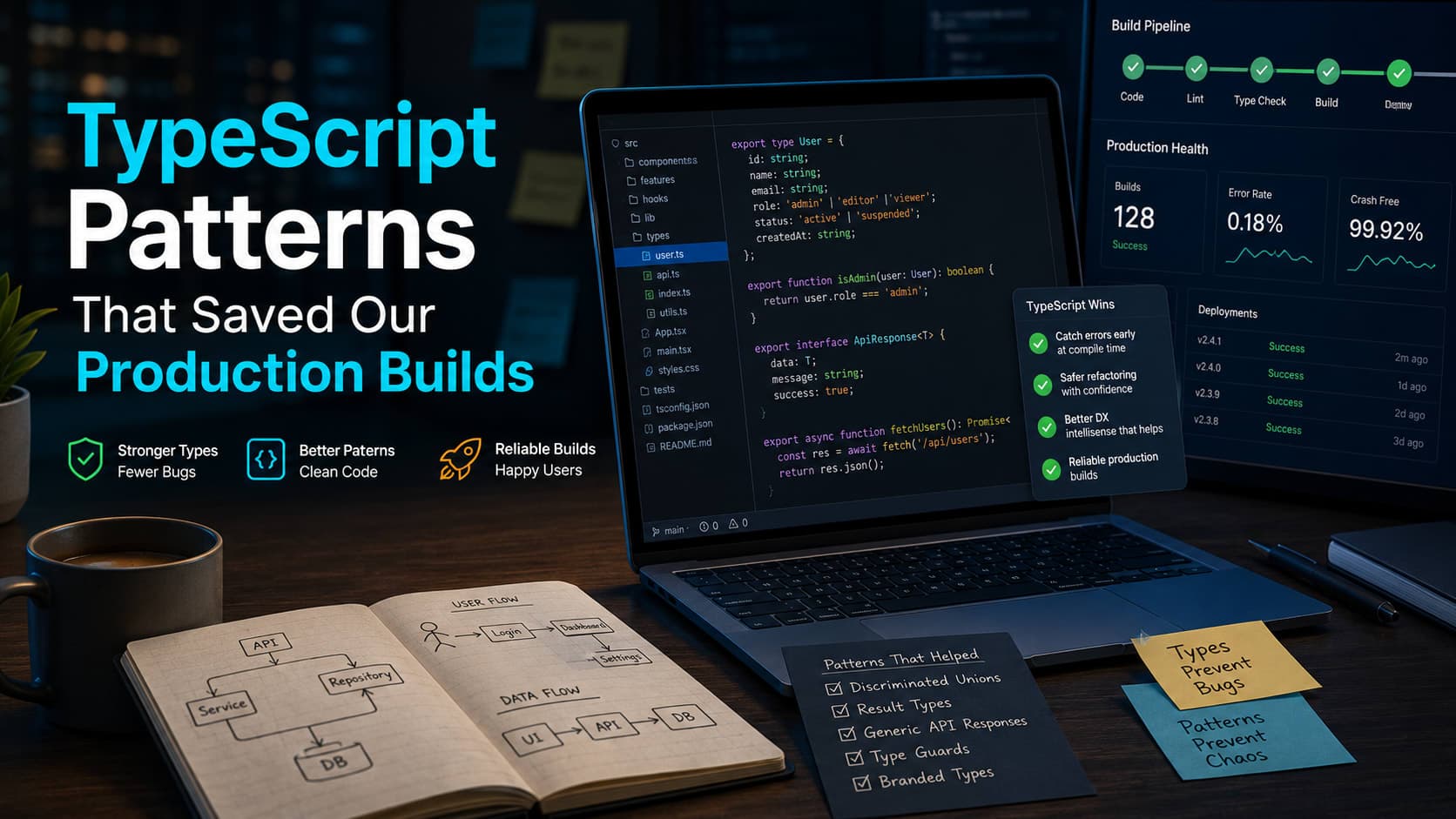
We've all been there: a seemingly minor code change leads to a cascade of build failures or, worse, bugs creeping into production. This is a painful reality in software development, especially as projects grow in complexity. Our team at Muhyo Tech constantly seeks ways to build more resilient systems.
TypeScript, with its strong typing, offers a significant advantage here. But simply using basic types isn't always enough to catch subtle issues before they hit production. We've found that adopting certain advanced patterns can dramatically improve build stability and long-term maintainability.
The Pain of Undefined and Unexpected States
One of the most common sources of production bugs is dealing with unexpected `undefined` values or states that the system wasn't designed to handle. This often happens when dealing with API responses, user inputs, or complex data transformations.
Traditional JavaScript might let these slip through, only to crash the application or display cryptic errors to users later. We look for ways to make these potential issues explicit in our code from the outset.
Pattern 1: Discriminated Unions for State Management
Discriminated unions are a powerful pattern for modeling states that can be one of several distinct possibilities. Each possible state has a literal type property (the discriminator) that tells us which variant we're dealing with.
Consider a data fetching process. It can be in a `Loading` state, a `Success` state with data, or an `Error` state with a message. Using discriminated unions, we can represent this clearly.
type FetchState
When we handle this state, TypeScript forces us to check the `type` property. This ensures we always handle all possible cases, preventing runtime errors from accessing properties that don't exist in a particular state.
This approach directly reduces bugs related to unhandled states in critical user flows, leading to a more reliable user experience and fewer support tickets. It's a cornerstone of how we approach complex client-side logic.
Pattern 2: Brand or Nominal Typing for Stronger Guarantees
Nominal typing, often simulated in TypeScript using branded types, adds an extra layer of safety. It allows us to create types that are structurally identical but are treated as distinct by the type checker.
For instance, we might have `UserId` and `OrderId`. Both could be represented as strings, but we don't want to accidentally pass an `OrderId` where a `UserId` is expected. Branded types prevent this.
type UserId = string & { __brand: 'UserId' };type OrderId = string & { __brand: 'OrderId' };
This might seem like overkill initially, but for systems with many IDs or distinct identifiers, it prevents subtle bugs where the wrong identifier is used. It’s particularly useful in API integrations or when passing data between different modules.
We learned early on that type safety goes beyond just ensuring a variable holds a string or a number; it’s about ensuring it holds the *correct* string or number for its intended purpose. This pattern helps us achieve that granular control.
Pattern 3: Utility Types for Immutability and Readonly
Ensuring immutability is crucial for predictable state management and preventing unintended side effects, especially in front-end applications and complex workflows. TypeScript's built-in utility types like `Readonly` and `DeepReadonly` are invaluable.
type UserProfile = { name: string; preferences: { theme: string } };const immutableProfile: Readonly
If you try to modify `immutableProfile.name` or `immutableProfile.preferences.theme`, TypeScript will throw a compile-time error. This prevents accidental mutations that can be hard to debug.
For nested objects, `DeepReadonly` provides full immutability. This is vital for data structures that flow through multiple components or services, ensuring their integrity.
This practice significantly reduces the risk of unexpected state changes, making our applications more stable and easier to reason about. It's a key part of our commitment to building robust digital services.
Pattern 4: Conditional Types for Flexible API Responses
Conditional types allow us to create types that depend on other types. This is incredibly useful when dealing with APIs that return different data structures based on query parameters or request types.
Imagine an API that returns a `User` object for a `/users/{id}` endpoint and a `Product` object for a `/products/{id}` endpoint. We can define a type that maps an entity name to its corresponding data structure.
type EntityData
This enables us to write functions that accept an entity type and correctly infer the shape of the returned data, ensuring type safety across different API calls. It streamlines integration logic and makes our code more adaptable.
We find these patterns particularly helpful when developing complex web applications or AI-assisted workflows where data shapes can vary significantly. This flexibility without sacrificing type safety is a huge win.
The Tradeoff: Initial Learning Curve vs. Long-Term Gains
Adopting these advanced TypeScript patterns does come with an initial learning curve. Developers new to these concepts might need some time to grasp them fully.
However, the investment pays off handsomely in the long run. Reduced debugging time, fewer production incidents, and more maintainable codebases are direct business benefits. Faster development cycles become possible because developers spend less time hunting down bugs and more time building features.
At Muhyo Tech, we believe in investing in robust engineering practices that lead to better outcomes for our clients. This includes not just writing code, but writing code that is inherently safer and more predictable.
Connecting to Client Value
These advanced TypeScript patterns directly translate into tangible benefits for our clients. By catching errors at compile time rather than runtime, we significantly reduce the likelihood of production bugs and application downtime.
This leads to a better user experience, increased customer trust, and lower maintenance costs. For businesses relying on their web presence or digital services, this stability is paramount. It means faster launches, more reliable operations, and ultimately, less owner stress.
Our commitment to leveraging TypeScript effectively is part of our broader approach to building scalable and reliable digital systems. We aim to deliver software that not only meets immediate needs but also stands the test of time.