


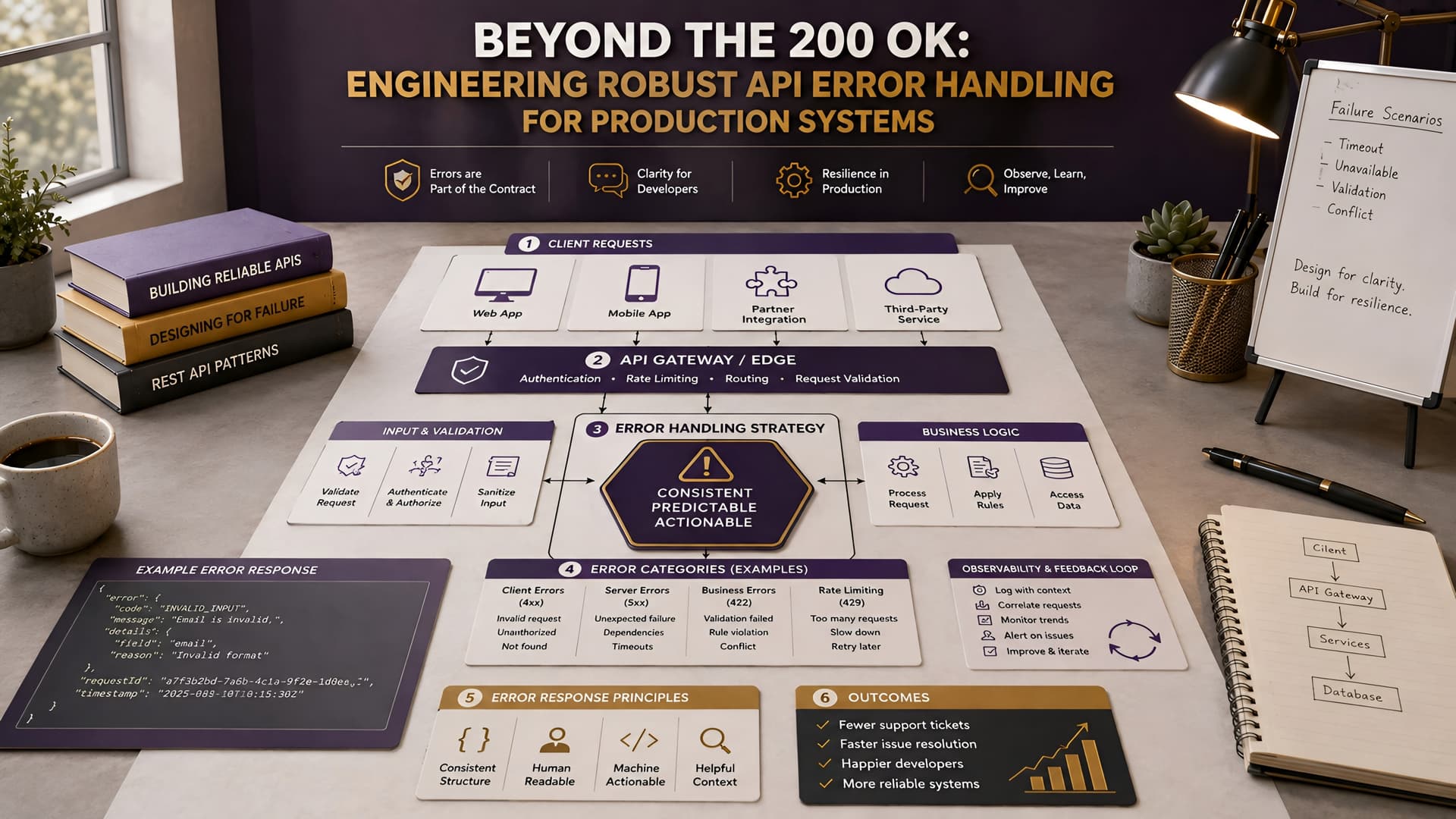
Every developer loves to see a 200 OK response. It signals success, a job well done. But what happens when things don't go as planned?
Inconsistent, uninformative, or poorly structured API error responses are a silent killer of productivity. They turn debugging into a frustrating guessing game, make client-side integrations brittle, and erode trust in your API. Worse, they can sometimes expose sensitive system details, creating security vulnerabilities.
The Hidden Cost of Poor Error Handling
Think about the last time you integrated with an API that returned a generic 500 Internal Server Error with no body. Or perhaps a 400 Bad Request that didn't specify which parameter was missing or malformed.
This lack of clarity costs time and money. Developers spend hours trying to replicate issues, support teams field repetitive questions, and business stakeholders see delays in product features. It impacts your team's velocity and your users' experience.
Foundations: HTTP Status Codes as Your First Language
The HTTP specification provides a rich set of status codes, and using them correctly is the bedrock of good API error handling. They are a universal language that clients understand without needing to parse a custom error payload.
A 400 Bad Request should indicate client-side input validation failure, while a 401 Unauthorized means authentication is missing or invalid. A 403 Forbidden implies the client is authenticated but lacks permission for the requested resource.
Client Errors (4xx Series)
These codes indicate issues originating from the client's request. They are actionable and tell the client exactly what went wrong on their end.
- 400 Bad Request: General client error, often due to invalid JSON, missing required fields, or malformed data.
- 401 Unauthorized: Authentication credentials were not provided or are invalid.
- 403 Forbidden: The client is authenticated but does not have the necessary permissions.
- 404 Not Found: The requested resource does not exist.
- 409 Conflict: Indicates a conflict with the current state of the resource, like trying to create a resource that already exists.
- 429 Too Many Requests: The client has sent too many requests in a given time frame (rate limiting).
Server Errors (5xx Series)
These codes signify problems on the server's side. The client should generally retry these requests, possibly with an exponential backoff strategy.
- 500 Internal Server Error: A generic server error, indicating something went wrong unexpectedly. This should be a last resort.
- 502 Bad Gateway: The server, while acting as a gateway or proxy, received an invalid response from an upstream server.
- 503 Service Unavailable: The server is currently unable to handle the request due to temporary overload or scheduled maintenance.
- 504 Gateway Timeout: The server, while acting as a gateway or proxy, did not receive a timely response from an upstream server.
At Muhyo Tech, we emphasize precision with status codes. A generic 500 is a red flag that we need to refine our error handling logic to provide more specific feedback.
Designing Informative Error Payloads
While HTTP status codes give a high-level overview, the error payload provides the crucial details. A well-structured error payload helps clients understand the problem and correct their requests efficiently.
We typically follow a standardized format, often inspired by RFC 7807 (Problem Details for HTTP APIs), for consistency across all our APIs.
Standard Error Payload Structure
A common and effective structure includes:
type: A URI reference that identifies the problem type (e.g.,/errors/validation-failed).title: A short, human-readable summary of the problem type (e.g., "Validation Failed").status: The HTTP status code (e.g.,400).detail: A human-readable explanation specific to this occurrence of the problem (e.g., "The 'email' field is required.").instance: A URI reference that identifies the specific occurrence of the problem (e.g., a unique error ID for logging).errors(optional): A nested object or array for detailed field-level validation errors.
{
  "type": "https://example.com/probs/out-of-credit",
  "title": "You do not have enough credit.",
  "status": 403,
  "detail": "Your current balance is 30, but you need 50 to make this purchase.",
  "instance": "/transactions/123456789",
  "errors": [
    {
      "field": "amount",
      "message": "Amount exceeds available credit."
    }
  ]
}
This structure provides both a general problem type and specific details, making it easy for both machines and humans to parse and understand.
Logging and Monitoring: The Unsung Heroes
An API error response is only half the story. Robust error handling requires a solid backend strategy for logging, monitoring, and alerting. This allows you to proactively identify issues before they impact many users or diagnose problems quickly.
Every error, especially 5xx errors, should be logged with sufficient context: request ID, user ID (if applicable), endpoint, stack trace, and any relevant request parameters. This data is invaluable for debugging.
Key Logging Practices
- Correlation IDs: Generate a unique ID for each incoming request and propagate it through your microservices. This allows you to trace a single request's journey across your entire system.
- Structured Logging: Log in JSON format for easier parsing and querying by log management systems like ELK Stack or Splunk.
- Error Levels: Use appropriate log levels (e.g.,
ERROR,WARN) to differentiate critical issues from minor ones.
Monitoring and Alerting
Monitoring tools track metrics like error rates per endpoint, latency spikes, and CPU usage. Set up alerts for unusual patterns or thresholds being crossed.
"A robust monitoring setup turns a reactive scramble into a proactive response. It's the difference between hearing about an outage from a customer and fixing it before they even notice." - Pir Ghulam Muhyo Din
This proactive approach significantly reduces downtime and improves overall system reliability.
Idempotency: Preventing Repeated Damage
When an API call fails and a client retries it, how do you prevent unintended side effects? This is where idempotency comes in. An idempotent operation is one that, when executed multiple times with the same parameters, produces the same result as if it were executed only once.
For example, a request to create a new user might not be idempotent if retried. A retry could create duplicate users. However, a request to delete a user should be idempotent; deleting an already deleted user simply results in the user still being deleted.
Implementing Idempotency
For non-idempotent operations, clients should send a unique idempotency key with their requests, often in a header like X-Idempotency-Key. The server then stores this key and the result of the first successful request.
Subsequent requests with the same key within a certain timeframe will return the cached result of the first request without re-executing the operation. This is crucial for financial transactions or resource creation where duplication is catastrophic.
Client-Side Error Management
Effective error handling isn't just about the backend; client applications must also be designed to gracefully handle API errors. This means more than just displaying a generic "Something went wrong" message.
Clients should parse error payloads, display user-friendly messages, and implement retry logic with exponential backoff for transient server errors (5xx). This improves user experience and makes client applications more resilient.
Client-Side Strategies
- User Feedback: Translate technical error messages into clear, actionable language for the end-user.
- Retry Mechanisms: Implement retry logic for 5xx errors, perhaps with a jittered exponential backoff to avoid overwhelming the server.
- Circuit Breakers: For critical integrations, implement circuit breakers to prevent a failing API from cascading and bringing down your entire application.
Common Pitfalls and How to Avoid Them
Even with good intentions, several common mistakes can undermine API error handling.
| Pitfall | Description | Solution |
|---|---|---|
| Generic 500s | Returning 500 Internal Server Error for all unhandled exceptions. |
Catch specific exceptions and map them to appropriate 4xx/5xx codes with detailed payloads. |
| Inconsistent Payloads | Different error structures across various API endpoints. | Define a global error response structure and enforce it through middleware or a common error handling module. |
| Exposing Internal Details | Sending raw stack traces or database errors to the client. | Sanitize error messages. Log full details internally but only return necessary information to clients. |
| Ignoring Idempotency | Not accounting for retries of non-idempotent operations. | Implement idempotency keys for operations where retries could cause unintended side effects. |
| Lack of Logging Context | Logging errors without sufficient context (e.g., request ID, user ID). | Implement correlation IDs and structured logging. |
Avoiding these pitfalls requires a disciplined approach and a commitment to developer experience, both for internal and external API consumers.
The Business Value of Robust Error Handling
While often seen as a technical detail, superior API error handling delivers tangible business value. It directly impacts system reliability, developer productivity, and user satisfaction.
When our team designs web applications or integrates APIs, we prioritize clear error contracts. This clarity means faster feature development, fewer support tickets, and a more stable product overall. It reduces the total cost of ownership for any system we build or maintain.
Frequently Asked Questions
What is the difference between 401 Unauthorized and 403 Forbidden?
A 401 Unauthorized response means the client has not authenticated or provided invalid authentication credentials. A 403 Forbidden response means the client is authenticated but does not have permission to access the requested resource.
Should I always return a 200 OK with an error message in the body?
No, this is an anti-pattern. Always use appropriate HTTP status codes (4xx for client errors, 5xx for server errors) to convey the nature of the error. Returning 200 OK for an error misleads clients and breaks standard HTTP semantics.
How do I prevent exposing sensitive information in error messages?
Ensure that error messages sent to the client are generic and non-descriptive of internal system details. Log detailed error information, including stack traces, only on the server side in secure logs. Never send raw exceptions or database errors directly to the client.
What is exponential backoff, and when should it be used?
Exponential backoff is a strategy where a client retries a failed request with progressively longer delays between retries. It's often combined with jitter (randomness) to prevent thundering herd problems. It should be used for transient server errors (like 5xx codes) to avoid overwhelming the server during temporary outages.
Conclusion: An Investment in Reliability and Experience
Engineering robust API error handling is not an afterthought; it's a critical component of building reliable, scalable, and user-friendly production systems. It requires thoughtful design, consistent implementation, and continuous monitoring.
By investing in clear HTTP status codes, informative error payloads, diligent logging, and client-side resilience, you transform potential points of failure into opportunities for system stability and improved developer experience. This approach doesn't just prevent bugs; it builds trust and accelerates innovation.