


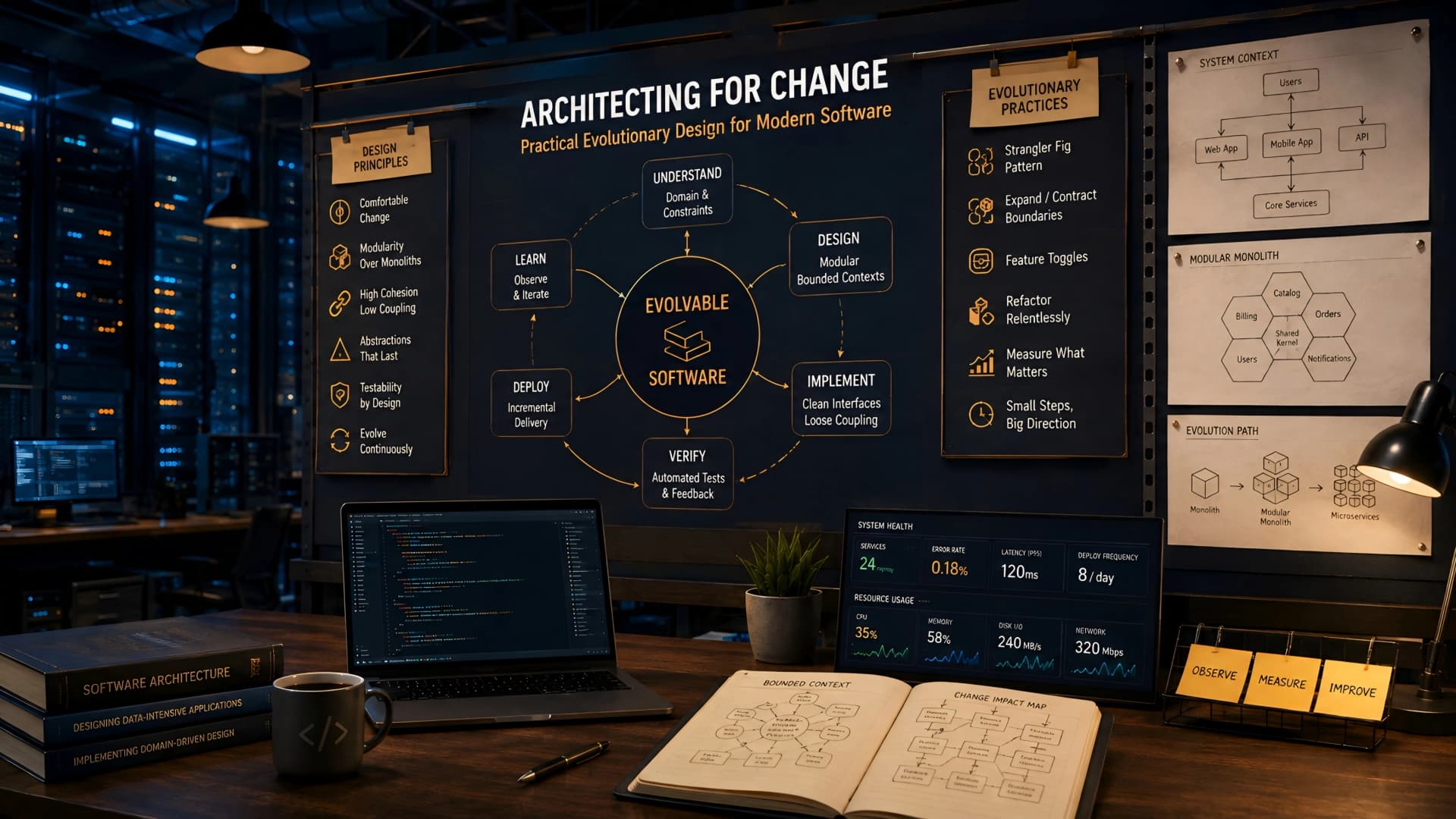
In the world of software development, change is the only constant. Business requirements shift, user expectations evolve, and new technologies emerge at a relentless pace.
Traditional 'big design up front' (BDUF) approaches often struggle in such dynamic environments, leading to rigid systems that become costly to maintain and impossible to innovate upon without major rewrites.
The Challenge of Rigidity in Software Design
Many software projects begin with ambitious, well-intentioned architectural plans. The idea is to foresee every possible future need and design a system to accommodate it from day one.
However, reality rarely aligns with these predictions. Requirements change mid-project, unforeseen scaling demands arise, or a new market opportunity necessitates a fundamental shift in product direction.
When this happens, a meticulously crafted, rigid architecture becomes a significant liability. Teams face the painful choice of either forcing new features into an ill-fitting structure, accumulating technical debt, or undertaking a costly and time-consuming re-architecture.
This cycle leads to slower innovation, increased development costs, and immense frustration for both engineering teams and business stakeholders.
What is Evolutionary Architecture?
Evolutionary architecture offers a pragmatic alternative. It's an approach to software design that embraces change as an inherent part of the system's lifecycle, rather than an exception to be avoided.
The core principle is to design systems that can continuously adapt and evolve over time, without requiring wholesale replacement or massive refactoring efforts.
Instead of aiming for a 'perfect' initial design, evolutionary architecture focuses on building a system that is inherently malleable. It prioritizes incremental changes, continuous feedback, and the ability to course-correct based on new information.
This mindset acknowledges that the best architecture is not static, but one that can gracefully transform alongside the business it serves.
Key Principles of Evolutionary Architecture
At Muhyo Tech, our approach to evolutionary architecture is built on several foundational principles:
- Incremental Change: Design for small, manageable changes rather than large, disruptive ones. Each architectural decision should be a stepping stone, not a final destination.
- Fitness Functions: Define objective, measurable criteria that an architecture must satisfy. These 'fitness functions' act as automated guardians, ensuring that architectural qualities (like performance, scalability, security, or maintainability) are preserved as the system evolves.
- Last Responsible Moment: Defer irreversible architectural decisions until the last possible moment. Gather more information, learn from early iterations, and only commit when the path is clearer.
- Antifragility: Design systems that don't just resist change, but actually get stronger and more capable when exposed to it. This involves building in redundancy, observability, and self-healing mechanisms.
- Bounded Contexts: Employ domain-driven design principles to break down large systems into smaller, independent services or modules. This minimizes the blast radius of changes and allows different parts of the system to evolve at their own pace.
Implementing Evolutionary Architecture in Practice
Adopting an evolutionary approach requires more than just understanding principles; it demands practical changes in how teams design, build, and maintain software.
Here’s how we integrate evolutionary architecture into our engineering workflows and standards:
1. Defining Architectural Fitness Functions
Fitness functions are the cornerstone of evolutionary architecture. They are objective, quantifiable measures that assess the architectural health of a system.
These are not just unit tests; they operate at a higher level, validating cross-cutting concerns and ensuring the architecture adheres to its non-functional requirements.
Examples of Fitness Functions:
- Performance: An automated test suite that asserts API response times remain below 200ms for critical endpoints under simulated load.
- Scalability: A deployment script that spins up a new instance and verifies it can handle a 10% increase in traffic without degradation.
- Security: Static analysis tools integrated into CI/CD that fail builds if critical security vulnerabilities are detected.
- Maintainability: Code complexity metrics (e.g., cyclomatic complexity) that trigger warnings if modules exceed a predefined threshold.
- Modularity: Dependency checks that prevent certain modules from directly calling others, enforcing architectural boundaries.
These functions should be automated and integrated into the continuous integration and deployment (CI/CD) pipeline. Every code change should be validated against these architectural assertions.
2. Embracing Incremental Design and Refactoring
Instead of massive, disruptive refactors, evolutionary architecture promotes continuous, small-scale refactoring. This means engineers are constantly looking for opportunities to improve code quality, simplify design, and enhance modularity as they work.
We encourage teams to view refactoring as an integral part of feature development, not a separate, delayed task. This keeps the codebase healthy and prevents the accumulation of crippling technical debt.
The 'boy scout rule' — always leave the campsite cleaner than you found it — is a powerful metaphor here. Every time a developer touches a piece of code, they should aim to make a small improvement, even if it's just renaming a variable or breaking out a helper function.
This philosophy, applied consistently, leads to a system that naturally evolves towards a better state.
3. Leveraging Microservices and Modular Monoliths
Architectural patterns like microservices or well-designed modular monoliths are natural fits for evolutionary architecture. They facilitate bounded contexts and allow for independent deployment and scaling of different system components.
Microservices, when implemented thoughtfully, allow different teams to work on distinct services, using different technologies if appropriate, and deploying them independently.
This decentralization significantly reduces the coupling between parts of the system, making it easier to evolve specific functionalities without impacting the entire application.
Even with a monolithic architecture, applying modular design principles can yield similar benefits, creating clear boundaries and interfaces between internal components.
Trade-offs and Common Pitfalls
While evolutionary architecture offers significant advantages, it's not without its challenges. Understanding the trade-offs and potential pitfalls is crucial for successful implementation.
| Aspect | Benefit of Evolutionary Architecture | Potential Pitfall / Trade-off |
|---|---|---|
| Initial Design Effort | Lower upfront investment, quicker to market. | Requires constant vigilance and discipline; can lead to chaos without strong governance. |
| Flexibility & Adaptability | System can readily adapt to new requirements and technologies. | Can be perceived as 'never finished'; requires continuous learning and skill development. |
| Technical Debt | Actively managed and reduced through continuous refactoring. | Poor discipline can lead to 'accidental' or unmanaged technical debt. |
| Team Communication | Fosters collaboration and shared understanding of evolving architecture. | Requires strong communication and alignment to prevent architectural drift. |
| Tooling & Automation | Relies heavily on robust CI/CD and automated fitness functions. | Significant initial investment in automation infrastructure. |
Common Pitfalls to Avoid:
- Lack of Vision: Evolutionary doesn't mean aimless. A clear, albeit adaptable, architectural vision is still necessary.
- Ignoring Fitness Functions: Without automated guards, the architecture will degrade over time.
- Insufficient Automation: Manual verification of architectural qualities is unsustainable.
- Fear of Refactoring: Postponing necessary changes will lead to accumulating technical debt.
- Over-engineering for Future Needs: The 'last responsible moment' principle must be honored. Don't build for what might be needed far in the future.
Architectural Decision Framework for Evolution
To make informed architectural choices within an evolutionary paradigm, we use a structured decision framework. This helps our teams evaluate options and commit to the most adaptable path.
1. Context and Constraints
Clearly define the current problem, business goals, and non-functional requirements. What are the known limitations? What are the hard deadlines? What existing systems must integrate?
2. Identify Architectural Drivers
What are the key qualities the system must possess? Is it high performance, extreme scalability, rapid feature delivery, or stringent security? These drivers will heavily influence decisions.
3. Explore Options (and their evolutionary paths)
Brainstorm several viable architectural options. For each option, consider not just its immediate benefits, but also its potential to evolve. How easily can it be changed? What are its inherent limitations for future growth?
4. Evaluate Against Fitness Functions
How well does each option align with the defined architectural fitness functions? Can we create automated tests to validate this option's adherence to those functions?
5. Assess Trade-offs
Every architectural decision involves trade-offs. Document them explicitly. What are we gaining? What are we giving up? Are these acceptable risks for the business?
6. Make Incremental Decisions
Choose the option that provides the most immediate value, aligns with current understanding, and offers the clearest path for future evolution. Avoid premature optimization or over-commitment.
7. Document and Communicate
Record the architectural decision, the reasoning behind it, and the trade-offs considered. Share this information with the entire team to foster shared understanding and alignment.
Business Value: Why Adaptable Architecture Matters
For founders and business owners, the engineering focus on evolutionary architecture translates directly into tangible business value. It's not just an engineering 'nice-to-have'; it's a strategic imperative.
Reduced Technical Debt and Maintenance Costs
By continuously refining the architecture and codebase, technical debt is actively managed and reduced. This means fewer unexpected bugs, less time spent firefighting, and lower long-term maintenance costs.
Our goal is to build systems that remain performant and stable, minimizing the hidden costs of a decaying codebase.
Increased Development Agility and Faster Time-to-Market
An adaptable architecture allows teams to respond quickly to market changes and new business opportunities. New features can be integrated more rapidly, and existing ones can be modified without fear of breaking the entire system.
This agility translates into faster time-to-market for new products and features, giving businesses a critical competitive edge.
Extended System Lifespan and Lower Risk
Systems designed for evolution have a much longer viable lifespan. Instead of facing costly and disruptive 'rip and replace' scenarios every few years, the software can continuously adapt and remain relevant.
This reduces the financial risk associated with large-scale software investments and provides a more stable foundation for long-term business growth.
Better User Experience and Discoverability
When the underlying architecture is flexible, it's easier to implement user experience improvements and integrate SEO-friendly practices. This ensures the website or web application remains intuitive, fast, and easily discoverable by target audiences.
A responsive architecture allows for continuous A/B testing and iteration on UX, directly impacting user satisfaction and conversion rates.
The Muhyo Tech Approach: Engineering for Enduring Value
At Muhyo Tech, we don't just build software; we engineer enduring solutions. Our commitment to evolutionary architecture means we design systems that are not only robust today but also resilient to the uncertainties of tomorrow.
Whether it's developing a full-stack web application from scratch or undertaking a website redesign, our focus is on creating foundations that empower businesses to innovate and scale.
We understand that the true value of software lies in its ability to adapt and grow with your business. This philosophy guides our architectural decisions, ensuring that every line of code contributes to a flexible, maintainable, and ultimately more valuable product.
Our maintenance and support services also benefit from this approach, as well-architected systems are inherently easier to monitor, update, and troubleshoot, leading to greater stability and lower operational overhead.
Checklist for Evolutionary Architecture Adoption
- Define Clear Architectural Vision: Understand the core business goals and key non-functional requirements.
- Establish Fitness Functions: Identify and automate objective metrics for architectural qualities (performance, security, scalability, etc.).
- Implement Robust CI/CD: Ensure automation for building, testing, and deploying changes with architectural checks.
- Foster a Culture of Continuous Refactoring: Encourage small, incremental improvements as part of daily development.
- Embrace Modular Design: Break down systems into independent, loosely coupled components (e.g., microservices, modular monoliths).
- Practice 'Last Responsible Moment': Defer irreversible decisions until sufficient information is available.
- Invest in Observability: Ensure systems are well-instrumented for monitoring and troubleshooting as they evolve.
- Document Architectural Decisions: Keep a living record of choices, their rationale, and trade-offs.
- Regularly Review and Adapt: Schedule periodic architectural reviews to assess fitness and identify areas for evolution.
Frequently Asked Questions (FAQs)
How does evolutionary architecture impact initial project timelines?
While some upfront effort is needed to establish fitness functions and CI/CD pipelines, evolutionary architecture often leads to faster initial delivery. It prioritizes delivering a minimum viable architecture that can grow, rather than a perfect, complete one, accelerating time-to-market.
Is evolutionary architecture only for large-scale systems or microservices?
Not at all. The principles of evolutionary architecture apply to systems of all sizes, including smaller web applications and even well-structured monoliths. The key is the mindset of continuous adaptation and the use of fitness functions, regardless of the architectural pattern.
What's the biggest challenge in adopting an evolutionary architecture practice?
The biggest challenge is often cultural: shifting from a 'fixed design' mindset to one that embraces continuous change and incremental improvement. It requires discipline, strong communication, and a commitment to automation from the entire team.
How do we ensure architectural consistency in an evolving system?
Architectural consistency is maintained through well-defined fitness functions, automated checks in the CI/CD pipeline, and clear communication of architectural guidelines. Regular code reviews and architectural discussions also play a crucial role in preventing drift.