


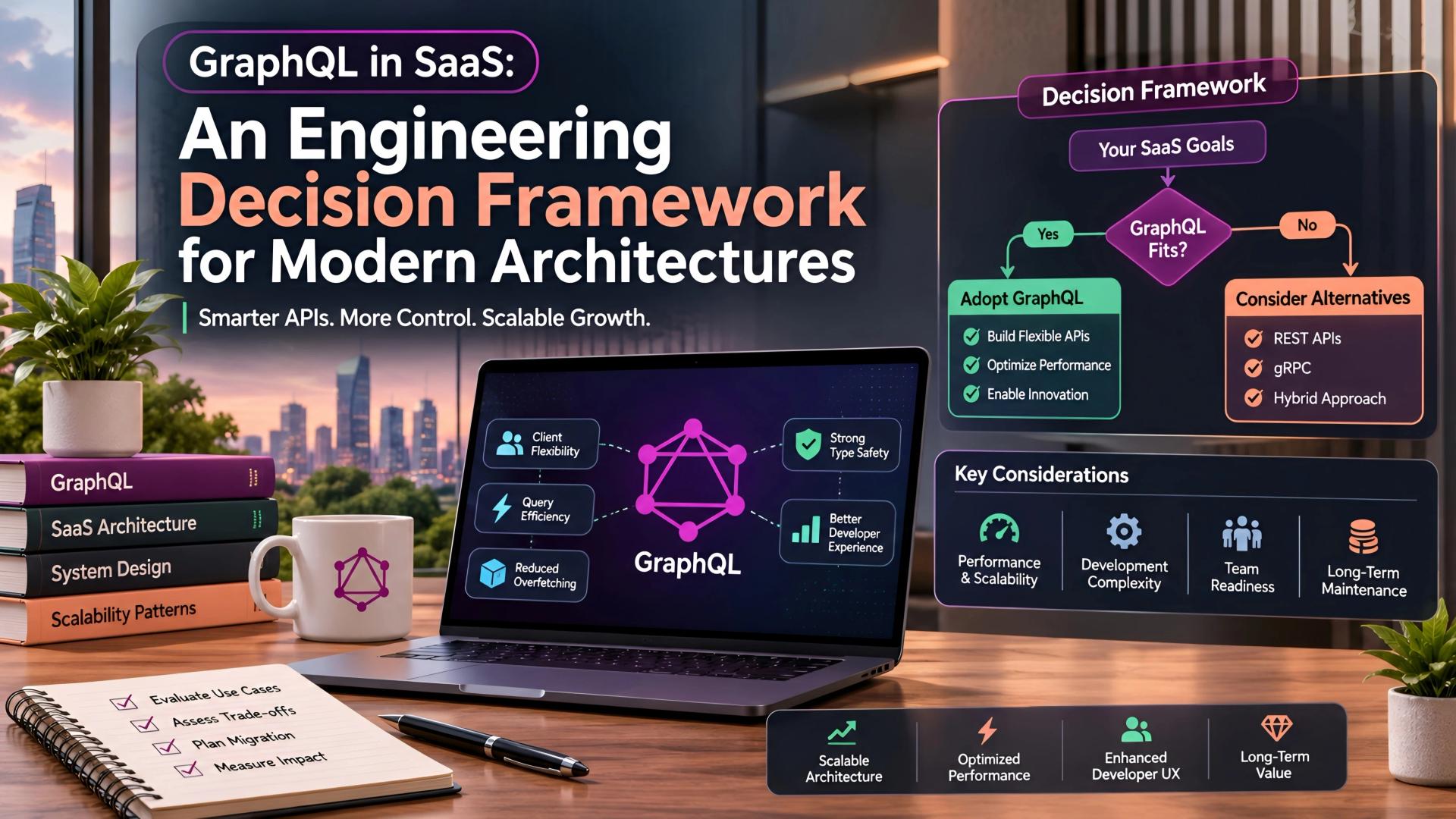
When building or evolving a SaaS platform, the choice of API architecture carries significant weight. It impacts everything from developer velocity to the long-term scalability and maintainability of your product.
For years, REST has been the default, but its limitations—especially around over-fetching, under-fetching, and the need for multiple round trips—become glaring in modern SaaS environments with diverse clients and rapid feature iteration.
The Core Problem: Client-Server Data Mismatch
Imagine a SaaS product with a web app, a mobile app, and perhaps even a third-party integration. Each client often needs a slightly different subset of data for the same conceptual 'resource'.
With REST, you're typically designing fixed endpoints. This often forces clients to make multiple requests or receive far more data than they actually need, leading to slower performance and increased complexity on the client side.
This mismatch creates a constant tension: how do we empower clients with flexibility without turning the backend into an unmanageable collection of bespoke endpoints?
Enter GraphQL: A Paradigm Shift for Data Fetching
GraphQL is a query language for your API and a runtime for fulfilling those queries with your existing data. It allows clients to precisely specify the data they need, nothing more, nothing less.
This fundamental shift puts control in the hands of the client, which can be incredibly powerful for SaaS applications serving varied frontends and evolving business logic.
At Muhyo Tech, we've seen how this approach can significantly streamline frontend development and reduce network overhead, especially for complex dashboards and interactive UIs.
When to Consider GraphQL for Your SaaS Architecture
Adopting GraphQL isn't a silver bullet; it's a strategic decision. Here's a framework we use to assess its suitability:
- Diverse Client Ecosystem: If you support web, mobile, and potentially third-party integrations, each with unique data requirements, GraphQL shines.
- Rapid Feature Development: When your product roadmap demands frequent UI changes and quick iterations on data models, GraphQL's flexibility accelerates development.
- Complex Data Relationships: For highly interconnected data graphs where clients often need to traverse relationships (e.g., users, organizations, projects, tasks, comments), GraphQL simplifies data retrieval.
- Reducing Network Overhead: If your clients operate in environments with limited bandwidth or high latency, minimizing data transfer is critical.
Conversely, for simpler CRUD-heavy applications with stable data models and few client types, the overhead of introducing GraphQL might not be justified.
Designing a Robust GraphQL Schema for SaaS
The schema is the contract between your clients and your API. For SaaS, a well-designed schema is paramount for multi-tenancy, security, and long-term maintainability.
We emphasize a 'product-first' schema design, reflecting the entities and operations meaningful to your business domain rather than strictly mirroring your database structure.
Multi-Tenancy Considerations
Multi-tenancy is a core aspect of SaaS. In GraphQL, this typically means ensuring that every query and mutation is implicitly or explicitly scoped to the requesting tenant.
This is often handled at the resolver level, where an authentication context containing the tenant ID is passed down. All data access logic within resolvers must then filter results based on this tenant ID.
Muhyo Tech Insight: We often implement a global middleware or context provider that injects tenant information into every resolver's execution context. This ensures that data isolation is enforced consistently, preventing accidental data leakage between tenants.
Schema Evolution and Versioning
GraphQL's strength lies in its extensibility. You can add new fields and types without breaking existing clients.
However, deprecating fields requires careful planning. Using the @deprecated directive is a standard practice, signaling to clients that a field will eventually be removed.
For significant breaking changes, consider a gradual rollout or maintaining multiple API gateways for different versions, though the latter adds considerable operational complexity.
Performance and Scalability in a GraphQL SaaS Backend
While GraphQL optimizes client-side fetching, it introduces new challenges on the server side, particularly around N+1 queries and complex query execution.
Batching and Dataloaders
The N+1 problem occurs when a resolver fetches data for a list of items, and then for each item, it makes another database query to fetch related data. Dataloaders are a critical pattern here.
They batch requests over a short period and deduplicate them, allowing a single SQL query (or other data source request) to fetch all necessary related data efficiently.
Query Complexity and Throttling
Clients can request deeply nested data, which can lead to expensive queries. Implementing query complexity analysis and depth limiting is crucial.
Tools and libraries exist to analyze an incoming query's cost before execution, allowing you to reject overly complex queries or apply rate limiting based on query cost.
Caching Strategies
Caching is still vital. Server-side caching can be implemented at various layers: resolver results, data source responses, or even CDN-level caching for public data.
For authenticated, tenant-specific data, careful cache invalidation strategies are essential to maintain data consistency and security.
Security Best Practices for GraphQL in SaaS
Security is non-negotiable for any SaaS platform, and GraphQL introduces specific considerations.
Authentication and Authorization
Integrate GraphQL with your existing authentication system (e.g., JWT, OAuth). Authorization, especially multi-tenant authorization, must be enforced at the resolver level.
Every resolver should check if the authenticated user has permission to access the requested data or perform the requested action, always considering the tenant scope.
Input Validation and Sanitization
All input arguments to mutations must be rigorously validated and sanitized to prevent injection attacks and ensure data integrity.
GraphQL's type system helps, but custom validation logic is often required for business rules and security policies.
Denial of Service (DoS) Protection
Beyond query complexity, guard against malicious queries designed to exhaust server resources. This includes rate limiting, query depth limiting, and payload size limits.
Consider exposing different GraphQL endpoints or limiting capabilities for public vs. authenticated users, or for different subscription tiers.
Migration Strategies from REST to GraphQL
If you have an existing REST API, a full rewrite to GraphQL is rarely practical. A common approach is a gradual migration.
Hybrid Approach (GraphQL API Gateway)
One effective strategy is to introduce GraphQL as an API gateway that sits in front of your existing REST services.
The GraphQL server would resolve queries by making requests to your underlying REST endpoints, effectively aggregating data and transforming it into the GraphQL response format.
Strangler Fig Pattern
Alternatively, you can use the Strangler Fig pattern. New features or services are built with GraphQL, while older, stable REST services remain untouched.
Over time, as old features are refactored or new ones replace them, more and more of your API surface transitions to GraphQL.
GraphQL vs. REST: A Practical Comparison
| Feature | REST API | GraphQL API |
|---|---|---|
| Data Fetching Model | Fixed endpoints, client over-fetches/under-fetches | Client requests exact data needed, single endpoint |
| Network Requests | Multiple requests often needed for related data | Single request for complex, related data |
| Schema Definition | Implicit via documentation (OpenAPI/Swagger) | Explicit, strongly typed schema (SDL) |
| Versioning | Commonly via URI (/v1/users) or headers | Schema evolution (adding fields), deprecation for removal |
| Developer Experience | Good, but can be verbose for complex data needs | Excellent for frontend, powerful tooling (GraphiQL) |
| Caching | Leverages HTTP caching mechanisms effectively | More complex, often requires custom resolver-level caching |
| Learning Curve | Lower, widely understood | Higher initially, new concepts (resolvers, SDL) |
| Overhead | Lower for simple CRUD | Higher for setup, requires robust resolver logic |
Muhyo Tech's Engineering Checklist for GraphQL Adoption
When we evaluate GraphQL for a SaaS project, our internal checklist covers these critical points:
- Schema Design Principles: Is the schema business-domain driven? Does it account for multi-tenancy from day one?
- Authorization Strategy: How will tenant and user permissions be enforced at the resolver level?
- Performance Optimization: Have Dataloaders been designed and implemented to prevent N+1 issues? Is query complexity analysis in place?
- Security Measures: Are all inputs validated? Are rate limiting and depth limiting configured?
- Error Handling: Is a consistent and informative error-handling strategy defined for both client and server?
- Monitoring and Observability: How will we track query performance, errors, and resource utilization?
- Developer Tooling: Is GraphiQL or a similar tool integrated for easy API exploration?
- Migration Path: If existing APIs exist, is there a clear, incremental strategy for transition?
This structured approach helps us anticipate challenges and build resilient, high-performing systems from the outset.
Frequently Asked Questions
How do you handle multi-tenancy with GraphQL in a SaaS application?
Multi-tenancy in GraphQL is typically enforced at the resolver level. Your authentication layer identifies the tenant, and this tenant ID is passed into the GraphQL execution context. Every resolver then uses this context to filter or scope data access, ensuring users only see data belonging to their tenant.
What are the best practices for GraphQL schema design in a SaaS architecture?
Focus on a product-first, domain-driven schema that reflects your business logic rather than your database structure. Use clear, descriptive names for types and fields. Plan for schema evolution by adding new fields rather than making breaking changes, and use the @deprecated directive when phasing out old fields.
How do you ensure data security and isolation in a GraphQL SaaS environment?
Beyond standard authentication, implement robust authorization checks in every resolver, ensuring tenant and user permissions are strictly enforced. Validate and sanitize all mutation inputs, implement query depth and complexity limiting, and use rate limiting to protect against DoS attacks.
Final Thoughts on GraphQL for SaaS
Adopting GraphQL for a SaaS architecture is a significant architectural decision. It promises unparalleled client flexibility, reduced network overhead, and accelerated frontend development.
However, it also introduces new engineering challenges around schema design, performance optimization, and security that demand careful consideration and robust implementation.
By following a structured decision framework, focusing on domain-driven design, and rigorously addressing performance and security, your team can harness GraphQL's power to build highly adaptable and scalable SaaS platforms. It's an investment in a more efficient and flexible future for your product.