


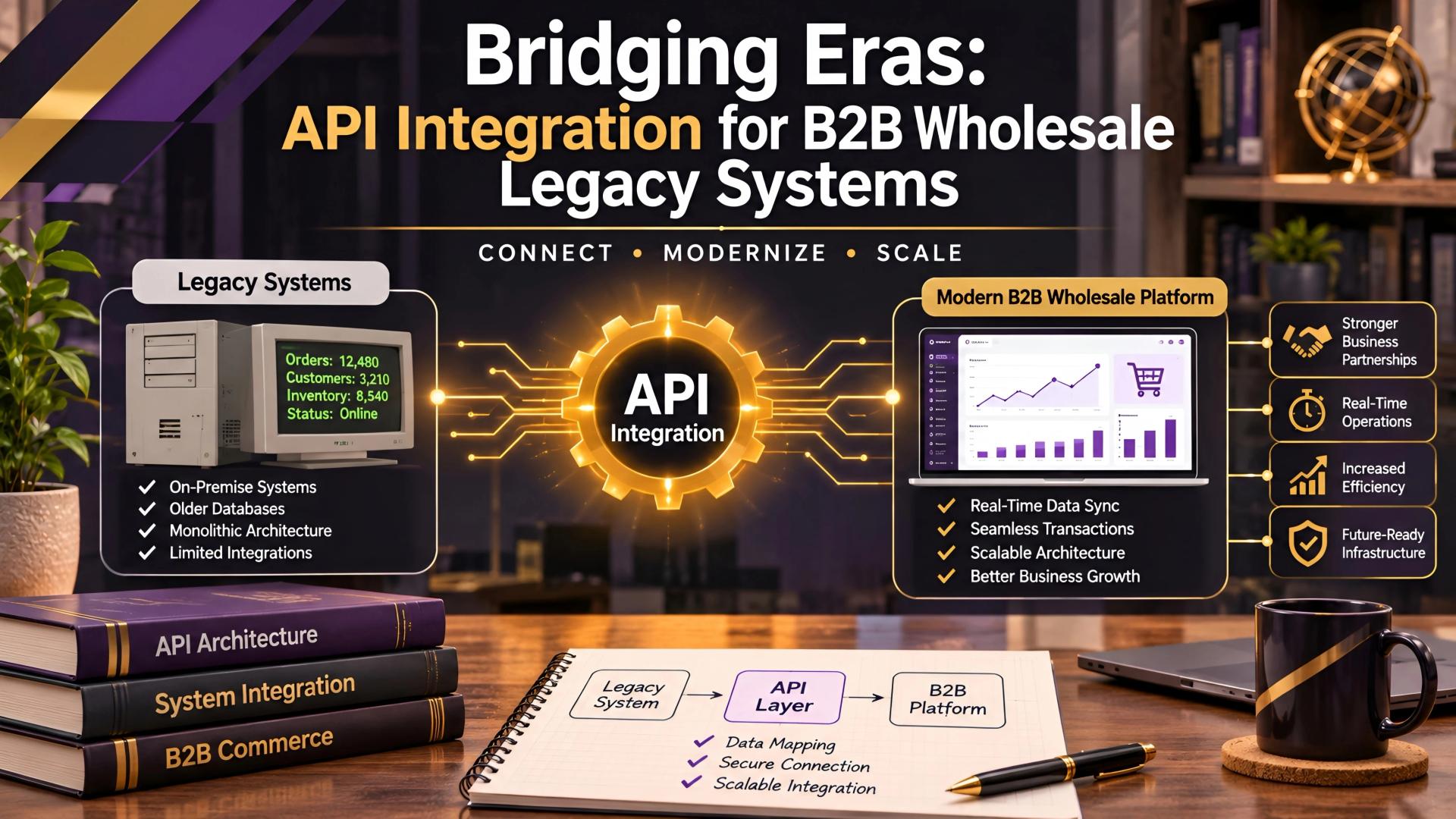
Bridging Eras: API Integration for B2B Wholesale Legacy Systems
The operational backbone of many B2B wholesale businesses often relies on robust, yet aging, legacy systems. These ERPs and inventory management tools, while stable, were rarely built for the real-time, interconnected demands of modern digital commerce.
Integrating new B2B APIs with these established systems presents a unique set of architectural and engineering challenges. The goal isn't just to connect them, but to create a seamless, reliable data flow that enhances operational efficiency without disrupting critical existing processes.
The Challenge of Siloed Legacy Systems in B2B Wholesale
B2B wholesale operations thrive on accurate, timely data for inventory, pricing, order fulfillment, and customer management. When this data is locked away in disconnected legacy systems, bottlenecks quickly emerge.
Manual data entry, reconciliation errors, and delayed information propagation become common. This directly impacts everything from customer satisfaction to supply chain responsiveness and ultimately, profitability.
Why Modern API Integration is Critical for Wholesale
Modern B2B APIs offer a pathway to unlock trapped data and automate critical workflows. They enable real-time inventory checks, automated order processing, dynamic pricing updates, and seamless communication with external partners and platforms.
For wholesale businesses, this means faster order-to-cash cycles, reduced operational costs, and the ability to adapt more quickly to market demands. It transforms a reactive business into a proactive, data-driven one.
Understanding the Legacy Landscape: Constraints and Considerations
Before designing any integration, a deep understanding of the legacy system's constraints is paramount. These systems often have rigid data schemas, limited API capabilities (or none at all), and specific operational windows.
Security protocols, data integrity requirements, and performance limitations must be thoroughly assessed. We often find that direct database access or file-based transfers are the only initial integration points, demanding careful handling.
Architectural Patterns for B2B Legacy API Integration
Successfully integrating modern APIs with legacy systems typically involves one of several architectural patterns. The choice depends heavily on the legacy system's capabilities, data volume, real-time requirements, and budget.
Each approach has its own set of trade-offs in terms of complexity, cost, and long-term maintainability.
1. Point-to-Point Integration
This involves direct connections between each new API and the legacy system. While seemingly simple for a few integrations, it quickly becomes unmanageable as the number of integrations grows.
It creates a 'spaghetti' architecture that is fragile and difficult to scale or maintain. We generally advise against this for anything beyond very simple, one-off data syncs.
2. Enterprise Service Bus (ESB) or Message Queue
An ESB acts as a central communication hub, routing messages between disparate systems and handling data transformations. Message queues provide asynchronous communication, decoupling systems and improving reliability.
This pattern is robust for complex environments but introduces significant infrastructure and management overhead. It's a powerful solution for high-volume, mission-critical integrations.
3. Integration Platform as a Service (iPaaS)
iPaaS solutions offer cloud-based platforms designed for building and managing integrations. They often provide pre-built connectors, visual development tools, and robust monitoring capabilities.
This can significantly accelerate development and reduce the burden of infrastructure management. However, vendor lock-in and ongoing subscription costs are important considerations.
4. API Gateway with Microservices Wrapper
This modern approach involves placing an API Gateway in front of legacy systems, exposing standardized APIs. Behind the gateway, small microservices (or 'wrappers') translate requests and responses to the legacy system's native protocols.
It provides a clean, decoupled interface for new applications while protecting the legacy system. This strategy is ideal for gradual modernization and exposing legacy data through modern RESTful APIs, a common approach we recommend at Muhyo Tech for long-term flexibility.
Comparison of Integration Approaches
Choosing the right strategy means weighing various factors. Here's a brief comparison to help frame the decision:
| Approach | Complexity | Scalability | Maintenance | Initial Cost | Real-time Capability |
|---|---|---|---|---|---|
| Point-to-Point | Low (initially) | Low | High | Low | Direct |
| ESB/Message Queue | High | High | Moderate | High | Excellent |
| iPaaS | Moderate | High | Low-Moderate | Moderate (recurring) | Good |
| API Gateway + Wrappers | Moderate-High | High | Moderate | Moderate | Excellent |
Key Engineering Considerations for Robust Integrations
Regardless of the architectural pattern, several engineering principles are non-negotiable for successful legacy system integration. These ensure reliability, security, and data integrity.
Data Transformation and Mapping
Legacy data structures rarely match modern API requirements. Robust data transformation layers are essential to map data fields, handle different data types, and ensure consistency across systems.
This often involves defining clear data contracts and using schema validation to prevent errors. Tools for ETL (Extract, Transform, Load) or specialized integration engines are often employed here.
Error Handling and Monitoring
Integrations will fail; it's a matter of when, not if. Comprehensive error handling, retry mechanisms, and detailed logging are crucial. Proactive monitoring provides visibility into integration health and alerts teams to issues before they become critical.
This minimizes downtime and prevents data inconsistencies. At Muhyo Tech, we prioritize robust observability in all our integration projects.
Security and Authentication
Connecting legacy systems to external APIs introduces new security vulnerabilities. Implementing strong authentication (e.g., OAuth 2.0, API keys), authorization, and data encryption is non-negotiable.
Regular security audits and adherence to industry best practices are vital to protect sensitive B2B data. This includes securing the integration points and the data in transit.
Performance and Scalability
Legacy systems may have performance limitations. Designing integrations to handle expected data volumes without overloading the legacy system is critical. This might involve asynchronous processing, batching, or caching strategies.
The chosen architecture must scale to accommodate future growth in transaction volume and connected systems. Overlooking this leads to bottlenecks as your business expands.
A Practical Checklist for Your B2B Wholesale Integration Project
Approaching an integration project systematically reduces risk and increases the chances of success. Use this checklist to guide your planning and execution:
- Define Clear Objectives: What specific business problems will this integration solve? What are the key performance indicators (KPIs)?
- Thorough Legacy System Audit: Document APIs (if any), database schemas, data types, security protocols, and performance limits.
- Data Mapping & Transformation Strategy: Outline how data will be translated between systems. Identify potential data conflicts or gaps.
- Choose Architectural Pattern: Select the most suitable approach (iPaaS, API Gateway, ESB) based on your needs and constraints.
- Security Protocol Definition: Detail authentication, authorization, and encryption methods for all integration points.
- Error Handling & Monitoring Plan: Design robust error capture, logging, alerting, and retry mechanisms.
- Performance & Scalability Planning: Estimate data volumes, transaction rates, and design for future growth.
- Testing Strategy: Develop comprehensive unit, integration, and end-to-end tests. Plan for user acceptance testing (UAT).
- Deployment & Rollback Plan: Document the deployment process and a clear strategy for rolling back if issues arise.
- Maintenance & Support Strategy: Define how the integration will be monitored, updated, and supported post-launch.
The Business Outcome: Beyond Just Connecting Systems
Implementing a well-designed API integration strategy for your B2B wholesale legacy systems delivers tangible business value. It's not just about technical connectivity; it's about unlocking efficiency and driving growth.
Expect streamlined operations, significantly reduced manual errors, and faster order processing. Your teams gain access to real-time data, enabling more informed decision-making and better customer service. This strengthens your competitive edge and prepares your business for future digital expansion.
Frequently Asked Questions (FAQs)
How can I integrate modern B2B wholesale APIs with my existing legacy ERP system?
The most effective methods involve using an API Gateway with microservices wrappers, an iPaaS solution, or an Enterprise Service Bus (ESB). The choice depends on your ERP's capabilities, data volume, and budget. These approaches create a buffer, translating modern API calls into a format your legacy ERP can understand without direct modification.
What are the common challenges when integrating B2B APIs with legacy wholesale infrastructure?
Key challenges include incompatible data formats, lack of modern API interfaces on legacy systems, performance limitations of older infrastructure, ensuring data consistency across systems, and maintaining robust security. Addressing these requires careful planning, data transformation layers, and robust error handling.
What tools or platforms (e.g., iPaaS, middleware) are best for B2B wholesale API integration with legacy systems?
iPaaS platforms like MuleSoft, Dell Boomi, or Zapier (for simpler cases) are excellent for their pre-built connectors and visual interfaces. For more complex, high-volume scenarios, traditional ESBs (e.g., Apache Camel, WSO2 ESB) or custom-built middleware using message queues (e.g., Kafka, RabbitMQ) might be more appropriate. The best tool aligns with your specific technical expertise and integration complexity.
How do I ensure data consistency and security when connecting new APIs to old systems in a wholesale context?
Data consistency requires robust data mapping, validation rules, and transactional integrity mechanisms (e.g., two-phase commit or eventual consistency with reconciliation). For security, implement strong authentication (OAuth, API keys), authorization checks, data encryption (in transit and at rest), and regularly audit access points. Protecting sensitive wholesale data is paramount.