


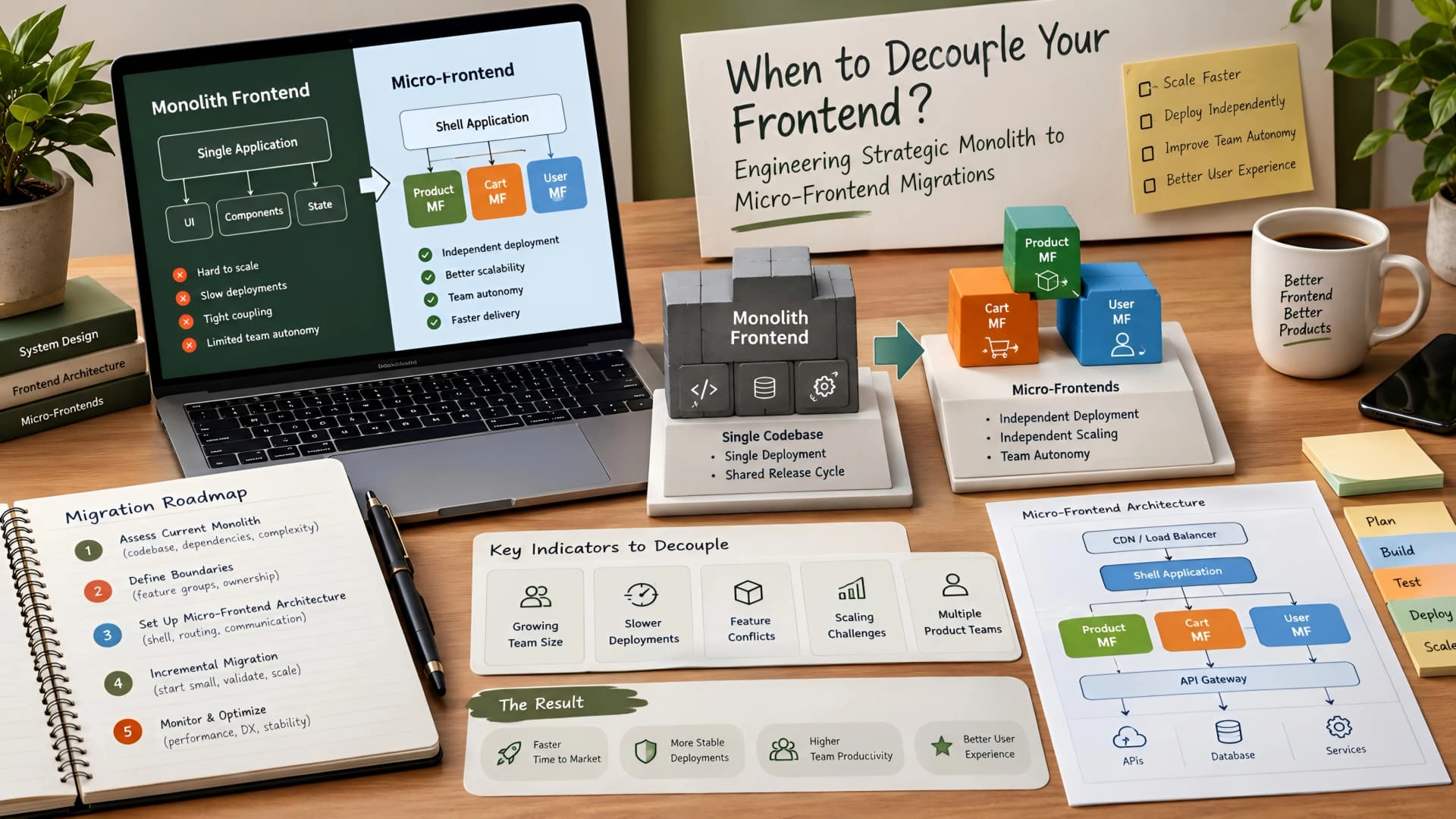
That moment when a frontend codebase feels less like a well-oiled machine and more like a tangled ball of yarn? It's a common inflection point for growing web applications.
Development slows, deployments become high-stakes events, and different teams struggle to work in parallel without stepping on each other's toes. This is often the signal that a monolithic frontend, once efficient, has become an operational bottleneck.
The Monolithic Frontend's Unspoken Costs
Initially, a single, unified frontend codebase offers simplicity. Everything is in one place, making initial development and deployment straightforward.
However, as an application grows in features, team size, and complexity, this simplicity turns into a liability. A small change in one module can inadvertently break another, forcing extensive regression testing and delaying releases.
Symptoms of an Overgrown Frontend
We often see clear indicators that a frontend is straining under its own weight. Build times become excessively long, and onboarding new developers takes weeks as they try to grasp the entire system.
Technological stagnation is another common issue; updating core dependencies or adopting new frameworks becomes a Herculean task due to widespread impacts.
Understanding Micro-Frontends: The Core Concept
Micro-frontends apply the principles of microservices to the frontend. Instead of a single, cohesive application, you decompose it into smaller, independently deployable units.
Each micro-frontend can be developed, tested, and deployed by a dedicated team, often using different technologies if appropriate for the specific domain.
Benefits Beyond the Hype
The primary appeal lies in improved team autonomy and faster release cycles. Teams can own their vertical slice of functionality from database to UI, leading to quicker iterations and fewer cross-team dependencies.
This approach also mitigates technological lock-in, allowing different parts of the application to evolve independently. For us at Muhyo Tech, this means we can design systems that are more resilient to future tech shifts.
When to Consider a Micro-Frontend Migration
Migrating to micro-frontends is not a universal solution; it introduces its own set of complexities. The decision should stem from genuine pain points and a clear understanding of the trade-offs.
We look for specific triggers: a large application with distinct, self-contained business domains, multiple independent teams working on the same codebase, or frequent deployment conflicts.
A Decision Framework for Decoupling
Consider your team structure, the application's domain complexity, and your current deployment pipeline's maturity. If your teams are already aligned with business domains, that's a strong indicator.
Conversely, if your application is relatively small, or your teams are tightly coupled across features, the overhead of micro-frontends might outweigh the benefits.
| Factor | Monolithic Frontend | Micro-Frontend Architecture |
|---|---|---|
| Development Speed | Fast initially, slows with complexity | Slower setup, faster feature delivery over time |
| Team Autonomy | Low, frequent coordination needed | High, independent teams |
| Deployment Risk | High, single point of failure | Lower, isolated deployments |
| Technology Flexibility | Low, difficult to update | High, varied tech stacks possible |
| Operational Overhead | Low initially, grows with complexity | Higher, distributed systems management |
| Initial Setup Cost | Low | High, requires infrastructure and tooling |
Strategic Approaches to Migration
A 'big bang' rewrite is almost always a bad idea. We advocate for an incremental, strangler-fig pattern approach. This involves gradually replacing parts of the monolith with new micro-frontends.
This strategy minimizes risk, allows teams to learn and adapt, and maintains a working application throughout the transition. It's about careful surgical cuts, not demolition.
Common Migration Patterns
- Vertical Split: Identify a distinct business domain (e.g., 'user profile' or 'product catalog') and extract its entire frontend and backend logic.
- Horizontal Split (by functionality): Less common for frontends, but sometimes useful for shared components like navigation or authentication that can be wrapped as a micro-frontend.
- Strangler Fig Pattern: Route new traffic to the new micro-frontends while the old monolith still serves the remaining parts. This allows for a gradual deprecation.
Key Technical Considerations for Micro-Frontends
Implementing micro-frontends isn't just about splitting code; it requires careful thought about integration, communication, and shared dependencies. These decisions shape the long-term maintainability and performance.
One critical area is routing and composition. How do these independent units come together to form a cohesive user experience?
Integration Strategies
Several patterns exist for integrating micro-frontends. Server-side composition (e.g., Edge Side Includes, Nginx proxying) renders different parts on the server before sending to the browser.
Client-side composition (e.g., Web Components, IFrames, or JavaScript-based orchestration frameworks like Single-SPA) assembles the parts directly in the browser. Each has its own performance and complexity implications.
Communication and State Management
Loose coupling is key. Micro-frontends should communicate via events rather than direct calls to avoid tight dependencies. A global event bus or shared state management library can facilitate this.
However, over-reliance on shared state can quickly reintroduce monolithic coupling, so clear boundaries are essential. Our engineering standards emphasize explicit contracts and minimal shared state.
Shared Dependencies and Performance
Managing shared libraries (e.g., React, Vue) without duplicating them across every micro-frontend is crucial for performance. Module Federation in Webpack 5 is a powerful solution here, allowing dynamic sharing of dependencies.
Lazy loading and efficient caching strategies are also paramount to ensure a snappy user experience. We meticulously optimize asset loading to prevent performance regressions.
Operational Challenges and Best Practices
While micro-frontends offer significant development benefits, they shift complexity from the codebase to the operational domain. Deployment pipelines, monitoring, and testing become more intricate.
A robust CI/CD setup is non-negotiable for independent deployments. Each micro-frontend needs its own pipeline, ensuring rapid, isolated releases.
Deployment and Monitoring
Automated deployments are crucial. A single command should be able to deploy a micro-frontend independently. Centralized logging and monitoring tools become even more important to diagnose issues across distributed components.
We configure alerts that span across micro-frontends to catch subtle interactions or performance degradations early.
Testing in a Distributed Environment
End-to-end testing becomes more complex. While individual micro-frontends have their unit and integration tests, cross-micro-frontend integration tests are essential.
These often involve setting up test environments that mimic production, ensuring all components work together as expected. This might involve containerized environments or virtualized services.
The Business Value of a Thoughtful Migration
The engineering effort in a micro-frontend migration isn't just about cleaner code; it directly translates to tangible business value. Faster time-to-market for new features is a significant benefit.
Reduced deployment risk means fewer critical outages and more stable operations. This builds customer trust and reduces owner stress.
Accelerated Innovation and Scalability
By empowering smaller, focused teams, micro-frontends foster innovation. Teams can experiment with new technologies or features within their domain without impacting the entire application.
This architectural choice supports long-term scalability, allowing different parts of the application to scale independently based on demand, both in terms of traffic and development resources.
Frequently Asked Questions (FAQs)
What are the common strategies for migrating to micro-frontends?
The most common and safest strategy is the Strangler Fig pattern, where new micro-frontends gradually replace parts of the monolithic application. This allows for incremental adoption and reduces risk.
How can I incrementally adopt micro-frontends from a monolithic application?
Start by identifying a well-isolated domain within your monolith. Develop the new functionality as a micro-frontend, integrate it alongside the existing monolith, and then slowly refactor or remove the old monolithic equivalent. Use routing to direct traffic to the new component.
What are the main challenges in a micro-frontend migration and how to overcome them?
Challenges include increased operational complexity, consistent user experience across different teams, shared dependencies, and communication overhead. Overcome these with robust CI/CD, a strong design system, careful dependency management (e.g., Module Federation), and clear communication protocols between micro-frontends.
When should I consider migrating to a micro-frontend architecture?
Consider migration when your monolithic frontend is causing significant development bottlenecks, build times are too long, multiple independent teams are struggling to work in parallel, or you need to introduce new technologies without a full rewrite. It's a strategic decision for growing, complex applications.