


Basic Retrieval-Augmented Generation (RAG) is a powerful starting point for grounding Large Language Models (LLMs) in specific data. However, as we push LLMs into complex production scenarios, simple RAG often hits its limits.
Queries can be nuanced, data can be noisy, and maintaining a coherent, relevant conversation becomes a significant engineering challenge. When LLM responses falter due to poor retrieval, user trust erodes, and the perceived value of your AI application plummets.
The Limits of Basic RAG in Production
Simple RAG typically involves a single retrieval step: a user query is used to search a knowledge base (like a vector database) for relevant documents, which are then fed to the LLM as context. This works well for straightforward questions.
The problems emerge with ambiguity, implicit intent, or when multiple pieces of information, perhaps from different sources, are needed to form a complete answer. We’ve seen scenarios where the LLM, despite having access to information, fails to synthesize it correctly because the retrieved chunks were not perfectly aligned with the user's underlying need.
Engineering Deeper Context: Beyond Single-Stage Retrieval
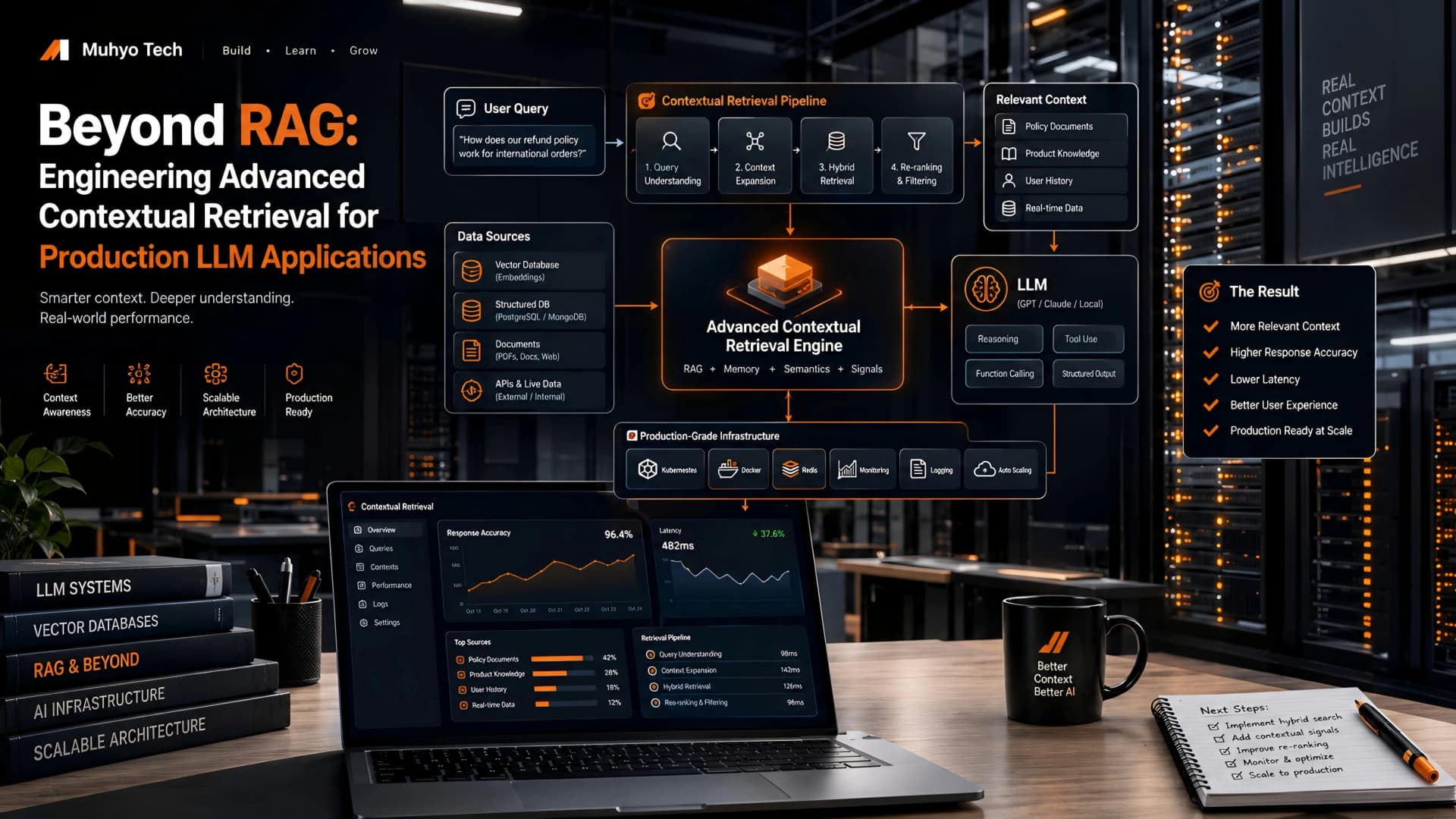
To overcome these limitations, we engineer more sophisticated retrieval pipelines. This involves multiple stages of processing, refinement, and contextualization before the information ever reaches the LLM.
Our approach focuses on ensuring the *right* information, in the *right* format, at the *right* time. This often means breaking down the problem into smaller, manageable retrieval and processing steps.
Multi-Stage Retrieval Pipelines
Instead of a single pass, we design pipelines that might involve an initial broad retrieval, followed by a more focused, refined search based on the first set of results. This helps to zero in on the most pertinent information.
For example, a user might ask a broad question about product features. The first stage retrieves all related feature documents. A second stage then analyzes these documents to identify specific feature sets or technical specifications that best match the implied detail in the user's original query.
Re-ranking for Relevance
Even with good retrieval, the order and relevance of the retrieved chunks matter. We implement re-ranking mechanisms, often using smaller, specialized models or sophisticated scoring algorithms, to push the most critical pieces of information to the top of the context window.
This ensures the LLM prioritizes the most relevant details, reducing the chance of it being distracted by less important, albeit still related, content. It’s about guiding the LLM’s attention effectively.
Query Expansion and Transformation
Sometimes, the user’s query isn't perfectly phrased for direct retrieval. We engineer techniques to expand or transform the query. This can include using the LLM itself to rephrase the query for better searchability or employing synonym dictionaries and knowledge graphs.
If a user asks about "speed upgrades" for a product, we might transform that into searches for "performance enhancements," "acceleration features," or "throughput improvements" to capture a wider net of relevant information.
Knowledge Graph Integration
For highly structured or relational data, integrating knowledge graphs can be transformative. This allows for semantic understanding and traversal of relationships between entities, providing richer context than simple keyword matching.
Imagine asking about a company’s competitors. A knowledge graph can link companies, their products, and market segments, allowing for a more nuanced and accurate answer than just retrieving documents mentioning company names.
Hybrid Search Strategies
We often combine different search modalities. This might include vector search (for semantic similarity) alongside keyword search (for exact matches) or full-text search. Each method has strengths and weaknesses.
A hybrid approach leverages the best of both worlds. For instance, a vector search might find semantically similar documents, while a keyword search ensures specific technical terms or product names are precisely matched.
Production Considerations: Beyond the Core Retrieval
Implementing advanced RAG isn't just about the retrieval algorithms themselves. It requires robust engineering practices to ensure reliability, scalability, and maintainability in a production environment.
Data Preparation and Indexing
The quality of your knowledge base is paramount. We invest heavily in data cleaning, chunking strategies, and effective indexing to ensure the retrieval system has high-quality material to work with.
Improperly formatted or overly large text chunks can degrade retrieval accuracy. Our process involves careful consideration of metadata and semantic boundaries when preparing data for indexing.
Validation and Human Review Loops
Probabilistic models like LLMs and retrieval systems can sometimes produce incorrect or nonsensical outputs. We engineer systems with built-in validation checks and, crucially, human review loops for critical applications.
This means not blindly trusting the output. We design mechanisms to flag potentially problematic responses for human oversight, ensuring accuracy and safety, especially in sensitive domains.
Privacy and Security
When dealing with proprietary or sensitive data, privacy and security are non-negotiable. We implement strict access controls, data anonymization where necessary, and ensure that retrieval systems only access authorized information.
The LLM should never be exposed to data it's not permitted to see. This requires careful architecture design and adherence to data governance policies.
Fallback Mechanisms
What happens when retrieval fails or the LLM produces an unhelpful response? Robust fallback strategies are essential. This could mean gracefully informing the user, offering alternative actions, or escalating to a human agent.
We aim to prevent frustrating dead ends for users. A well-defined fallback ensures a smoother experience even when the AI’s primary response isn't optimal.
Observability and Monitoring
Understanding how your RAG system performs in the wild is critical. We build comprehensive observability into our systems, tracking retrieval success rates, LLM response quality, latency, and error patterns.
This data is vital for identifying performance bottlenecks, areas for improvement, and potential issues before they impact a large number of users. It’s proactive system health management.
Cost Management
Advanced retrieval techniques, especially those involving multiple LLM calls or complex indexing, can increase operational costs. We meticulously analyze and optimize these costs, balancing performance gains with economic efficiency.
This might involve selecting the most cost-effective models for specific tasks, optimizing data retrieval queries, or implementing caching strategies to reduce redundant computations.
Comparison of Retrieval Strategies
Choosing the right retrieval strategy depends on your specific use case, data complexity, and performance requirements. Here’s a look at common approaches:
| Strategy | Description | Pros | Cons | Best For |
|---|---|---|---|---|
| Basic RAG | Single-stage vector search. | Simple to implement, fast for basic queries. | Struggles with complex intent, noise, multi-faceted answers. | FAQ bots, simple information retrieval. |
| Multi-Stage Retrieval | Sequential retrieval, refining results. | Improved accuracy for complex queries, better focus. | Increased latency, more complex pipeline. | Customer support, technical documentation. |
| Re-ranking | Post-retrieval ordering of results. | Prioritizes key information for LLM. | Adds processing time, requires a re-ranking model. | Context-sensitive applications, summarization. |
| Query Expansion | Enriching or transforming user queries. | Captures broader semantic intent. | Risk of introducing irrelevant terms, needs careful tuning. | Natural language interfaces, search engines. |
| Knowledge Graph Integration | Leveraging structured relationships. | Deep contextual understanding, complex relationship queries. | Requires building and maintaining a KG, complex integration. | Enterprise knowledge management, recommendation systems. |
| Hybrid Search | Combining vector, keyword, and other searches. | Best of multiple worlds, high accuracy across different query types. | Increased complexity in implementation and tuning. | E-commerce search, complex document retrieval. |
Architectural Checklist for Production RAG
When engineering an advanced RAG system for production, we rely on a structured approach. Here’s a checklist we often consider:
- Clear Objective Definition: What specific problems must the LLM solve?
- Data Source Assessment: What data is available? What is its quality and structure?
- Retrieval Strategy Selection: Choose based on query complexity and data type (basic, multi-stage, hybrid, KG).
- Chunking and Embedding Strategy: Optimize text segmentation and vector representation.
- Vector Database Choice: Select a scalable, performant database.
- Query Processing Pipeline: Design for expansion, transformation, and potential LLM-assisted refinement.
- Re-ranking Implementation: Decide on a re-ranking approach if needed.
- LLM Integration: Define prompt engineering for context injection.
- Validation and Safety Layers: Implement checks for accuracy, bias, and hallucinations.
- Human-in-the-Loop: Design review processes for critical outputs.
- Fallback and Error Handling: Plan for retrieval or generation failures.
- Observability and Monitoring: Set up logging, tracing, and performance metrics.
- Security and Access Control: Ensure data privacy and compliance.
- Cost Optimization: Monitor and tune resource usage.
- Scalability Planning: Architect for anticipated load.
Common Mistakes to Avoid
Even with advanced techniques, missteps can lead to underperforming systems. We often see these pitfalls:
- Over-reliance on a single retrieval method: Not accounting for query diversity.
- Poor data quality: Garbage in, garbage out.
- Inadequate chunking: Text segments too large or too small.
- Ignoring re-ranking: Letting less relevant information dilute context.
- Lack of validation: Trusting LLM output without checks.
- Neglecting observability: Flying blind when issues arise.
- Underestimating complexity: Treating advanced RAG as a simple add-on.
The Muhyo Tech Approach to AI Engineering
At Muhyo Tech, we view advanced RAG not as a single tool, but as an integrated system within a larger application architecture. Our engineering standards emphasize robustness, maintainability, and clear value delivery.
We focus on building these systems with a deep understanding of the underlying data and the specific business problems they are designed to solve. This practical, problem-first approach ensures that the AI capabilities we engineer translate into tangible improvements, whether it’s better customer insights or more efficient internal workflows.
Frequently Asked Questions
How do I choose between different RAG strategies?
Evaluate your data complexity, the anticipated variety of user queries, and your tolerance for latency and cost. Simple FAQs might suit basic RAG, while complex research assistants require multi-stage or hybrid approaches.
What are the performance implications of advanced RAG?
Advanced RAG typically increases latency due to more processing steps. However, this is often a trade-off for significantly improved accuracy and relevance, which enhances user experience and task success rates.
How can I ensure the LLM doesn't hallucinate with advanced RAG?
While advanced RAG significantly reduces hallucinations by grounding responses in retrieved data, it doesn't eliminate them entirely. Implement strong validation checks, prompt engineering that discourages speculation, and consider human review for critical outputs.
What is the role of prompt engineering in advanced RAG?
Prompt engineering is crucial for guiding the LLM on how to use the retrieved context effectively. It involves crafting instructions that tell the LLM to answer based *only* on the provided information, to cite sources, or to synthesize data from multiple retrieved chunks.
Final Thoughts: Engineering for Production-Ready AI
Moving from basic RAG to advanced contextual retrieval is essential for unlocking the full potential of LLMs in demanding production environments. It requires a deep understanding of retrieval mechanics, careful data management, and robust software engineering practices.
By engineering multi-stage pipelines, incorporating re-ranking, and focusing on critical aspects like validation, security, and observability, we can build AI applications that are not only intelligent but also reliable, accurate, and trustworthy. This is the foundation for genuinely valuable AI-powered digital services.