


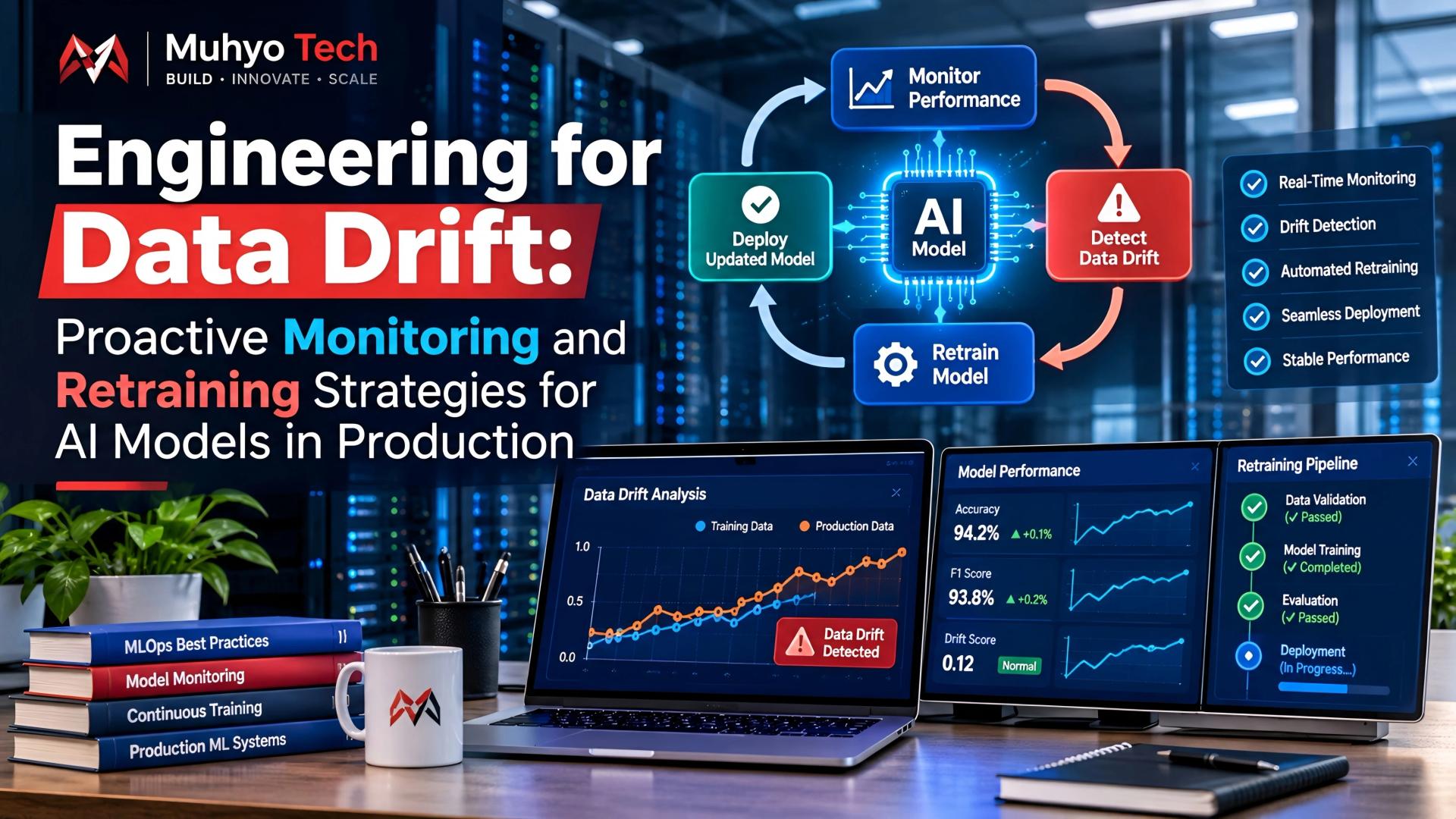
Deploying an AI model into production feels like a major victory. The real work, however, often begins the moment that model starts serving live traffic.
One of the most insidious challenges we face is data drift: the silent, gradual shift in the characteristics of incoming data that slowly erodes a model's accuracy and effectiveness.
The Silent Erosion: Understanding Data Drift
Data drift occurs when the statistical properties of the data a model processes in production diverge from the data it was trained on. This isn't about bugs or broken code; it's a fundamental change in the environment.
Imagine a recommendation engine trained on user preferences from last year. If user tastes or product offerings significantly change, the model's 'understanding' becomes outdated, leading to poor recommendations and frustrated users.
Why Data Drift Matters for Business Outcomes
For any business relying on AI-powered features, data drift is a direct threat to value. A credit fraud detection model that misses new fraud patterns, or a predictive maintenance model that misdiagnoses equipment, directly impacts revenue and trust.
Unchecked drift leads to unreliable predictions, degraded user experiences, and ultimately, a loss of confidence in the AI system itself. This can translate to weak lead generation, missed sales opportunities, or operational inefficiencies.
Proactive Detection: The First Line of Defense
The core challenge with data drift is its subtlety; performance often degrades slowly, making it hard to notice until the impact is significant. Proactive monitoring is essential to catch these shifts early.
We look for changes in statistical distributions, feature importance, and model predictions themselves. This isn't just about accuracy, but about understanding the underlying data generating process.
Statistical Monitoring Techniques for Feature Drift
Monitoring individual feature distributions is a foundational step. For numerical features, we can track mean, variance, and skewness over time, often comparing current distributions to a baseline from the training data.
For categorical features, changes in category frequencies are key. Statistical tests like the Kullback-Leibler (KL) divergence, Jensen-Shannon divergence, or Population Stability Index (PSI) can quantify the difference between two distributions, providing a numerical score for drift.
Monitoring Model Performance and Prediction Drift
While feature drift tells us about input data, prediction drift tells us how the model's outputs are changing. We track the distribution of model predictions (e.g., predicted probabilities, class distributions) over time.
Additionally, monitoring core model performance metrics like accuracy, precision, recall, F1-score, or AUC is critical. However, this often requires ground truth labels, which can be delayed or expensive to obtain in real-time production settings.
Automated Retraining Pipelines: Adapting to Change
Detecting drift is only half the battle; the other half is responding to it. Automated retraining pipelines are a robust engineering solution to ensure models can adapt to new data patterns without constant manual intervention.
These pipelines typically involve triggering a retraining job when drift is detected or on a scheduled basis, using the most recent production data, and then deploying the updated model.
Designing a Robust Retraining Workflow
A well-designed retraining workflow includes several key stages: data collection and labeling (if needed), data validation, model training, model evaluation against new data and a holdout set, and finally, deployment.
At Muhyo Tech, we emphasize immutable training data snapshots and versioning for reproducibility. This ensures that if a retraining run introduces issues, we can revert to a known good state.
Canary Deployments and A/B Testing for New Models
Blindly replacing an old model with a newly retrained one can introduce new problems. Canary deployments allow us to route a small percentage of live traffic to the new model, monitoring its performance and stability in real-time.
If the canary performs well, traffic can be gradually increased. A/B testing takes this further, allowing for controlled experiments where different model versions serve different user segments, providing clear performance comparisons before a full rollout.
Architectural Considerations for Drift Management
Effective data drift management requires specific architectural components to be in place. These aren't just add-ons; they are integral to a reliable AI system.
Thinking about data ingestion, feature stores, and model serving infrastructure with drift in mind from the outset saves significant rework later.
A Production-Ready Drift Management Checklist
- Data Ingestion & Validation: Ensure all incoming data is validated against a schema to catch immediate anomalies.
- Feature Store: Centralize and version features to ensure consistency between training and serving.
- Monitoring Dashboard: Visualizations for feature distributions, prediction distributions, and model performance metrics.
- Alerting System: Automated alerts (Slack, email, PagerDuty) triggered by drift detection metrics exceeding thresholds.
- Automated Retraining Pipeline: CI/CD for models, including data fetching, training, evaluation, and deployment.
- Model Registry: Version control for models, metadata, and associated artifacts.
- Canary/A/B Testing Infrastructure: Tools to safely roll out and test new model versions.
- Rollback Mechanism: Ability to quickly revert to a previous stable model version.
Choosing the Right Tools for Data Drift Detection
The MLOps landscape offers numerous tools, both open-source and commercial, to help manage data drift. The best choice depends on your existing infrastructure, team expertise, and specific requirements.
It's rarely about one silver bullet; often, a combination of tools provides the most robust solution.
Comparison of Drift Detection Approaches
| Approach | Description | Pros | Cons | Best Use Case |
|---|---|---|---|---|
| Statistical Tests (PSI, KL, JS Divergence) | Quantifies distribution differences between datasets. | Mathematically rigorous, widely understood. | Can be sensitive to noise, threshold setting is crucial. | Feature drift detection for well-defined features. |
| Control Charts (e.g., Shewhart, CUSUM) | Monitors changes in mean or variance of a metric over time. | Effective for detecting shifts in central tendency. | May miss subtle changes in distribution shape. | Monitoring aggregated model metrics (e.g., average prediction score). |
| Model-based Drift Detection (e.g., Drift Detectors) | Trains a secondary model to classify if data is 'old' or 'new'. | Can detect complex, multivariate drift patterns. | Adds another model to manage, can be computationally intensive. | Detecting subtle, non-linear drift in high-dimensional data. |
| Feature Importance Tracking | Monitors changes in feature relevance to model predictions. | Identifies which features are most affected by drift. | Requires interpretability techniques (e.g., SHAP, LIME). | Understanding the 'why' behind performance degradation. |
Beyond Detection: Tradeoffs and Considerations
Implementing a comprehensive drift management strategy involves balancing technical complexity, operational costs, and the criticality of the AI application. Not every model requires the same level of vigilance.
Over-engineering can be as detrimental as under-engineering, leading to unnecessary maintenance overhead or alert fatigue.
Common Pitfalls to Avoid
- Ignoring Data Quality: Drift detection is useless if the underlying data pipelines are unreliable or dirty.
- Static Thresholds: Drift thresholds often need dynamic adjustment based on seasonalities or business cycles.
- Lack of Ground Truth: Without a way to measure true model performance, drift detection becomes a heuristic.
- Retraining Too Often (or Not Enough): Finding the right balance for retraining frequency is crucial to avoid cost overruns or stale models.
- Neglecting Interpretability: Simply knowing drift occurred isn't enough; understanding why helps in remediation.
Muhyo Tech's Approach to AI Reliability
At Muhyo Tech, we integrate drift detection and automated retraining as core components of our AI solution architecture, not as afterthoughts. We prioritize building observable systems where model behavior is transparent.
Our focus is on creating resilient, self-healing AI workflows that provide sustained business value, minimizing operational risk and ensuring models remain effective long after their initial deployment.
The Business Value of Proactive Drift Management
Investing in robust data drift detection and mitigation isn't just a technical best practice; it's a strategic business decision. It directly translates into sustained accuracy, reliability, and ultimately, ROI from your AI investments.
Preventing silent degradation means your AI-powered features continue to deliver expected benefits, whether that's improved customer experience, optimized operations, or stronger fraud prevention.
Frequently Asked Questions
How do I detect data drift in my AI models in production?
You detect data drift by monitoring the statistical properties of your incoming production data, comparing them to the data used during training. Techniques include tracking feature distributions (mean, variance, frequencies) using metrics like PSI or KL divergence, and observing shifts in model prediction distributions.
What are the different types of data drift and how do they impact AI models?
The main types are Concept Drift (the relationship between input features and target changes) and Covariate Shift (the distribution of input features changes, but the relationship with the target remains). Both degrade model performance because the model's learned patterns no longer accurately reflect reality.
How can I mitigate data drift once it's detected in a production AI system?
The primary mitigation strategy is automated model retraining using the most recent, relevant production data. Other strategies include fine-tuning the existing model, re-engineering features, or implementing an ensemble of models that can adapt to different data regimes.
What are the best tools or platforms for monitoring data drift in ML?
Many MLOps platforms and libraries offer drift detection capabilities. Open-source options include evidently.ai, NannyML, and Deepchecks. Cloud providers like AWS Sagemaker, Google Cloud Vertex AI, and Azure ML also provide integrated monitoring services for their ML pipelines.