


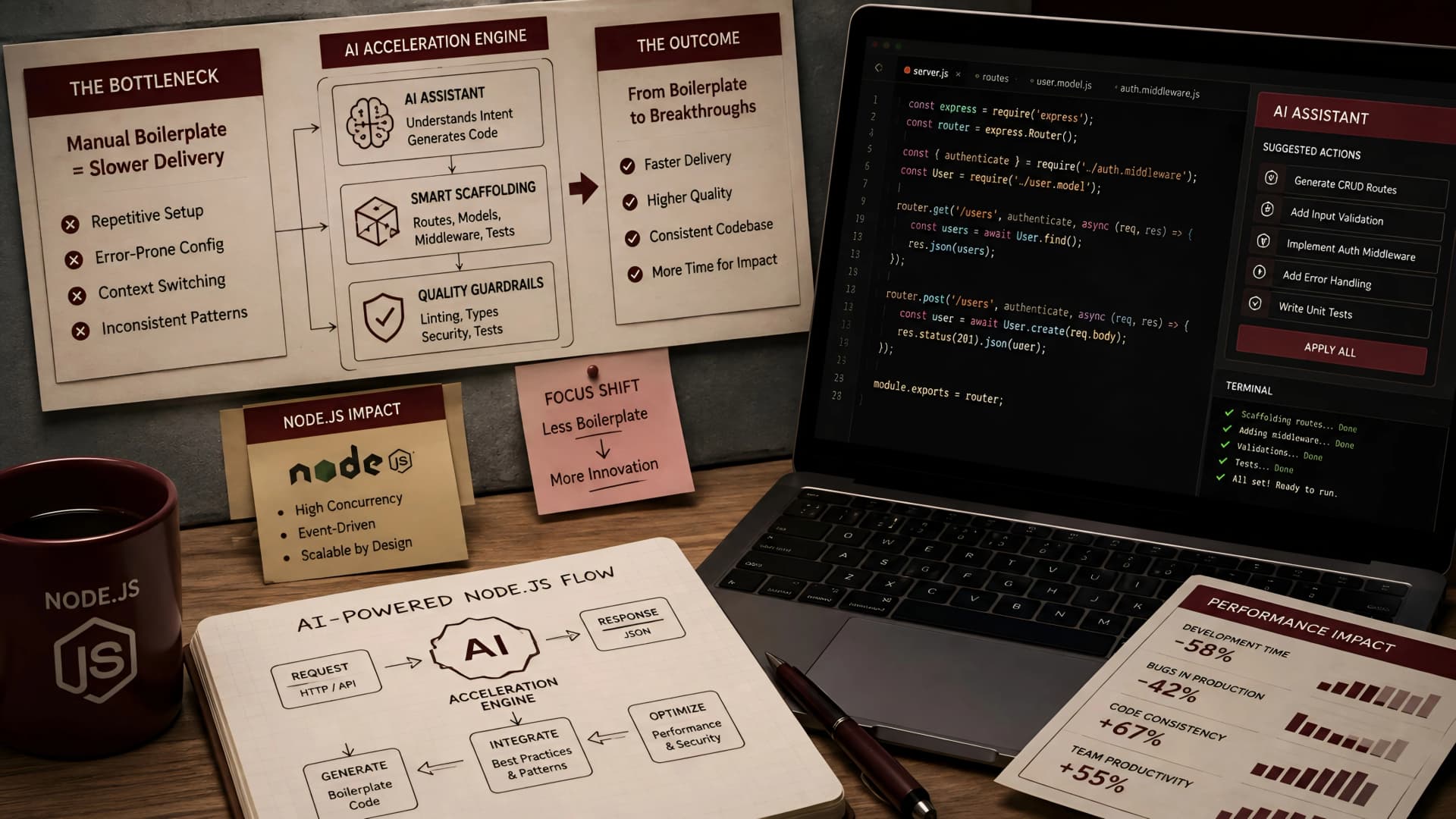
Every Node.js developer knows the drill: starting a new project often means writing the same setup code, configuring routes, or creating database models, again and again. This boilerplate isn't complex, but it's a significant time sink. Similarly, inheriting a sprawling legacy Node.js application can feel like deciphering an ancient scroll, demanding hours of manual refactoring to improve readability or performance.
These repetitive tasks and complex refactorings are precisely where AI-powered tools are beginning to shine. They promise to transform the Node.js development workflow, moving us closer to truly intelligent assistance. As we explore in our foundational guide, AI in Web Development: An Engineering Guide to Boosting Efficiency and Innovation, these tools aren't just novelties; they're becoming essential.
The Pain Points AI Addresses in Node.js Development
Node.js applications, while powerful and flexible, can suffer from common engineering challenges. The sheer volume of asynchronous code, callback hell (or promise chains), and the need for robust error handling often lead to verbose codebases. This complexity grows with project scale.
Maintaining consistency across a large team or refactoring an older application to adopt modern JavaScript features (like async/await) can be a monumental effort. These are not just inconveniences; they directly impact project timelines, increase technical debt, and can lead to developer burnout. Our approach at Muhyo Tech always seeks to minimize such friction points for long-term project health.
AI for Node.js Code Generation: Beyond Basic Snippets
When we talk about AI code generation for Node.js, it's more than just auto-completing variable names. Modern AI assistants can generate entire functions, API endpoints, or even simple CRUD operations based on a natural language prompt or existing code context. Imagine describing a REST API route for user management, and the AI drafts the Express.js code, complete with request validation and database interaction.
This capability dramatically accelerates the initial scaffolding phase of any Node.js project. It allows developers to focus on unique business logic and architectural decisions, rather than the mechanical act of typing out standard patterns. This shift reduces the time spent on repetitive tasks, freeing up valuable engineering hours.
AI-Assisted Refactoring: Taming Technical Debt
Refactoring is crucial for maintaining a healthy codebase, but it's often postponed due to time constraints and the risk of introducing new bugs. AI tools can analyze existing Node.js code and suggest intelligent refactorings. This could range from identifying redundant logic, suggesting more idiomatic JavaScript patterns, or even converting older callback-based code to modern async/await syntax.
These tools act as an extra pair of eyes, highlighting areas for improvement in performance, readability, and maintainability. While human oversight is still critical to ensure correctness and architectural alignment, AI significantly reduces the manual effort involved. It's about augmenting developer capabilities, not replacing them.
Integrating AI into Your Node.js Workflow: Practical Steps
Integrating AI code generation and refactoring tools into a Node.js workflow requires careful consideration. Most commonly, this involves using IDE extensions (like GitHub Copilot for VS Code) or specialized AI-driven platforms. For more advanced use cases, direct integration with AI APIs (like OpenAI's models) can enable custom code generation or analysis within your build pipelines.
Key steps include authenticating with the AI service, managing API keys securely (never commit them directly to source control), and understanding rate limits. It's essential to treat AI-generated code as a draft, subject to the same rigorous testing, code reviews, and quality gates as human-written code. Our engineering standards at Muhyo Tech emphasize this critical human-in-the-loop validation.
Benefits, Limitations, and the Muhyo Tech Perspective
The benefits of AI in Node.js development are clear: faster development cycles, reduced boilerplate, and improved code quality through intelligent refactoring suggestions. This leads to quicker launches and less technical debt in the long run. For businesses, this translates directly to lower development costs and more resources available for innovation.
However, AI is not a silver bullet. Its limitations include generating code that might be syntactically correct but functionally flawed, introducing security vulnerabilities, or simply not aligning with project-specific architectural patterns. The generated code also needs careful review for licensing compliance if the AI model was trained on proprietary or restricted codebases.
At Muhyo Tech, we view AI as a powerful assistant, not a replacement for skilled engineers. We leverage these tools to accelerate repetitive tasks and provide intelligent insights, always ensuring that human expertise guides the architectural decisions, performs thorough testing, and maintains overall code ownership. This hybrid approach allows us to deliver robust, scalable Node.js applications efficiently, whether we're building a new full-stack web application or integrating complex API integrations.
The Future of AI and Node.js Development
The landscape of AI-powered development tools is evolving rapidly. We can expect more sophisticated AI models capable of understanding larger codebases, performing more complex architectural suggestions, and even autonomously fixing certain classes of bugs. The focus will shift from simple code generation to more intelligent, context-aware engineering assistance.
For Node.js developers, embracing these tools will be crucial for staying competitive and efficient. It's about evolving our workflows to incorporate intelligent automation, allowing us to tackle bigger, more challenging problems. The goal is to build better, faster, and more maintainable web applications, ultimately leading to greater business value and reduced long-term maintenance burdens.