


When a Node.js application slows down under load, the immediate suspects often include database queries or external API calls. Yet, sometimes the bottleneck hides closer to home, deep within the very engine that makes Node.js so efficient: the event loop.
Misunderstanding how the Node.js event loop operates can lead to insidious performance issues, turning a seemingly powerful server into a sluggish roadblock. Our goal at Muhyo Tech is always to build systems that scale reliably, and that starts with a firm grasp of these core mechanics.
The Core Problem: Blocking the Event Loop
Node.js thrives on its non-blocking, asynchronous nature. This design allows it to handle many concurrent connections with a single thread, making it incredibly efficient for I/O-bound operations. The magic behind this is the event loop.
However, this single-threaded model means that any operation that takes too long to complete synchronously will 'block' the event loop. This prevents other pending tasks from being processed, causing delays, increased latency, and a poor user experience across all active connections.
Imagine a bustling restaurant with only one chef. If that chef stops to peel 100 potatoes by hand while orders pile up, the entire kitchen grinds to a halt. The Node.js event loop is that chef.
Deconstructing the Event Loop: Phases and Priorities
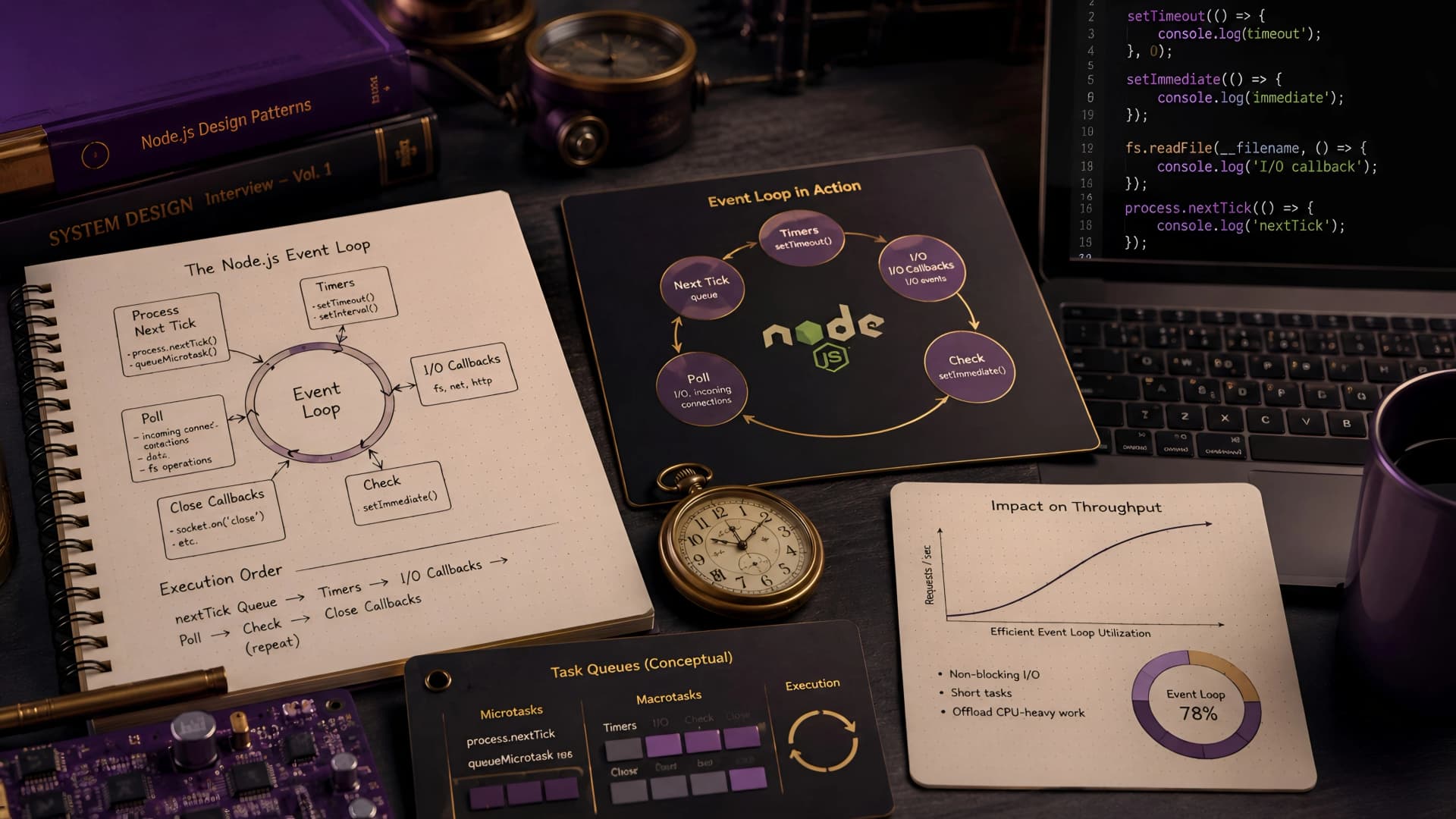
The Node.js event loop isn't a single continuous loop; it operates in distinct phases. Understanding these phases is critical for Node.js event loop optimization and for scheduling tasks correctly.
- Timers (
setTimeout(),setInterval()): This phase executes callbacks scheduled by timers. - Pending Callbacks: Executes I/O callbacks deferred to the next loop iteration.
- Idle, Prepare: Internal phases used only by Node.js.
- Poll: This is the most crucial phase. It retrieves new I/O events (like network requests or file reads) and executes their callbacks. If no I/O events are ready, it might block here briefly, waiting for events or checking for timers to expire.
- Check (
setImmediate()): ExecutessetImmediate()callbacks. - Close Callbacks: Handles
'close'events for some handles.
Additionally, microtask queues exist outside these main phases: the Promise queue (for .then()/.catch()/.finally()) and the process.nextTick() queue. These microtasks are executed immediately after the currently running operation completes and before the event loop proceeds to the next phase.
Common Pitfalls and How to Diagnose Them
The most common pitfall is synchronous, CPU-intensive work. Cryptographic operations, complex calculations, large JSON parsing, or heavy data transformations performed synchronously will halt the event loop.
Another common issue involves blocking I/O operations, such as reading a very large file synchronously. While Node.js offers synchronous I/O methods (e.g., fs.readFileSync), they should be used with extreme caution and only for startup scripts, never in request handlers.
Diagnosis often begins with monitoring. Tools like the Node.js built-in profiler, clinic.js, or even simple console.time()/console.timeEnd() blocks can help pinpoint slow functions. Look for functions that consistently take tens or hundreds of milliseconds.
Strategies for Non-Blocking Operations and Efficiency
Achieving Node.js event loop optimization means embracing asynchronous patterns fully. Here are key strategies we implement in our work:
1. Prioritize Asynchronous I/O
Always use the asynchronous versions of I/O operations. For file system access, opt for fs.readFile over fs.readFileSync. For database interactions, ensure your ORM or client library is configured for non-blocking operations.
This ensures that while your application waits for a file to load or a database query to return, the event loop remains free to process other incoming requests.
2. Offload CPU-Bound Tasks
For truly CPU-intensive computations, Node.js offers worker threads. These allow you to run JavaScript code in parallel, outside the main event loop thread. This is a game-changer for tasks like image processing, complex data analytics, or heavy cryptographic calculations.
By moving these tasks to a worker thread, the main thread stays responsive, ensuring a smooth experience for all users. Our approach at Muhyo Tech often involves identifying these 'heavy' operations early in the design phase.
3. Understand process.nextTick() vs. setImmediate() vs. setTimeout(fn, 0)
These scheduling mechanisms have distinct behaviors within the event loop:
process.nextTick(): Executes its callback immediately after the current operation finishes, before the event loop moves to the next phase. Use it for error handling or normalizing arguments before continuing with synchronous code.setTimeout(fn, 0): Schedules a callback to be run in the 'timers' phase of the next event loop cycle.setImmediate(): Schedules a callback to be run in the 'check' phase of the current event loop cycle, after the poll phase. This is often better for deferring tasks thansetTimeout(fn, 0)if you want to ensure I/O callbacks are processed first.
Choosing the right deferral mechanism depends on your specific use case and how urgently you need the task to run relative to other event loop phases.
4. Streamline Data Processing
Instead of loading entire large files or datasets into memory at once, use Node.js streams. Streams allow you to process data in chunks, significantly reducing memory footprint and preventing blocking operations.
This is especially valuable when dealing with large uploads, parsing big log files, or streaming media content. It’s a core pattern for efficient resource utilization.
Business Value: Responsiveness and Scalability
The immediate business value of Node.js event loop optimization is undeniable. Applications become more responsive, leading to better user satisfaction and reduced bounce rates. This translates directly to improved customer trust and engagement.
Beyond responsiveness, a well-optimized event loop allows your application to handle a much higher volume of concurrent users and requests. This means your backend can scale more efficiently, requiring fewer server resources for the same workload, which in turn reduces operational costs.
At Muhyo Tech, our commitment to robust backend architecture, as detailed in our comprehensive guide Optimizing Node.js Performance: An Engineering Guide to High-Scale Backends, directly reflects these principles. By paying meticulous attention to the event loop, we build systems that are not just functional, but truly performant and resilient under pressure.
Conclusion: The Foundation of High-Performance Node.js
The Node.js event loop is the heartbeat of every application. Ignoring its intricacies or allowing it to be blocked is a direct path to performance woes. By understanding its phases, diagnosing bottlenecks, and employing asynchronous patterns, worker threads, and careful scheduling, you can unlock the full potential of Node.js.
Investing in this fundamental understanding ensures that your applications remain fast, reliable, and capable of scaling to meet future demands, providing tangible business value through superior performance and reduced operational overhead.