

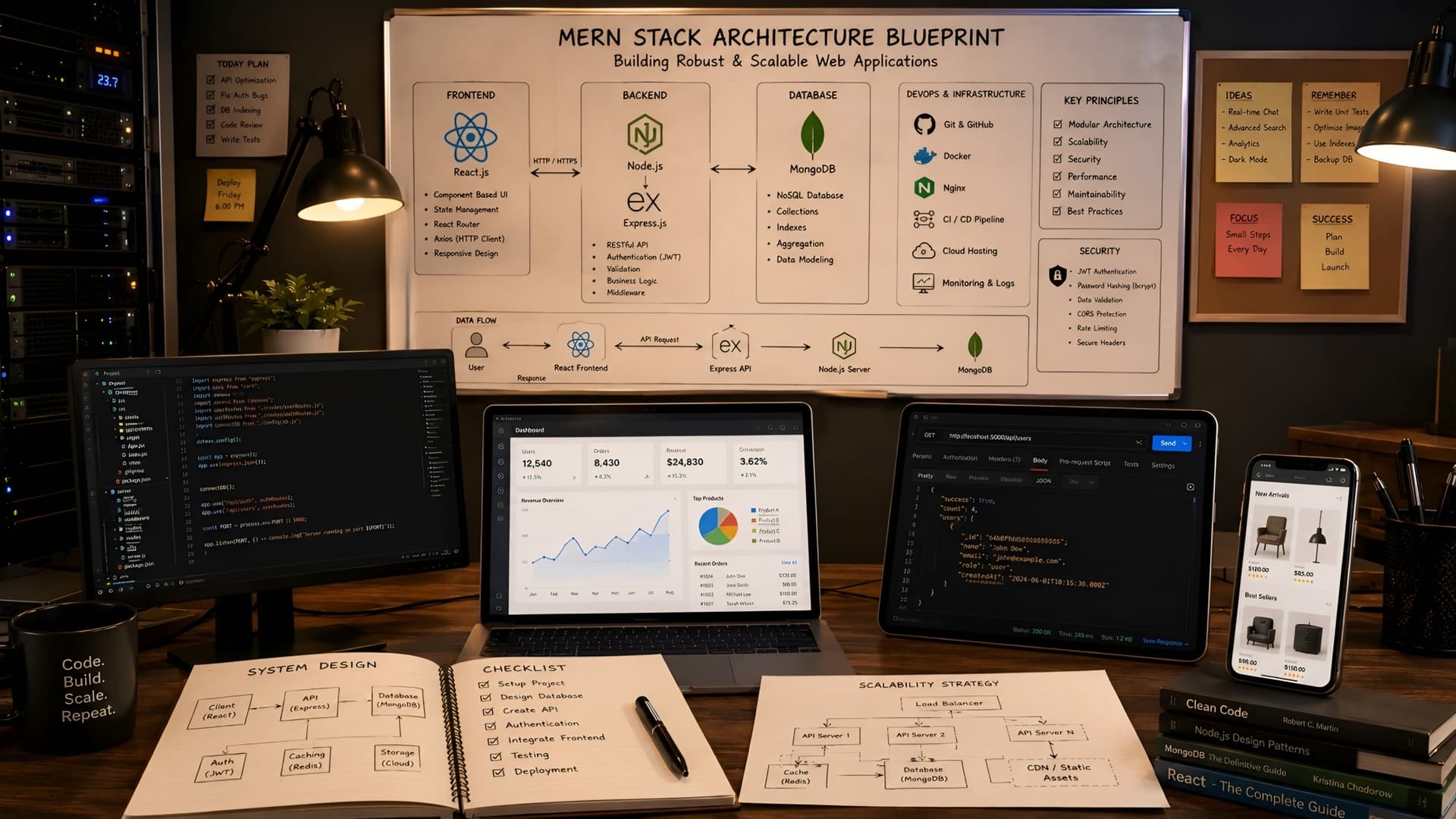
When we talk about full-stack web development, the MERN stack often comes up as a powerful, cohesive choice. It offers a JavaScript-centric approach from front-end to back-end, which can streamline development workflows significantly.
However, simply knowing the components isn't enough. The real challenge, and where we often see teams struggle, lies in integrating MongoDB, Express.js, React, and Node.js into a truly cohesive, high-performance, and scalable application.
This guide serves as our engineering blueprint for architecting, developing, and deploying robust web applications using the MERN stack. We'll cover everything from data modeling to API design, front-end patterns, authentication, and deployment strategies, all through the lens of building for scale and reliability.
Understanding the MERN Stack: A Unified Ecosystem
The MERN stack is an acronym for MongoDB, Express.js, React, and Node.js. Each component plays a critical role in the full-stack ecosystem, and their collective power comes from their seamless integration.
MongoDB provides a flexible NoSQL database, Express.js handles the server-side routing and middleware, React powers dynamic user interfaces, and Node.js serves as the JavaScript runtime for the back-end. This JavaScript ubiquity across the stack is a core advantage, reducing context switching for developers.
MongoDB: Flexible Data Storage for Dynamic Applications
MongoDB is a document-oriented database, meaning it stores data in flexible, JSON-like documents. This schema-less nature is incredibly beneficial for applications with evolving data requirements or diverse data types.
When designing data models for MERN applications, we often lean into MongoDB's flexibility. We think about how documents will be accessed and updated, optimizing for read and write performance rather than strict relational structures.
Express.js: The Robust Back-end Framework
Express.js is a minimalist and flexible Node.js web application framework. It provides a robust set of features for web and mobile applications, allowing us to build powerful RESTful APIs.
Our approach with Express typically involves structuring routes, middleware, and controllers for clarity and maintainability. This ensures our API remains organized and easy to extend as the application grows.
React: Building Interactive User Interfaces
React is a JavaScript library for building user interfaces, known for its component-based architecture and declarative syntax. It allows developers to create complex UIs from small, isolated pieces of code.
At Muhyo Tech, we prioritize creating reusable, performant React components. This not only speeds up development but also enhances maintainability and consistency across the application's front-end.
Node.js: The Server-Side JavaScript Runtime
Node.js is a JavaScript runtime built on Chrome's V8 JavaScript engine. It enables server-side execution of JavaScript, making it possible to use a single language for both front-end and back-end development.
Node.js's non-blocking, event-driven architecture is excellent for building scalable network applications. This makes it a perfect fit for the high-concurrency demands of modern web applications.
Architecting Your MERN Application for Scalability
Scalability isn't an afterthought; it's a fundamental design consideration from day one. A well-architected MERN application anticipates growth and gracefully handles increased load.
We typically separate our front-end and back-end into distinct projects, allowing independent deployment and scaling. This microservice-like approach, even within a monolith, provides significant advantages.
Data Modeling in MongoDB: Beyond the Basics
Effective data modeling is crucial for MongoDB performance and scalability. While MongoDB is schema-less, thoughtful design prevents performance bottlenecks down the line.
We often use embedded documents for data that is frequently accessed together and rarely updated independently. For one-to-many relationships, we consider referencing other documents to avoid large, unwieldy documents.
Muhyo Tech Insight: Always consider your application's access patterns. Will you mostly read related data together? Embed it. Will you frequently update only a small part of a large document? Consider separate collections and references.
Designing Robust RESTful APIs with Express.js
Your API is the bridge between your front-end and back-end, so it needs to be well-defined, consistent, and secure. We adhere to RESTful principles, using standard HTTP methods and status codes.
Version control for your API (e.g., /api/v1/users) is also a critical practice. This allows for backward compatibility as your API evolves, preventing breaking changes for existing front-ends or third-party integrations.
Front-end Architecture with React: Components and State Management
React's component-based nature lends itself well to scalable front-ends. We structure our components into logical hierarchies: presentational components for UI and container components for logic and data fetching.
For state management, we evaluate options like React Context API for simpler applications or Redux/Zustand for more complex global state needs. The goal is to keep state predictable and manageable as the application grows.
Authentication and Authorization: Securing Your MERN App
Security is paramount for any web application. Implementing robust authentication and authorization mechanisms protects user data and application integrity.
For MERN applications, we commonly use JSON Web Tokens (JWTs) for stateless authentication. This allows the server to verify the token's authenticity without needing to store session data, which aids scalability.
Implementing JWT-Based Authentication
When a user logs in, the server issues a JWT. This token is then stored on the client-side (e.g., in local storage or HTTP-only cookies) and sent with every subsequent request to protected routes.
On the server, middleware verifies the JWT's signature and expiration. If valid, the request proceeds; otherwise, an unauthorized error is returned. This process is efficient and distributed.
Role-Based Access Control (RBAC)
Authorization dictates what an authenticated user is allowed to do. We implement Role-Based Access Control (RBAC) by embedding user roles within the JWT or fetching them from the database.
Our API routes then have middleware that checks the user's role against the required permissions for that specific action. This ensures that only authorized users can perform sensitive operations.
Performance Optimization Strategies
A scalable application isn't just one that handles more users; it's also one that performs well under load. Performance optimization is an ongoing process.
We focus on both front-end and back-end optimizations to deliver a fast and responsive user experience. Slow applications lead to frustrated users and lost business.
Back-end Performance with Node.js and MongoDB
- Database Indexing: Proper indexing in MongoDB dramatically speeds up query performance. We analyze query patterns and create indexes on frequently queried fields.
- Query Optimization: We avoid N+1 queries and ensure our MongoDB queries are efficient. Aggregation pipelines are powerful for complex data transformations.
- Caching: Implementing caching layers (e.g., Redis) for frequently accessed, immutable data reduces database load and speeds up response times.
- Load Balancing: Distributing incoming network traffic across multiple Node.js instances (using tools like Nginx) ensures high availability and improved responsiveness.
Front-end Performance with React
- Code Splitting: Using dynamic imports to split your React application into smaller chunks means users only download the code they need for the current view.
- Lazy Loading: Components and images can be lazy-loaded, deferring their loading until they are actually needed, improving initial page load times.
- Memoization: React's
React.memoanduseMemo/useCallbackhooks prevent unnecessary re-renders of components, optimizing rendering performance. - Image Optimization: Compressing and serving appropriately sized images, and using modern formats like WebP, significantly reduces page weight.
Deployment Strategies for MERN Applications
Getting your MERN application from development to production requires a thoughtful deployment strategy. We aim for automated, reliable, and scalable deployments.
Separating the front-end and back-end deployment allows for more flexibility and independent scaling. This is a key advantage of the MERN stack's decoupled nature.
Containerization with Docker
Dockerizing your MERN application provides consistency across environments. We create separate Docker images for the React front-end and the Node.js back-end.
This ensures that your application runs exactly the same way on a developer's machine, in staging, and in production, eliminating "it works on my machine" issues.
Orchestration with Kubernetes
For larger, more complex applications, Kubernetes can manage containerized deployments, scaling, and networking. It automates the deployment, scaling, and management of containerized applications.
While there's a learning curve, Kubernetes offers unparalleled control and scalability for production MERN applications.
CI/CD Pipelines for Automated Deployment
Continuous Integration/Continuous Deployment (CI/CD) pipelines automate the entire release process. Tools like GitHub Actions, GitLab CI, or Jenkins can be configured to build, test, and deploy your MERN application automatically.
This not only speeds up deployment but also reduces human error, leading to more reliable releases and faster time-to-market for new features.
Common MERN Stack Challenges and Muhyo Tech's Solutions
Every technology stack comes with its unique set of challenges. The MERN stack is no exception, but understanding these pitfalls allows us to engineer robust solutions.
Our experience has taught us to anticipate and mitigate these issues early in the development cycle, ensuring smoother project delivery and greater long-term stability.
| Challenge | Muhyo Tech Solution / Best Practice |
|---|---|
| State Management Complexity (React) | Use React Context for local/mid-level state; Redux/Zustand for global, complex state; careful planning of state hierarchy. |
| Callback Hell / Async Handling (Node.js) | Embrace modern async/await syntax for cleaner, more readable asynchronous code. Use Promises consistently. |
| Schema-less Data Consistency (MongoDB) | Implement Mongoose for schema validation and modeling. Use validation at the application layer to enforce data integrity. |
| Security Vulnerabilities (Express.js) | Use Helmet.js for security headers, sanitize all user input, implement rate limiting, and validate all API requests. |
| Performance Bottlenecks | Profiling tools (e.g., Node.js built-in profiler, React Dev Tools) to identify hotspots, implement caching, optimize database queries, and use CDN for static assets. |
| Environment Configuration Management | Utilize .env files and environment variables (e.g., process.env.NODE_ENV) for secure and flexible configuration across environments. |
Looking Ahead: The Future of MERN and Beyond
The MERN stack continues to evolve, with new features and best practices emerging regularly. Staying current is part of our commitment to delivering modern, high-quality web applications.
We constantly evaluate new libraries, tools, and architectural patterns to enhance our MERN development process, ensuring our solutions remain cutting-edge and efficient.
Next.js and Server-Side Rendering (SSR)
While React is primarily client-side rendered, frameworks like Next.js integrate seamlessly with React to provide server-side rendering (SSR) or static site generation (SSG). This significantly improves initial page load times and SEO for content-heavy applications.
For projects requiring better SEO or faster initial content display, pairing a MERN back-end with a Next.js front-end is a common and powerful approach we often recommend.
GraphQL vs. REST for API Design
While REST is a staple for MERN APIs, GraphQL offers an alternative for more complex data fetching scenarios. GraphQL allows clients to request exactly the data they need, reducing over-fetching or under-fetching.
We consider GraphQL for projects with diverse client needs or complex data relationships where RESTful endpoints might become cumbersome. It's a powerful tool, but comes with its own set of tradeoffs in terms of tooling and caching.
Conclusion: A Robust MERN Foundation for Your Digital Ambitions
Building scalable web applications with the MERN stack requires more than just knowing the individual components. It demands a holistic engineering approach, focusing on architecture, security, performance, and maintainability.
By following this blueprint, you can lay a strong foundation for your MERN projects, leading to faster launches, fewer bugs, better user experiences, and easier long-term scaling. This is precisely the kind of thoughtful engineering we apply at Muhyo Tech, helping our clients achieve their digital goals with confidence.
Whether you're building a complex web app or a robust business platform, a well-executed MERN stack development strategy can be a game-changer. It's about turning potential pains into practical engineering solutions that deliver real business value.
Frequently Asked Questions About MERN Stack Development
Is the MERN stack suitable for large-scale applications?
Absolutely. Many large-scale applications leverage the MERN stack. Its decoupled nature, non-blocking I/O in Node.js, and flexible MongoDB database make it highly adaptable and scalable for handling significant traffic and data.
However, successful large-scale MERN applications require careful architecture, performance optimization, and robust deployment strategies, as detailed in this guide.
What are the main advantages of using the MERN stack?
The primary advantage is its JavaScript-centric nature, which reduces context switching for developers. It also offers a large community, extensive libraries, and strong performance for I/O-bound applications.
The flexibility of MongoDB, the efficiency of Node.js, and the reactivity of React combine to create a powerful and efficient development environment.
How does Muhyo Tech ensure MERN applications are secure?
We implement a multi-layered security approach, including robust JWT-based authentication, role-based access control, input validation and sanitization, and the use of security middleware like Helmet.js.
Regular security audits and keeping dependencies updated are also critical practices in our development workflow.
What is the typical deployment process for a MERN application?
Our typical deployment process involves containerizing the front-end and back-end with Docker, setting up CI/CD pipelines for automated builds and deployments, and often using cloud providers like AWS, GCP, or Azure.
For more complex needs, we might use Kubernetes for orchestration to manage scaling and high availability.
Can I use TypeScript with the MERN stack?
Yes, absolutely. TypeScript is highly recommended for MERN stack development, especially for larger projects. It adds static typing to JavaScript, which improves code quality, reduces bugs, and enhances developer experience.
Both Node.js/Express and React have excellent TypeScript support, and we often integrate it into our projects for improved maintainability and scalability.