


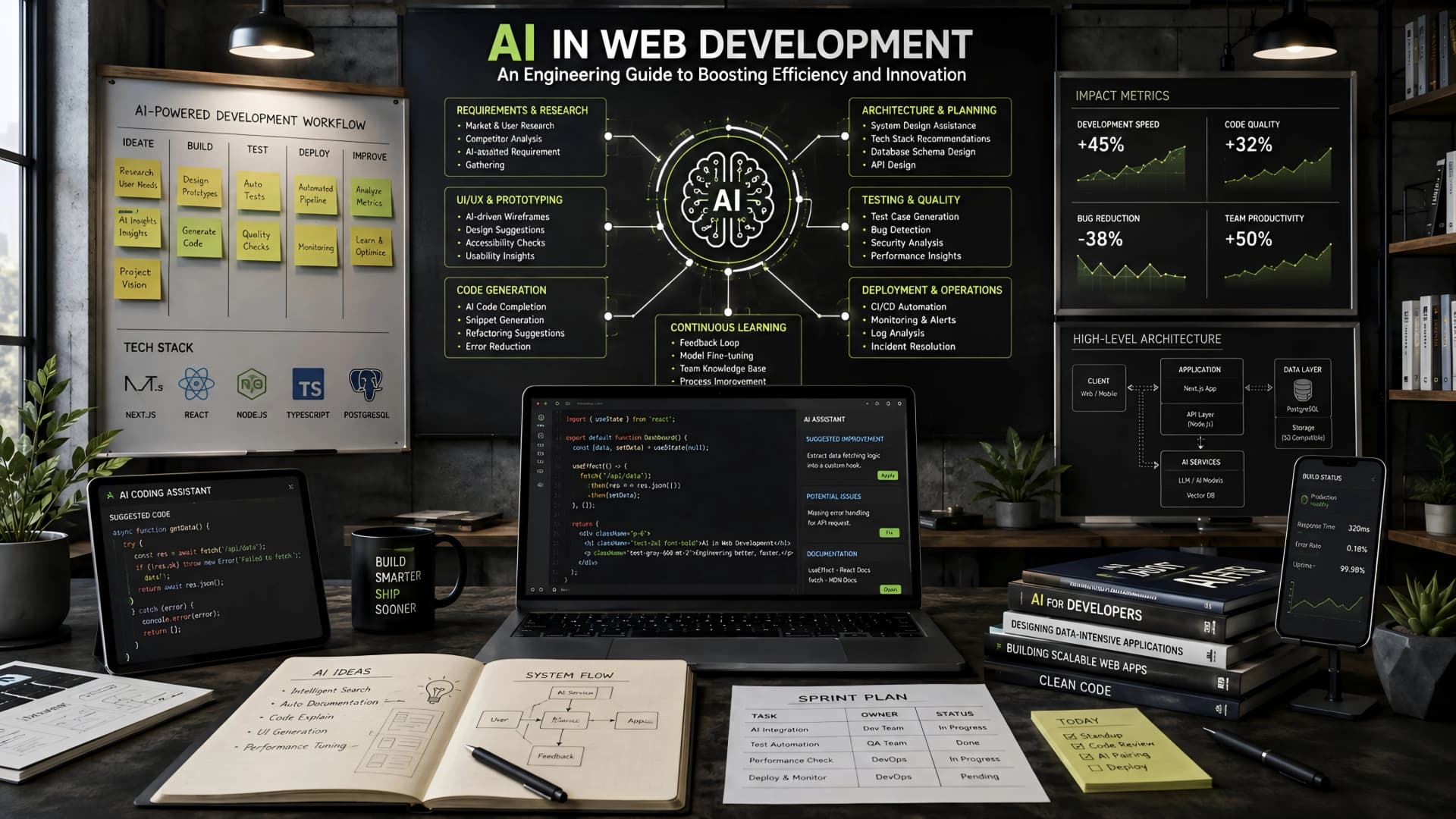
The promise of AI in web development often sparks excitement, but the reality of integrating it into production systems can be daunting. Teams face constant pressure to deliver faster, maintain quality, and innovate without ballooning costs or technical debt.
We've seen firsthand how manual, repetitive tasks drain developer productivity. The challenge isn't just about adopting AI; it's about doing so strategically, ensuring it genuinely enhances workflows and contributes to a stronger, more intelligent web application.
The Core Problem: Manual Overload and Stalled Innovation
Modern web development involves a significant amount of repetitive work. From boilerplate code generation to routine testing and content optimization, these tasks consume valuable engineering hours.
This manual overhead often leaves little room for deep architectural thinking, performance optimization, or genuine innovation. Development cycles lengthen, costs rise, and the ability to pivot quickly to new market demands diminishes.
How AI Transforms the Development Lifecycle
AI isn't a magic bullet, but a powerful set of tools that, when applied thoughtfully, can significantly streamline the web development lifecycle. It shifts the focus from rote tasks to higher-value creative and problem-solving activities.
The goal is to augment human capabilities, making developers more productive and enabling the creation of more sophisticated, responsive web applications. This means faster delivery and more resilient systems.
Automating Repetitive Tasks with AI
One of AI's most immediate benefits is its ability to automate tasks that are traditionally time-consuming and prone to human error. This includes everything from code generation to content creation and data analysis.
Automating these processes frees up engineers to concentrate on complex logic, unique user experiences, and strategic system design.
- Code Generation: AI assistants can suggest code snippets, complete functions, or even generate entire components based on natural language prompts or existing code patterns. This accelerates initial development and reduces boilerplate.
- Testing and Debugging: AI-powered tools can analyze code for potential bugs, generate test cases, and even suggest fixes. This improves code quality earlier in the development cycle, reducing post-deployment issues.
- Content Creation and Optimization: For marketing sites or content-heavy web apps, AI can assist in generating draft content, optimizing it for SEO, and even localizing it for different audiences.
- Deployment and Operations (DevOps): AI can monitor system performance, predict potential failures, and automate routine maintenance tasks, ensuring higher uptime and stability.
Enhancing Code Quality and Security
Poor code quality and security vulnerabilities are persistent threats in web development. AI tools offer a new layer of defense and improvement.
They can analyze vast amounts of code for patterns that indicate potential issues, often catching problems that human reviewers might miss.
- Static Code Analysis: AI can go beyond traditional linters, identifying complex anti-patterns, potential performance bottlenecks, and security flaws with greater accuracy.
- Vulnerability Detection: AI models trained on known exploits can detect subtle vulnerabilities in codebases, from injection flaws to misconfigurations, before they reach production.
- Code Refactoring Suggestions: AI can recommend ways to improve code readability, maintainability, and efficiency, guiding developers toward best practices.
Architectural Considerations for AI Integration
Integrating AI into a web application requires careful architectural planning. It's not just about adding a library; it's about designing robust, scalable, and maintainable systems.
We look for clear boundaries between AI services and the core application logic, ensuring that the system remains modular and adaptable.
Client-Side vs. Server-Side AI
The choice between client-side and server-side AI processing profoundly impacts performance, security, and user experience. Each approach has distinct trade-offs.
Understanding these differences is crucial for making informed architectural decisions that align with project requirements.
| Feature | Client-Side AI (e.g., TensorFlow.js) | Server-Side AI (e.g., OpenAI API, custom models) |
|---|---|---|
| Processing Location | User's browser/device | Remote server/cloud service |
| Latency | Low (data stays local) | Higher (network round trip) |
| Data Privacy | High (data processed locally) | Depends on API/service provider |
| Scalability | Scales with user devices | Requires server infrastructure scaling |
| Complexity | Limited model size/complexity | Can handle very large, complex models |
| Cost | Zero compute cost to developer | API costs, server infrastructure costs |
| Use Cases | Real-time UI enhancements, offline capabilities, simple predictions | Complex NLP, image recognition, heavy data processing, secure predictions |
Integrating Third-Party AI Services vs. Custom Models
Teams often face the decision of leveraging existing AI APIs or building and deploying their own models. This choice affects development time, cost, and control.
At Muhyo Tech, we evaluate this based on project specificity, data sensitivity, and the required level of customization.
- Third-Party AI Services (e.g., OpenAI, Google Cloud AI, AWS AI/ML):
Pros: Fast integration, pre-trained models, managed infrastructure, lower initial development cost, immediate access to cutting-edge research.
Cons: Vendor lock-in, recurring API costs, data privacy concerns (data sent to vendor), limited customization, potential rate limits. - Custom AI Models (self-hosted or managed):
Pros: Full control over data and models, highly customized for specific use cases, potential cost savings at scale, enhanced data privacy.
Cons: Significant engineering effort, data collection and labeling, model training and deployment, ongoing maintenance, higher infrastructure costs.
Practical Applications of AI in Web Development
Beyond abstract concepts, AI provides concrete solutions across various aspects of web engineering. These applications demonstrate how AI can deliver tangible value.
We look for opportunities where AI can solve a clear problem or unlock a new capability that was previously too complex or resource-intensive.
Enhanced User Experience (UX) and Personalization
AI can make web applications more intuitive and tailored to individual users, leading to higher engagement and satisfaction.
This personalization extends beyond simple recommendations, touching on dynamic content and adaptive interfaces.
- Personalized Content Recommendations: AI algorithms analyze user behavior to suggest relevant products, articles, or services, similar to e-commerce giants.
- Dynamic UI Adaptation: AI can adjust UI elements, layouts, or navigation paths based on user preferences, device, or context, making interfaces more responsive and helpful.
- Natural Language Interfaces: Chatbots and voice assistants powered by AI provide new ways for users to interact with web applications, improving accessibility and convenience.
Optimizing Development Workflows and Productivity
The internal development process itself benefits immensely from AI. These tools act as intelligent co-pilots, accelerating routine tasks and improving output quality.
This directly translates to faster feature delivery and reduced development costs.
- AI-Powered Code Editors: Tools like GitHub Copilot provide intelligent code suggestions, auto-completion, and even entire function generation, significantly speeding up coding.
- Automated Documentation Generation: AI can parse codebases and generate initial drafts of documentation, freeing developers from a tedious, often neglected task.
- Smart Search and Information Retrieval: Within large codebases or knowledge bases, AI-powered search can help developers quickly find relevant code, solutions, or documentation.
Challenges and Trade-offs of AI Integration
While the benefits are clear, integrating AI is not without its hurdles. Engineers must navigate performance impacts, data requirements, and ethical considerations.
Understanding these trade-offs upfront helps in designing a more resilient and responsible system.
Performance and Scalability
AI models, especially complex ones, can be computationally intensive. This can impact server response times or client-side performance if not managed carefully.
We often employ strategies like model quantization, edge computing, or asynchronous processing to mitigate these challenges.
- Increased Latency: API calls to external AI services introduce network latency. Processing large models locally can strain client-side resources.
- Resource Consumption: Training and serving AI models require significant CPU, GPU, and memory resources, leading to higher infrastructure costs.
- Scalability Bottlenecks: Ensuring AI services can scale with user demand without performance degradation requires robust infrastructure and careful load balancing.
Data Privacy and Security
AI relies heavily on data. Handling sensitive user data for AI processing introduces significant privacy and security concerns.
Adherence to regulations like GDPR and careful data anonymization are paramount.
- Data Collection and Storage: Ensuring secure, ethical data collection and storage practices is critical. Mismanagement can lead to breaches and compliance issues.
- Model Bias: If training data is biased, the AI model will perpetuate and even amplify those biases, leading to unfair or discriminatory outcomes.
- Adversarial Attacks: AI models can be vulnerable to attacks where malicious inputs cause incorrect outputs or expose sensitive information.
Maintenance and Explainability
AI models are not static; they require ongoing monitoring and maintenance. Understanding why a model makes certain decisions can also be challenging.
This 'black box' problem complicates debugging and regulatory compliance.
- Model Drift: Over time, the performance of an AI model can degrade as the underlying data patterns change. Continuous monitoring and retraining are necessary.
- Explainability: For many complex AI models, it's difficult to understand the reasoning behind their predictions. This lack of transparency can be a problem in regulated industries or when debugging.
- Dependency Management: Relying on external AI APIs introduces a dependency that needs to be managed, including versioning, pricing changes, and potential service outages.
Muhyo Tech's Engineering Approach to AI Integration
At Muhyo Tech, our approach to AI in web development is pragmatic and value-driven. We prioritize solutions that deliver tangible improvements in efficiency, reliability, and user experience.
Our focus is on smart integration that avoids unnecessary complexity and technical debt.
Architectural Checklist for Production AI
Before deploying AI into a production web application, we meticulously review several critical aspects. This checklist ensures robustness, performance, and maintainability.
It guides our decisions, helping us build systems that are not just functional but also future-proof.
- Clear Service Boundaries: Is the AI functionality encapsulated as a distinct service or module? This minimizes coupling and simplifies updates.
- Asynchronous Processing: Are long-running AI tasks handled asynchronously to prevent blocking the main application thread and impacting user experience?
- Error Handling and Fallbacks: What happens if the AI service fails or returns an unexpected response? Robust error handling and graceful degradation are essential.
- Monitoring and Logging: Are there comprehensive logging and monitoring systems in place for AI service performance, latency, and error rates?
- Security Measures: Are API keys securely managed? Is data encrypted in transit and at rest? Are input validations in place to prevent prompt injection or other attacks?
- Scalability Planning: How will the AI service scale under increased load? Is there a clear strategy for handling higher traffic or larger data volumes?
- Cost Management: Are there mechanisms to monitor and control the costs associated with AI API usage or infrastructure?
- Version Control: Is the AI model or API versioning strategy clear to ensure predictable behavior and enable rollbacks?
Embracing Progressive AI Enhancement
We advocate for a progressive enhancement strategy when introducing AI. Instead of a 'big bang' approach, we integrate AI features iteratively, starting with low-risk, high-impact areas.
This allows us to test, learn, and refine, ensuring that AI genuinely adds value without disrupting core functionality.
For instance, we might begin with AI-assisted content suggestions for an admin dashboard, then expand to user-facing personalization once the system is proven stable and effective. This reduces risk and builds confidence.
The Business Value: Beyond Just Code
Ultimately, the integration of AI in web development isn't just about faster coding or cooler features. It translates directly into significant business advantages.
These benefits contribute to a stronger competitive position and a more resilient digital presence.
- Faster Time-to-Market: Automated tasks and accelerated development cycles mean features and products can launch sooner, capitalizing on market opportunities.
- Reduced Development Costs: Increased efficiency and fewer manual errors lead to lower labor costs and less rework over the long term.
- Improved User Engagement: Personalized experiences and intelligent features lead to higher user satisfaction, retention, and conversion rates.
- Enhanced Operational Efficiency: AI-driven monitoring and automation reduce the burden on DevOps teams, leading to more stable systems and less downtime.
- Innovation and Competitive Edge: AI enables the creation of novel features and intelligent applications that differentiate a business from its competitors.
Frequently Asked Questions (FAQs)
How can I implement AI in web development safely in production?
Focus on robust error handling, secure API key management, thorough input validation, and clear service boundaries. Implement comprehensive monitoring for performance and security anomalies. Start with non-critical features and scale gradually.
What are common pitfalls when scaling AI for web development?
Common pitfalls include underestimating infrastructure costs, neglecting model drift, insufficient monitoring, and overlooking data privacy compliance. Plan for asynchronous processing, caching, and robust API management from the outset.
How does AI in web development impact performance and maintenance?
AI can introduce latency and increase resource consumption if not optimized. Maintenance can be complex due to model updates and the 'black box' nature of some AI. Careful architectural design, performance tuning, and continuous monitoring are crucial to mitigate these impacts.
Is AI in web development suitable for small businesses?
Absolutely. Many third-party AI services offer pay-as-you-go models, making advanced AI capabilities accessible without significant upfront investment. Focusing on specific, high-value use cases like content generation or basic personalization can provide immediate benefits.
Conclusion: Engineering a Smarter Web Future
AI is fundamentally reshaping the landscape of web development, moving it towards greater efficiency and innovation. It's not about replacing developers but empowering them with tools to build more sophisticated, responsive, and intelligent web applications.
At Muhyo Tech, we believe in a balanced, engineering-led approach to AI integration. This means carefully evaluating trade-offs, prioritizing robust architecture, and ensuring that every AI enhancement delivers measurable business value. By embracing AI thoughtfully, we can build a web that is not only faster and more reliable but also more intuitive and engaging for everyone.