


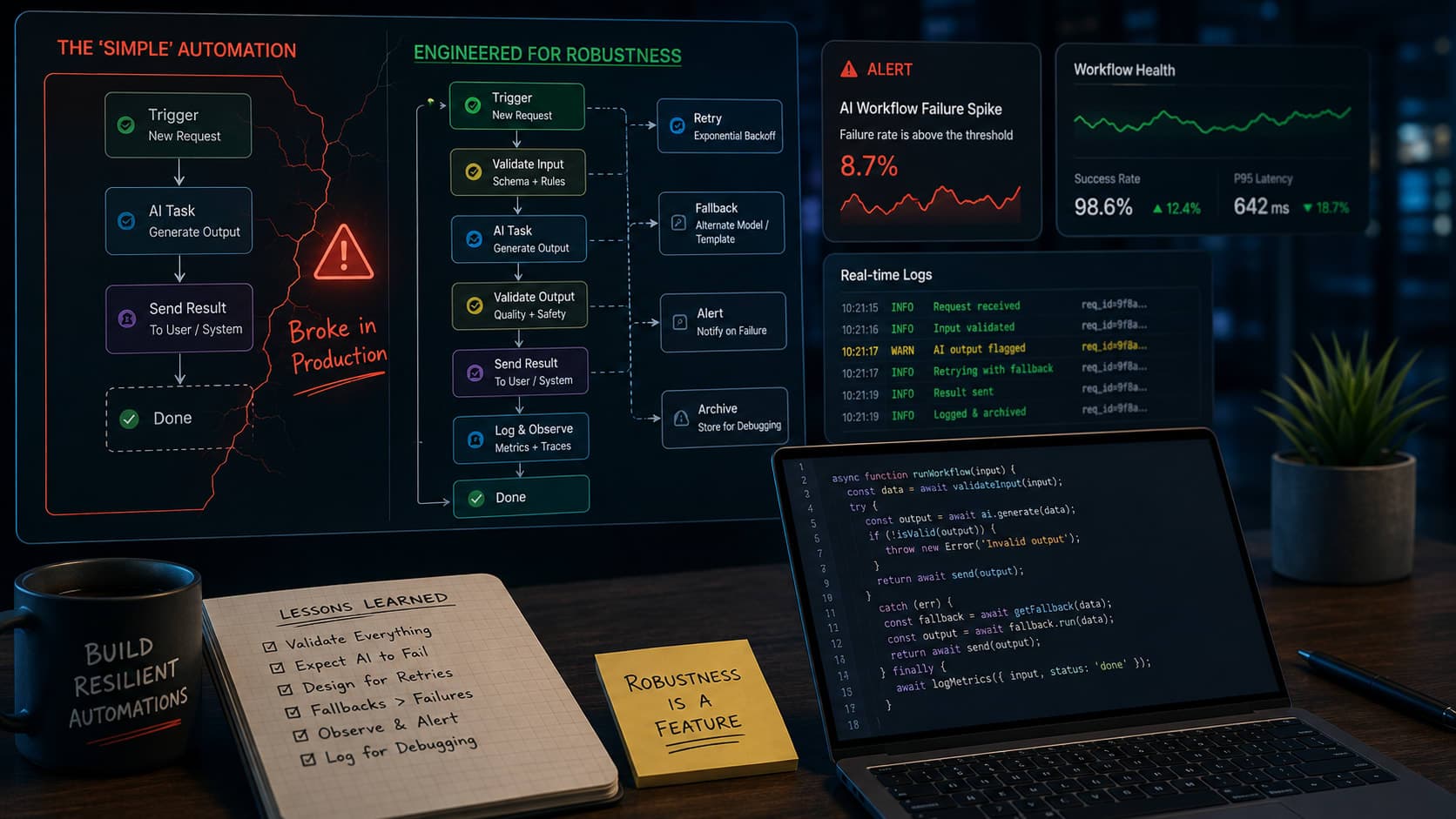
It starts so innocently. A small, clever script using a language model or an image processing API. You run it once, it works, and suddenly the vision of 'simple AI automation' takes hold.
Then, you move it into a production environment, expecting the same smooth operation. This is often where the dream collides with reality, revealing the inherent fragility of seemingly straightforward AI tools.
The Illusion of 'Simple' AI: Why Prototypes Fail in Production
Many AI automations begin as prototypes, built for ideal conditions. They assume perfect API responses, stable internet connections, and consistent data inputs.
Production environments, however, are messy. APIs rate-limit, network connections drop, and data schemas evolve unexpectedly. A prototype that works perfectly on a developer's machine can become a constant source of headaches in a live system.
We've seen this pattern repeatedly: the excitement of a proof-of-concept quickly turns into frustration when it can't handle real-world variability.
Anticipating Failure: The Core of Robust AI Engineering
Engineering robust AI automation isn't about preventing failures entirely; it's about anticipating and managing them gracefully. This mindset shift is crucial for anyone moving an AI solution beyond a demo.
Our approach at Muhyo Tech involves designing for resilience from day one. We assume that external services will fail, data will be malformed, and network requests will time out.
This means baking in error handling, retries, and fallback mechanisms into the very architecture of the system.
Implementing Smart Retry Strategies and Fallbacks
One of the most common causes of AI automation failure is transient issues with external APIs. A temporary server blip or a rate limit can halt an entire workflow.
Instead of immediately crashing, a robust system employs intelligent retry logic. This means waiting for an increasing duration between retries (exponential backoff) and setting a maximum number of attempts.
For critical operations, we also design fallback mechanisms. If an AI service consistently fails, can we revert to a human review step, use a simpler rules-based system, or queue the task for later processing?
Comprehensive Monitoring and Alerting: Your Eyes and Ears
Even with the best error handling, issues will inevitably arise. Without proper monitoring, you're flying blind until a user reports a problem, which is often too late.
Robust AI workflows require granular monitoring of API calls, processing times, error rates, and queue depths. We set up alerts for anomalies, like a sudden spike in failed requests or a backlog of unprocessed tasks.
This proactive visibility allows us to diagnose and resolve issues quickly, minimizing downtime and maintaining trust in the automation.
Data Validation and Input Sanitization: Preventing GIGO
The 'garbage in, garbage out' principle is particularly relevant for AI automations. Language models, for instance, can produce unexpected outputs if fed malformed or ambiguous inputs.
Rigorous data validation at every stage of the workflow is non-negotiable. This includes schema checks, type validation, and content sanitization before data ever reaches an AI model.
We implement robust input checks to ensure the AI receives data it can reliably process, significantly reducing unpredictable errors and improving output quality.
Version Control and Rollback Capabilities
AI models and the code that orchestrates them are constantly evolving. New versions of models, libraries, or even the automation logic itself can introduce unforeseen bugs.
Just like any critical software, AI automation needs proper version control and the ability to quickly roll back to a stable state. This means treating your AI workflow code and model configurations as first-class citizens in your deployment pipeline.
This practice minimizes the risk of new deployments introducing breaking changes and ensures rapid recovery if something goes wrong.
Beyond the Code: Human-in-the-Loop and Review Processes
Even the most robust AI systems benefit from human oversight, especially for high-stakes decisions or new automations. A 'human-in-the-loop' approach provides a safety net.
This might involve periodic audits of AI outputs, a manual review queue for edge cases, or a clear escalation path when the automation encounters something truly unexpected.
Integrating human checks doesn't diminish the automation; it makes it more trustworthy and reliable for business operations.
The Business Value of Reliable AI Automation
When AI automation works reliably, the business value is clear: increased efficiency, reduced manual effort, and faster processing. However, if it's constantly breaking, it becomes a liability, draining time and resources.
Engineering robust AI automation isn't an afterthought; it's a foundational requirement for any production system. It's about building solutions that not only work but continue to work, day in and day out.
At Muhyo Tech, we apply these principles to ensure the AI-assisted workflows we build deliver consistent value, reduce operational stress, and truly scale with your business needs.