


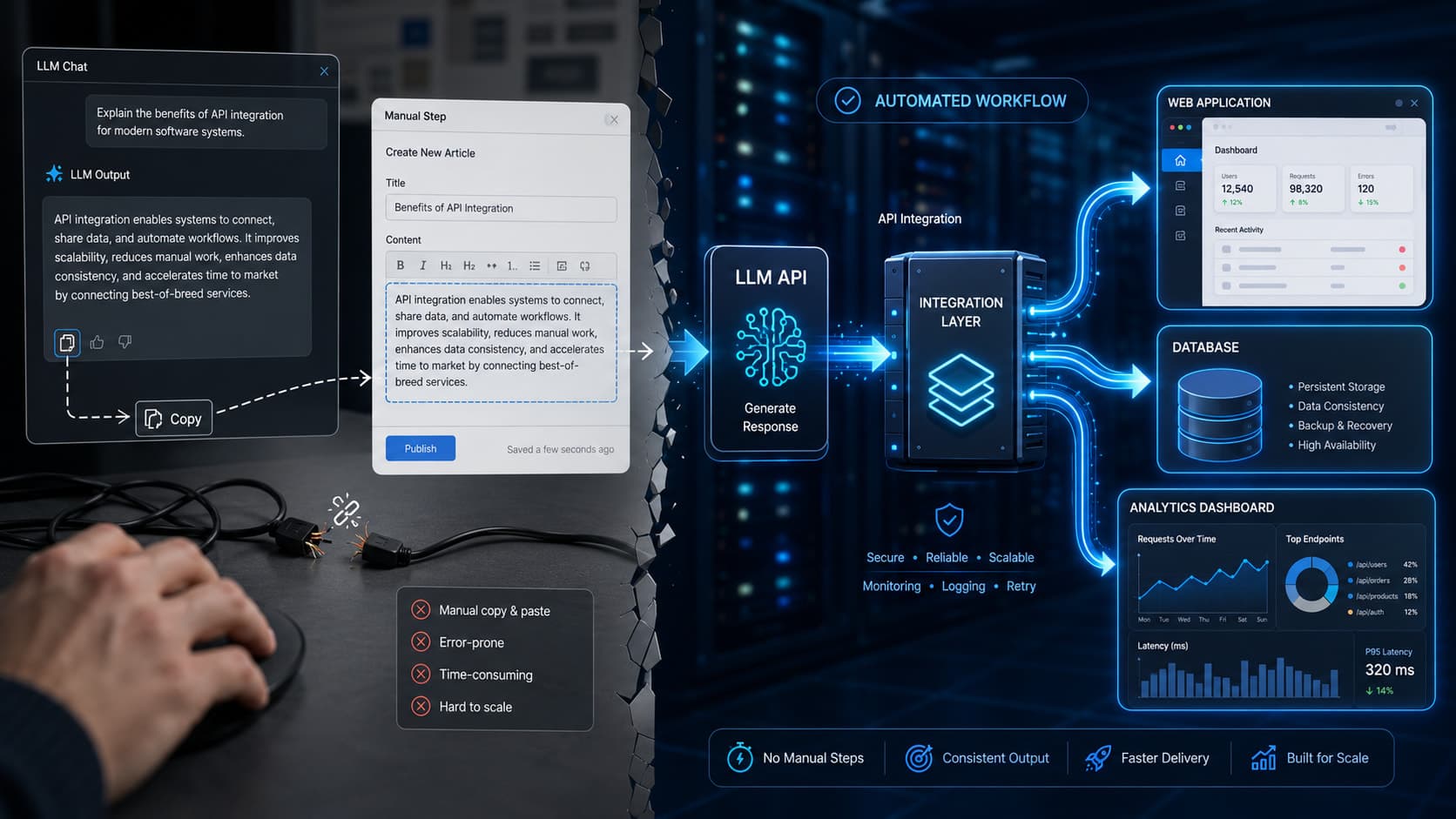
We've all been there: a critical task looms, and the perfect prompt in a large language model (LLM) delivers exactly what's needed. The temptation to simply copy the output and paste it directly into your website, marketing material, or internal system is strong.
This 'AI copy-paste' approach feels efficient in the moment, offering immediate relief from a blank page or a difficult rewrite. Yet, this manual bridge between AI output and your digital services quickly becomes a significant bottleneck and a source of silent stress.
Beyond the Chat Window: Why Copy-Paste Doesn't Scale
While a quick copy-paste might work for a single blog post or an isolated social media caption, it crumbles under the weight of real-world business demands. This manual intervention introduces errors, inconsistencies, and a severe lack of scalability.
Imagine trying to generate hundreds of product descriptions, update dozens of knowledge base articles, or personalize email campaigns for thousands of users this way. The human effort required quickly negates any efficiency gains from the AI itself, trapping operations in a costly, labor-intensive cycle.
The Engineering Diagnosis: Identifying Workflow Gaps
The problem isn't the LLM's capability; it's the missing automation layer between the AI's intelligence and your operational systems. We often see businesses invest in powerful AI tools without adequately planning for their integration into existing digital infrastructure.
This creates a workflow gap, where the LLM becomes an isolated tool rather than a seamlessly integrated component of a larger system. Our diagnosis always looks for these manual touchpoints, understanding where data enters and exits the AI process, and how it then flows through your business.
Designing for Automation: The API-First Approach
Moving beyond the copy-paste trap means embracing an API-first approach to LLM integration. This involves directly connecting your digital services to LLM APIs, allowing for programmatic interaction and automated data exchange.
At Muhyo Tech, we design robust integration points that define clear input schemas for prompts and validate output structures. This ensures the AI receives precise instructions and delivers data in a format your systems can immediately consume, reducing manual cleanup and error checking.
Consider, for example, generating SEO-optimized meta descriptions for an e-commerce site. Instead of a human copying from a chat window, our systems can automatically feed product data to the LLM API, receive the structured meta description, and update the database directly.
This automation significantly speeds up content generation, ensuring every product page is optimized without manual oversight. It's about treating the LLM as another service in your architecture, not a standalone chatbot.
Building the Feedback Loop: Continuous Improvement for AI Workflows
A truly engineered AI workflow doesn't stop at initial integration; it includes a feedback loop for continuous improvement. This means establishing mechanisms to review AI-generated content, identify areas for refinement, and use that data to improve future outputs.
For instance, human editors might flag certain stylistic inconsistencies or factual errors in AI-generated articles. This feedback isn't just a correction; it's data that can be used to refine prompts, fine-tune models, or even adjust pre-processing rules within your system.
Implementing this loop is crucial for maintaining quality and relevance as your digital services evolve. It transforms AI from a static content generator into an adaptable, learning partner in your operations, ensuring long-term value and consistency.
The Real-World Impact: From Manual Drudgery to Scalable Digital Services
The business value of moving beyond the AI copy-paste trap is profound. Automated LLM workflows lead to dramatically faster content creation, consistent brand voice across all channels, and a significant reduction in manual labor costs.
This shift frees up your team to focus on higher-value, creative tasks that truly require human insight, rather than tedious data transfer. It means less owner stress about repetitive, error-prone tasks and more confidence in the scalability of your digital services.
For a business owner, this translates to faster launches of new products, improved discoverability through consistent SEO content, and a more reliable customer experience. For developers, it means building cleaner operations and reducing maintenance risk associated with manual processes.
Our Approach to Intelligent Automation
At Muhyo Tech, we believe in leveraging AI not just as a tool, but as an integral part of a robust, scalable digital ecosystem. Our focus is on designing and implementing these seamless LLM workflows, ensuring they integrate cleanly with your existing web apps and services.
We look for opportunities to automate, validate, and optimize every step, transforming manual copy-paste operations into efficient, error-resistant systems. This approach ensures your investment in AI delivers genuine, long-term business value, pushing your digital services forward with confidence and control.
The true power of AI isn't in what it generates, but in how seamlessly that generation integrates into your business operations. We build those bridges.