


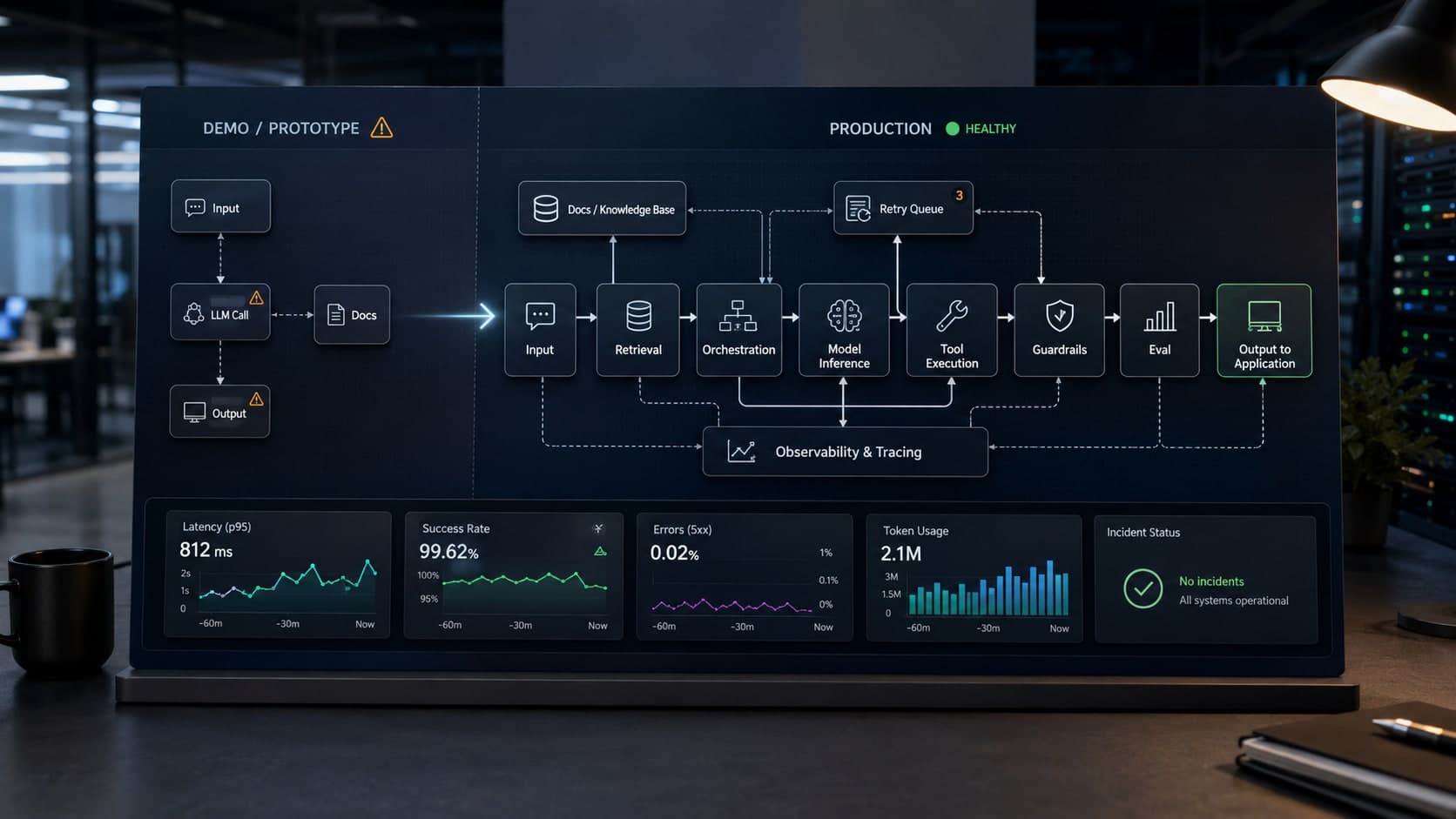
When Large Language Models (LLMs) burst onto the scene, the initial excitement was palpable. Everyone could spin up a demo, generate creative text, or answer complex questions with seemingly magic ease. However, moving an LLM from a compelling proof-of-concept to a reliable, scalable, and cost-effective production system is where the real engineering challenge begins.
Many teams quickly discover that the 'just prompt it' approach doesn't translate well to production. The non-deterministic nature, potential for drift, and the sheer cost and latency of API calls can quickly turn an innovative feature into an operational nightmare. At Muhyo Tech, we’ve been building practical AI-assisted workflows for our clients, and we've learned a few hard-earned lessons about what it takes to integrate LLMs responsibly.
The Gap Between Demo and Deploy: Understanding the Pain Points
The biggest hurdle often lies in the unpredictable nature of LLMs. A prompt that works perfectly today might yield a different, less desirable result tomorrow, even with the same model version. This 'model drift' makes traditional software testing methodologies incredibly difficult to apply effectively.
Beyond drift, there are significant operational concerns. Each API call carries a cost, and frequent, unoptimized calls can quickly inflate bills, especially at scale. Latency is another critical factor; waiting several seconds for an LLM response can degrade user experience and isn't viable for real-time applications.
Building Resilience: Architectural Layers Around the LLM
Our approach at Muhyo Tech is to treat the LLM as a powerful, but somewhat unreliable, external service. This means building robust architectural layers around it, shielding our core application logic from its inherent variability. We often implement a dedicated microservice or a set of API wrappers to manage all interactions with the LLM provider.
This abstraction layer allows us to control request/response formats, implement retry logic, and handle rate limiting gracefully. It also provides a single point for observability, making it easier to monitor usage, performance, and errors without scattering LLM logic throughout the codebase.
The Discipline of Prompt Engineering: More Than Just 'Magic Words'
Effective prompt engineering is not just about finding the right incantation; it's a structured, iterative process. We treat prompts like critical pieces of code, versioning them and subjecting them to the same review processes as other parts of our application. This ensures consistency and makes it easier to track changes and their impact.
We often use dynamic prompt construction, where relevant context from the application or user input is programmatically injected into a templated prompt. This allows the LLM to provide more relevant and accurate responses without hardcoding every possible scenario, improving UX and reducing the need for constant prompt updates.
Testing and Validation: Beyond Traditional Unit Tests
Testing LLM-powered features requires a different mindset. Since outputs aren't perfectly deterministic, we can't always assert exact string matches. Instead, we focus on 'golden datasets' and semantic validation.
A golden dataset consists of known inputs and their desired, human-verified LLM outputs. We use these to automatically evaluate prompt changes and model updates, checking for regressions or unexpected behavior. For critical paths, a 'human-in-the-loop' review process ensures quality before deployment, catching subtle issues that automated tests might miss.
Optimizing for Performance and Cost: Smart Caching and Model Selection
Cost and latency are constant considerations in production LLM workflows. We implement aggressive caching strategies for common or repeated LLM queries, storing responses in a fast data store like Redis. This significantly reduces API calls and speeds up response times for frequently requested information, directly impacting operational costs and user experience.
Furthermore, we carefully select the right model for the job. Not every task requires the largest, most expensive LLM. For simpler classifications or summarizations, smaller, faster, and cheaper models can often deliver sufficient quality. This thoughtful model selection is a core part of designing efficient and scalable AI workflows for our clients.
Observability and Monitoring: Keeping an Eye on the 'Black Box'
Integrating LLMs means adding a new layer of complexity to our systems, making robust observability crucial. We log every LLM request and response, including tokens used, latency, and any error codes. This data is invaluable for debugging, performance analysis, and identifying potential prompt or model drift over time.
Setting up alerts for unusual token usage, increased error rates, or significant latency spikes helps us proactively identify and address issues. This level of monitoring allows us to maintain the reliability of AI features, giving business owners confidence in their digital services and reducing the stress associated with potential operational surprises.
The Tradeoffs: Complexity for Reliability
Adopting this systematic approach to LLM integration undeniably adds initial complexity to the development process. There's a learning curve, and it requires a deeper investment in architecture, testing, and monitoring infrastructure. However, the tradeoff is well worth it.
By treating LLM integration as a first-class engineering problem, we transform a potentially fragile, expensive, and unpredictable component into a reliable, scalable, and manageable part of a robust digital system. This allows our clients to confidently launch innovative AI-powered features, knowing they are built on a stable and maintainable foundation.
Building Trust Through Engineered AI Workflows
At Muhyo Tech, our experience integrating LLMs has reinforced a fundamental principle: great ideas require great engineering to truly deliver value. Whether it's enhancing content generation, streamlining customer support, or automating internal processes, a well-engineered AI workflow translates directly to tangible business outcomes.
This includes faster feature launches, stronger system reliability, better user experiences, and significantly lower long-term maintenance risk. We believe that by applying rigorous engineering standards to AI, we help founders and business owners harness its power effectively, building trust and delivering on the promise of their digital services.