


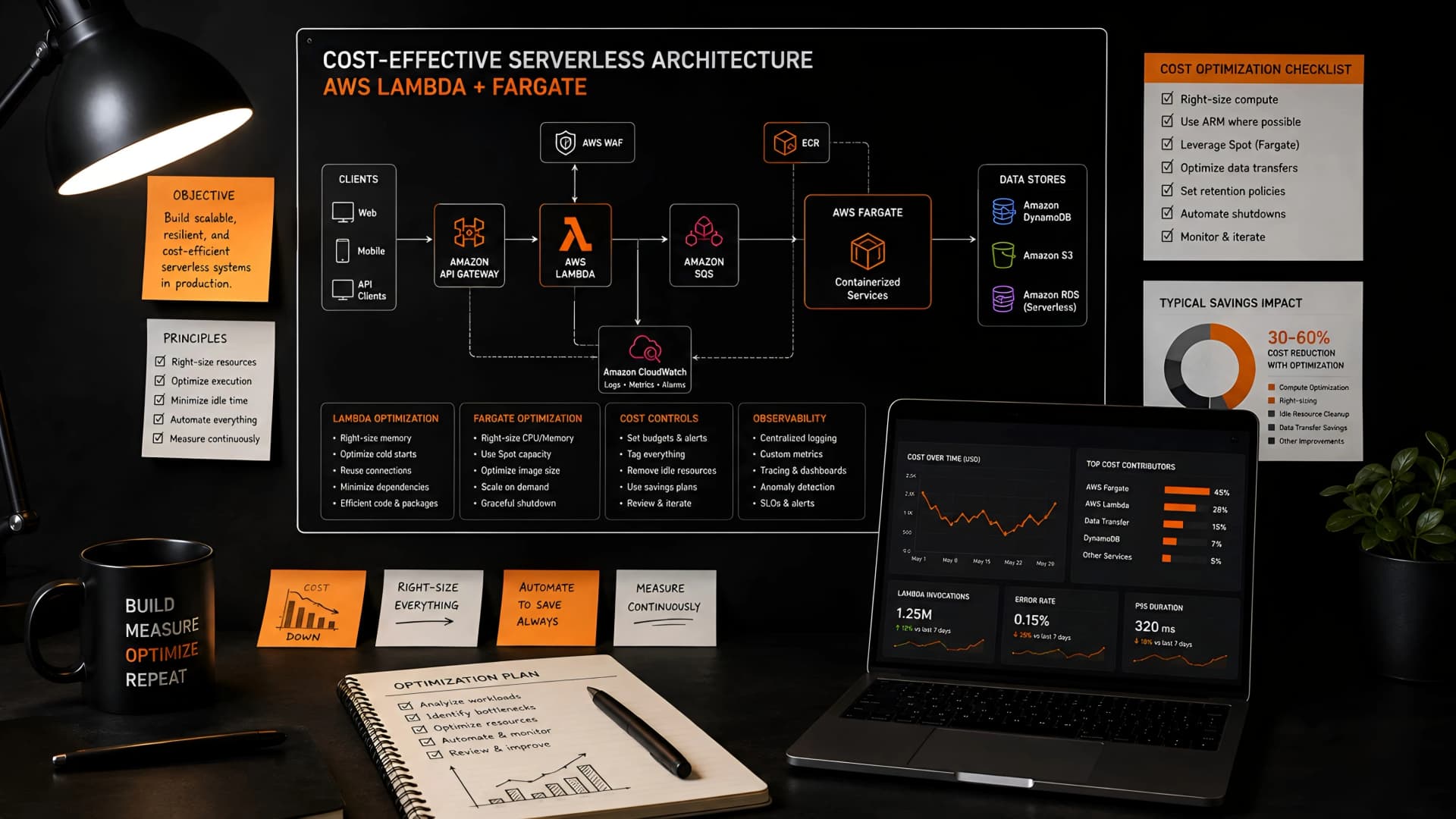
Serverless architectures promise incredible scalability and reduced operational overhead. Yet, the reality of running AWS Lambda and Fargate in production often includes an unwelcome surprise: escalating cloud bills and unexpected performance bottlenecks.
The dream of paying only for what you use can quickly turn into a nightmare if configurations aren't meticulously tuned. Unoptimized serverless functions and containers can quietly consume resources, leading to significant cost overruns that undermine the very economic benefits serverless aims to deliver.
The Core Challenge: Balancing Cost and Performance in Serverless
Our goal at Muhyo Tech is always to build systems that are not just functional, but also robust and economically sound. With serverless, this means a constant balancing act between responsiveness, reliability, and cost efficiency.
Ignoring these trade-offs can lead to slow user experiences, frustrated developers, and an unhappy finance department. True serverless optimization isn't just about cutting costs; it's about intelligent resource allocation that supports business goals without wasteful spending.
Understanding AWS Lambda Cost Drivers
AWS Lambda bills primarily on two factors: duration (how long your function runs) and memory allocated. This seemingly simple model hides several critical nuances that directly impact your spending.
Cold starts, for instance, add latency and can subtly increase billed duration, especially for infrequently invoked functions. Excessive memory allocation, while improving performance, directly translates to higher costs even if that memory isn't fully utilized.
Memory Allocation: The Sweet Spot
Choosing the right memory for a Lambda function is paramount. AWS bills in 1ms increments, and memory allocation also directly influences CPU power.
Often, increasing memory slightly can drastically reduce execution time, leading to a lower overall cost despite a higher per-GB-second rate. We typically use tools like AWS Lambda Power Tuning to find the optimal memory configuration for critical functions.
Concurrency Management: Preventing Surprises
Uncontrolled concurrency can lead to spiraling costs and backend service exhaustion. Each concurrent invocation is a separate execution that adds to your bill.
Setting appropriate reserved concurrency for critical functions ensures they always have resources, while provisioned concurrency eliminates cold starts for latency-sensitive applications, though at a continuous cost.
Cold Starts: Mitigating Latency and Cost
Cold starts are the bane of many serverless applications, particularly for user-facing APIs. They introduce noticeable delays as AWS provisions a new execution environment.
Strategies include using smaller deployment packages, optimizing code for faster initialization, and leveraging Provisioned Concurrency for critical paths. For less critical workloads, accepting occasional cold starts is a valid cost-saving tradeoff.
Optimizing AWS Fargate for Containerized Workloads
AWS Fargate offers a serverless compute engine for containers, removing the need to manage EC2 instances. Its cost model is based on vCPU and memory resources consumed, measured from when the container starts to download until it terminates.
Like Lambda, Fargate's flexibility can lead to unexpected expenses if not properly managed. Over-provisioning resources or inefficient container images are common culprits.
Right-Sizing Fargate Tasks
Just as with Lambda memory, accurately sizing Fargate tasks for vCPU and memory is crucial. Many teams initially over-provision to ensure stability, but this directly increases costs.
Monitoring actual resource utilization using CloudWatch metrics allows for iterative right-sizing. Begin with a reasonable estimate and then scale down as you gather real-world data.
Leveraging AWS Graviton Processors
For Fargate (and even Lambda, with specific runtimes), migrating to AWS Graviton processors can offer significant cost savings and performance improvements. Graviton processors are custom-built by AWS using ARM architecture.
They often deliver up to 40% better price-performance over comparable x86 instances. While migration requires recompiling or ensuring ARM compatibility for your container images, the long-term benefits are substantial for eligible workloads.
Container Image Optimization
A smaller, more efficient container image means faster startup times and less data transfer, which can subtly reduce costs. Multi-stage Docker builds are an excellent way to achieve lean production images.
Removing unnecessary tools, libraries, and build artifacts from the final image streamlines the deployment process. We advocate for a 'minimalist' approach to containerization.
Monitoring and Alerting for Cost Anomalies
The first step in controlling serverless costs is visibility. Without proper monitoring, unexpected spikes can go unnoticed until the monthly bill arrives.
AWS Cost Explorer, along with detailed CloudWatch metrics and custom alarms, forms the backbone of our cost management strategy. Setting budget alerts is non-negotiable for any production environment.
Tools and Dashboards
Beyond native AWS tools, third-party solutions can provide more granular insights and visualization. Services like Datadog, New Relic, or even custom Grafana dashboards pulling from CloudWatch can help identify cost trends and anomalies.
These tools often correlate cost data with performance metrics, giving a holistic view of efficiency. At Muhyo Tech, we integrate cost visibility directly into our operational dashboards.
Architectural Choices and Trade-offs for Cost Efficiency
Sometimes, the most significant cost savings come from architectural decisions rather than micro-optimizations. Choosing the right serverless service for the job, or even opting out of serverless for specific components, can have a profound impact.
For example, a long-running, constant-load background process might be cheaper on a small EC2 instance or ECS than on Fargate, despite Fargate's operational simplicity. These are the trade-offs we evaluate.
Synchronous vs. Asynchronous Processing
Designing for asynchronous processing with services like SQS or EventBridge can dramatically reduce Lambda costs. By decoupling components, functions can process messages at their own pace, preventing cascading failures and allowing for more controlled concurrency.
Synchronous calls, while simpler to implement, directly tie request duration to billed time and can be more susceptible to cold start impacts. We prioritize asynchronous patterns for resilience and cost.
Choosing the Right Serverless Data Stores
Data storage costs can often overshadow compute costs in serverless applications. DynamoDB is a common choice, but its provisioned throughput model needs careful tuning.
Over-provisioning read/write capacity units (RCUs/WCUs) for DynamoDB can lead to significant waste. Leveraging on-demand capacity or auto-scaling can help, but understanding access patterns is key.
Muhyo Tech's Approach to Serverless Cost Optimization
At Muhyo Tech, our engineering approach to serverless cost optimization is deeply integrated into the development lifecycle. It starts with design, moves through careful implementation, and continues with proactive monitoring.
We believe that building cost-aware applications from the ground up prevents expensive refactoring later. This involves a continuous feedback loop between performance, cost, and business value.
"True serverless optimization isn't just about cutting costs; it's about intelligent resource allocation that supports business goals without wasteful spending."
Checklist for Cost-Effective Serverless Deployments
- Right-Size Lambda Memory: Use tools to identify optimal memory/CPU for each function.
- Control Lambda Concurrency: Set reserved concurrency limits to prevent cost spikes and ensure critical function availability.
- Utilize Provisioned Concurrency Judiciously: Only for latency-sensitive functions where cold starts are unacceptable, balancing cost.
- Migrate to Graviton: Evaluate ARM compatibility for Fargate and Lambda runtimes to leverage price-performance benefits.
- Optimize Container Images: Build lean Docker images for faster Fargate startup and reduced data transfer.
- Monitor Resource Utilization: Regularly check Fargate vCPU/memory usage to right-size tasks.
- Implement Asynchronous Patterns: Decouple components with SQS/EventBridge to reduce synchronous Lambda invocations.
- Manage DynamoDB Capacity: Use on-demand or auto-scaling for DynamoDB, or carefully provision RCUs/WCUs based on actual traffic.
- Set Cost Alarms: Configure AWS Budgets and CloudWatch alarms for unexpected cost increases.
- Clean Up Unused Resources: Regularly audit and delete old Lambda versions, Fargate tasks, and associated resources.
Frequently Asked Questions
How can I reduce my AWS Lambda costs?
The most effective ways to reduce Lambda costs include right-sizing memory allocations, optimizing code for faster execution, managing concurrency limits, and leveraging Graviton processors if your runtime supports it. Regularly review and remove unused functions and versions.
What are the best practices for optimizing serverless costs on AWS?
Best practices involve a continuous cycle of monitoring, analysis, and adjustment. This includes precise memory and vCPU allocation, intelligent use of provisioned concurrency, optimizing container images for Fargate, designing for asynchronous communication, and setting up robust cost monitoring and alerting systems.
Which AWS serverless services contribute most to cost?
For most serverless applications, AWS Lambda compute and AWS Fargate compute are primary cost drivers. However, data storage (e.g., DynamoDB, S3) and API Gateway requests can also contribute significantly. Understanding your specific application's usage patterns is key.
Are there tools available for AWS serverless cost monitoring and optimization?
Yes, AWS provides native tools like Cost Explorer, CloudWatch, and AWS Budgets for monitoring. Third-party tools such as Datadog, New Relic, and specialized serverless monitoring platforms offer enhanced visibility and optimization suggestions. For specific Lambda memory tuning, the AWS Lambda Power Tuning tool is invaluable.
Conclusion: Proactive Engineering for Sustainable Serverless
Achieving cost-effective serverless deployments on AWS isn't a one-time configuration; it's an ongoing engineering discipline. It demands a deep understanding of how Lambda and Fargate consume resources and a commitment to continuous optimization.
By embracing proactive strategies for memory allocation, concurrency control, and architectural choices, organizations can truly harness the power of serverless without the hidden costs. This meticulous approach is central to how Muhyo Tech builds scalable, reliable, and economically sound web applications and digital services, ensuring long-term value for our partners.