


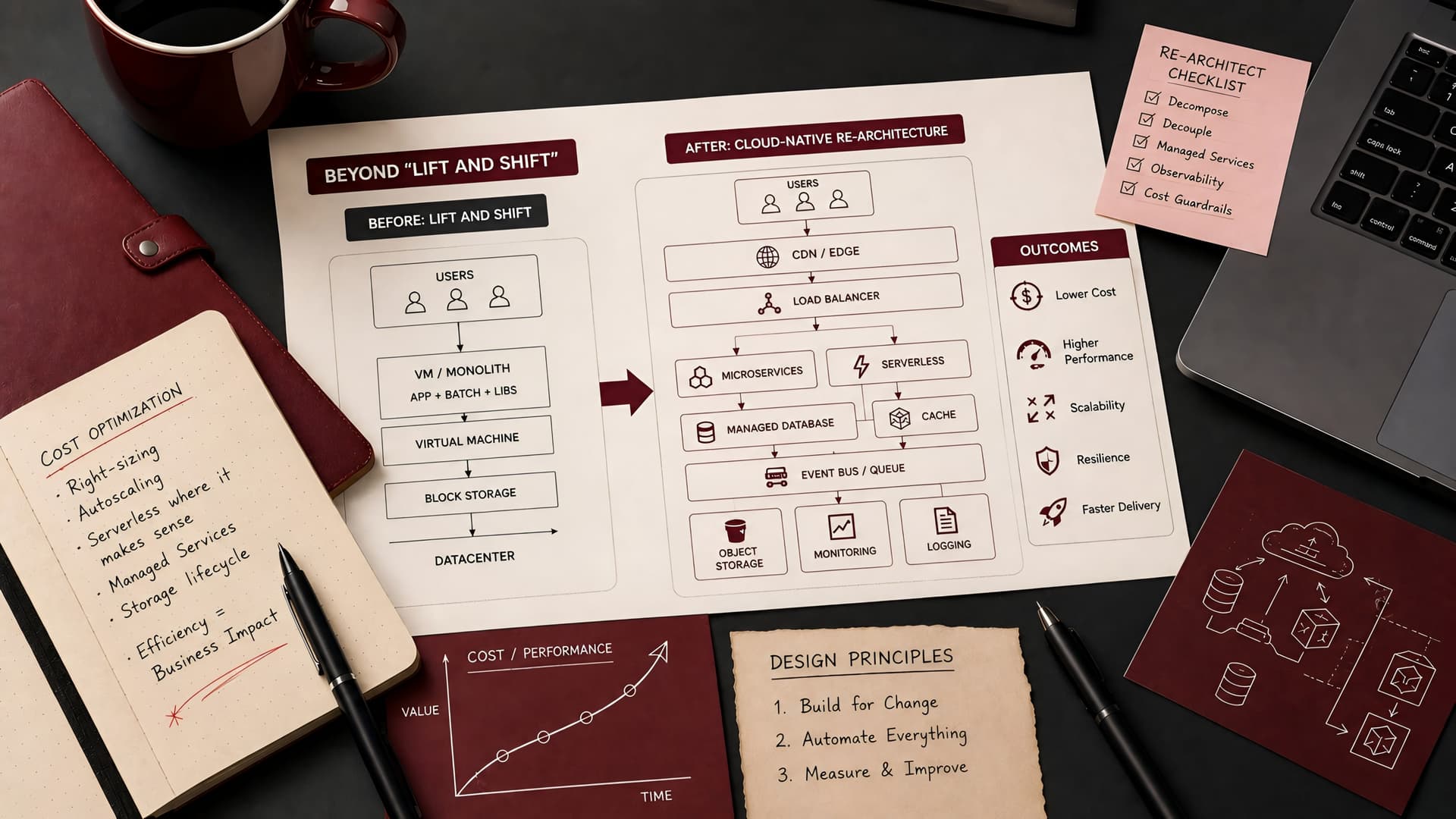
When businesses first migrate to the cloud, the 'lift and shift' approach often seems like the quickest path. It gets applications running in a new environment without significant code changes. Yet, this initial ease frequently masks a deeper problem: inflated operational costs, underutilized cloud capabilities, and a missed opportunity for true performance gains.
Many organizations find themselves paying more for cloud resources than they anticipated, simply because their architecture isn't optimized for the cloud's unique billing models and managed services. This isn't just about cost; it's about agility, reliability, and the ability to innovate.
The Hidden Costs of 'Lift and Shift'
Simply moving virtual machines from an on-premise data center to a cloud provider rarely unlocks the full value proposition of cloud computing. You're essentially paying for someone else to host and manage your hardware, without adopting the paradigm shifts that make the cloud so powerful.
This approach often results in over-provisioned instances, continuous running costs for resources that could be ephemeral, and a lack of elasticity. The promise of paying only for what you use remains unfulfilled, leading to budget strains and a perception that the cloud is expensive.
What is Cloud-Native Re-architecture?
Cloud-native re-architecture is the strategic process of redesigning existing applications to fully embrace the principles and services offered by cloud platforms. It involves breaking down monolithic applications into smaller, independent services, adopting serverless functions, utilizing managed databases, and leveraging containerization with orchestration.
The goal is to build applications that are resilient, scalable, observable, and optimized for the cloud's pay-as-you-go model. This transformation isn't just technical; it's a shift in mindset towards microservices, automation, and continuous delivery.
The Strategic Framework for Cloud-Native Transformation
Approaching re-architecture without a clear strategy can lead to more problems than it solves. At Muhyo Tech, we typically break down this journey into several key phases, focusing on measurable outcomes and controlled iterations.
This structured approach ensures that the business value is continuously assessed, and engineering efforts are aligned with long-term strategic goals. It's about making informed decisions at every step.
Phase 1: Assessment and Discovery
Before any code is touched, a deep dive into the existing application is crucial. We identify application dependencies, performance bottlenecks, and current operational costs. This phase involves mapping out the entire system, understanding its business criticality, and establishing a baseline.
Key questions include: What are the peak usage times? Which components are most expensive? Where are the single points of failure? What regulatory or compliance constraints exist?
Phase 2: Define Target Architecture & Cloud-Native Patterns
With a clear understanding of the current state, we then design the future cloud-native architecture. This involves selecting appropriate cloud services, such as AWS Lambda, Azure Functions, Google Cloud Run for serverless computing, or Kubernetes for container orchestration.
The aim is to identify components that can be decoupled, refactored into microservices, or replaced with managed services. This phase focuses on designing for resilience, scalability, and cost efficiency from the ground up.
Phase 3: Incremental Refactoring and Migration
Big-bang migrations are inherently risky. Our approach favors incremental refactoring, often using the Strangler Fig pattern. This involves gradually replacing parts of the existing application with new cloud-native services, allowing for continuous operation during the transition.
Each refactored component is deployed and tested independently, minimizing disruption and allowing for immediate feedback. This iterative process is vital for managing complexity and risk.
Phase 4: Optimization, Automation, and Observability
Once components are cloud-native, the focus shifts to continuous optimization. This includes fine-tuning auto-scaling rules, optimizing database queries, and implementing robust monitoring and logging. Automation of deployment pipelines (CI/CD) is also critical here.
Establishing comprehensive observability—metrics, logs, and traces—allows teams to understand application behavior, troubleshoot issues quickly, and identify further optimization opportunities. This feedback loop is essential for sustained cost and performance gains.
Key Cloud-Native Patterns for Cost and Performance
Embracing cloud-native means adopting specific architectural patterns that are inherently more efficient and scalable. These are the building blocks for modern, resilient applications.
Understanding these patterns helps in making informed decisions about which services to use and how to structure your application components for maximum benefit.
Serverless Functions (e.g., AWS Lambda, Azure Functions, Google Cloud Functions)
Pros: Pay-per-execution model drastically reduces costs for intermittent workloads. Eliminates server management, scales automatically, and offers high availability out-of-the-box. Accelerates development by focusing solely on business logic.
Cons: Can introduce vendor lock-in, cold start latencies for infrequently invoked functions, and limits on execution duration or memory. Debugging can be more complex due to distributed nature.
Containers and Orchestration (e.g., Docker, Kubernetes, Amazon ECS)
Pros: Provides environment consistency from development to production, improving deployment reliability. Offers efficient resource utilization and strong isolation between applications. Kubernetes provides powerful orchestration for scaling, self-healing, and service discovery.
Cons: Adds operational complexity, requiring specialized skills for setup and management. Resource consumption can be higher than serverless for very sporadic tasks, and security configuration demands expertise.
Managed Databases (e.g., Amazon RDS, Azure SQL Database, Google Cloud SQL)
Pros: Offloads database administration tasks like patching, backups, and scaling to the cloud provider. Offers high availability and robust security features. Can be significantly more reliable and less error-prone than self-managed solutions.
Cons: Less control over underlying infrastructure and specific database configurations. Cost can be higher than self-managed databases on EC2 for very large, highly optimized instances, though operational savings often outweigh this.
Event-Driven Architectures (e.g., AWS SQS/SNS, Azure Service Bus, Google Pub/Sub)
Pros: Decouples services, improving fault tolerance and scalability. Enables asynchronous processing, leading to better user experience and resource utilization. Ideal for microservices communication and real-time data processing.
Cons: Introduces eventual consistency challenges and can make tracing and debugging distributed transactions more complex. Requires careful design to avoid message loss or duplication.
Cost Optimization Checklist for Cloud-Native Re-architecture
To truly achieve the cost efficiencies promised by cloud-native patterns, a systematic approach to optimization is essential. This checklist guides our decision-making and implementation processes.
Following these steps ensures that every architectural decision considers both performance and financial implications, leading to a truly optimized solution.
- Right-Sizing Instances: Continuously monitor resource utilization and adjust compute instance types (VMs, containers) to match actual needs, avoiding over-provisioning.
- Leverage Spot Instances/Preemptible VMs: For fault-tolerant, flexible workloads, utilize cheaper ephemeral compute options that can be interrupted.
- Implement Auto-Scaling: Automatically adjust resources up or down based on demand, ensuring you only pay for what you use during peak times and scale down during idle periods.
- Optimize Data Storage: Use appropriate storage tiers (e.g., S3 Glacier, Azure Blob Archive) for different data access patterns and retention needs. Delete unnecessary data.
- Serverless Adoption: Migrate suitable workloads to serverless functions (Lambda, Functions, Cloud Run) to pay per execution rather than per hour of server uptime.
- Containerization for Resource Efficiency: Package applications in containers to improve resource density on underlying compute instances, reducing VM count.
- Managed Services Preference: Prioritize managed services (databases, queues, caches) to offload operational overhead and often benefit from economies of scale.
- Network Egress Cost Reduction: Minimize data transfer out of the cloud provider's network, which is often the most expensive data movement. Use CDN for static assets.
- Implement Cost Monitoring & Alerts: Set up detailed cost tracking, dashboards, and alerts to identify budget anomalies and areas for optimization early.
- Clean Up Unused Resources: Regularly identify and terminate idle or unattached resources like EBS volumes, unassigned IPs, or old snapshots.
- Reserved Instances / Savings Plans: Commit to predictable usage for a fixed term to receive significant discounts on compute and database costs.
- Architect for Event-Driven Patterns: Decouple services using message queues and event buses to enable asynchronous processing and reduce the need for constantly running services.
Trade-offs and Considerations
While cloud-native re-architecture offers immense benefits, it's not without its trade-offs. Understanding these helps in making balanced decisions that align with business priorities and team capabilities.
Every engineering choice involves a balance between performance, cost, complexity, and maintainability. A senior engineering perspective acknowledges these nuances.
| Aspect | Benefit of Cloud-Native Re-architecture | Potential Trade-off / Challenge |
|---|---|---|
| Cost Efficiency | Reduced operational costs (pay-per-use, auto-scaling, managed services). | Higher initial re-architecture investment; potential for increased complexity if not managed well; vendor-specific billing models can be complex. |
| Performance & Scalability | Elastic scaling, high availability, improved responsiveness under load. | Requires careful design for distributed systems; latency concerns for highly distributed components; increased monitoring complexity. |
| Developer Velocity | Faster deployment cycles, easier feature development with microservices. | Learning curve for new cloud services and paradigms; increased operational burden on developers (DevOps culture). |
| Operational Complexity | Automation of infrastructure, reduced manual server management. | Increased complexity in debugging distributed systems; new tools for monitoring and observability; managing multiple smaller services. |
| Vendor Lock-in | Deep integration with cloud provider services unlocks maximum benefits. | Reduced portability across different cloud providers; migration to another cloud becomes more challenging and costly. |
The Business Value: Beyond Just Savings
The true value of cloud-native re-architecture extends far beyond merely reducing your cloud bill. It's about building a foundation for future growth and competitive advantage.
By embracing these principles, businesses can achieve a level of agility and resilience that was previously unattainable, translating directly into market responsiveness and customer satisfaction.
Accelerated Innovation: Microservices and serverless architectures allow teams to develop, test, and deploy new features independently and more rapidly. This speed to market is critical in competitive landscapes.
Enhanced Reliability and Resilience: Cloud-native patterns are designed for failure. Services are loosely coupled, highly available, and can self-heal, leading to significantly reduced downtime and a more robust user experience.
Improved Developer Experience: By abstracting away infrastructure concerns, developers can focus more on writing business logic. This not only boosts productivity but also makes the engineering team happier and more effective.
Future-Proofing: A cloud-native architecture is inherently more adaptable to new technologies and evolving business requirements. It provides a flexible backbone that can easily integrate emerging services like advanced AI/ML capabilities.
How Muhyo Tech Approaches Cloud-Native Projects
At Muhyo Tech, our engineering philosophy centers on building scalable, performant, and cost-effective solutions. When we engage with clients on cloud migration or re-architecture projects, our focus is always on understanding the core business drivers first.
We apply these cloud-native principles to ensure that every web application, API, or digital service we develop is not just functional, but also robust, efficient, and future-ready. This approach minimizes long-term maintenance risk and maximizes discoverability.
Frequently Asked Questions (FAQs)
Is cloud-native re-architecture always worth the investment?
For applications with significant traffic, fluctuating loads, or critical business functions, the long-term cost savings, performance gains, and increased agility usually justify the initial investment. For very simple, static sites with minimal traffic, a 'lift and shift' or even shared hosting might suffice initially, but scalability limitations will eventually emerge.
How long does a typical cloud-native re-architecture project take?
The duration varies greatly depending on the application's complexity, size, and team resources. Small applications might take a few months, while large monolithic systems could be a multi-year effort. Incremental refactoring (Strangler Fig pattern) helps deliver value continuously during the process.
What are the biggest risks of re-architecting to cloud-native?
Key risks include increased initial development cost, potential for increased operational complexity if not managed with robust DevOps practices, and vendor lock-in if too many proprietary cloud services are used. A lack of internal expertise can also be a significant hurdle.
Can I achieve cost savings without a full re-architecture?
Some cost savings can be achieved through optimization of existing 'lift and shift' deployments (right-sizing, reserved instances, schedule-based shutdowns). However, the most significant and sustainable cost reductions, coupled with performance and scalability benefits, come from truly embracing cloud-native architectural patterns.
Conclusion
Moving beyond 'lift and shift' to a truly cloud-native architecture is more than just a technical upgrade; it's a strategic business imperative. It transforms your infrastructure from a cost center into an engine for innovation, reliability, and sustained growth.
While the journey requires careful planning and execution, the rewards—in terms of cost efficiency, enhanced performance, and accelerated development—are substantial. It positions your organization to fully capitalize on the power and flexibility of modern cloud platforms.