


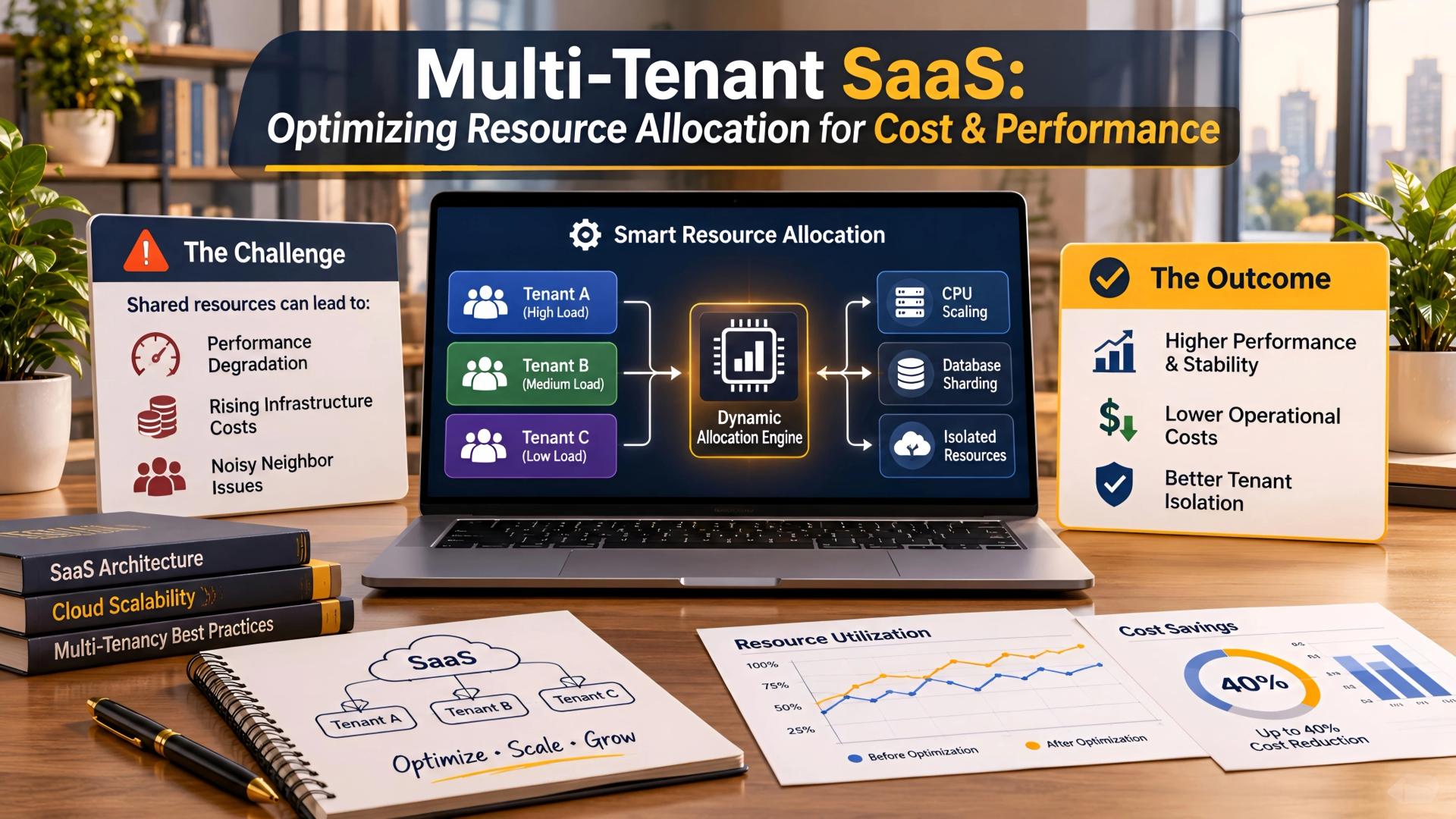
Building a multi-tenant SaaS application introduces a unique set of engineering challenges. One of the most critical is how to efficiently allocate resources across all your tenants without spiraling cloud costs or sacrificing performance for any single user.
It's a delicate balance: provide enough compute and memory to handle peak loads, but avoid over-provisioning that drains your budget. This tension often leads to complex architectural decisions.
The Core Problem: Inefficient Resource Allocation
Without careful planning, multi-tenant environments quickly become expensive. You might initially allocate a fixed amount of resources per tenant, which is simple but rarely efficient.
Some tenants will underutilize their allocation, wasting money, while others will hit bottlenecks during peak usage, leading to poor user experience. This inconsistency erodes trust and makes your operational costs unpredictable.
At Muhyo Tech, we've seen this firsthand. The initial ease of a 'one size fits all' approach quickly gives way to performance complaints and budget overruns as a SaaS platform scales.
The solution lies in a more dynamic, intelligent approach to resource management. As we outlined in our foundational guide, Architecting Robust Multi-Tenant SaaS: Strategies for Data Isolation and Scalability, proper isolation is just one piece of the puzzle; efficient resource use is the other.
Dynamic Resource Provisioning: Scaling Smarter
Dynamic resource provisioning moves away from static allocation. Instead, it adjusts resources based on actual demand, tenant usage patterns, and predefined thresholds.
This means your infrastructure can shrink during off-peak hours and expand automatically when traffic surges. It's a fundamental shift from reactive firefighting to proactive, automated scaling.
Implementing this often involves robust monitoring and automation tools. We continuously track metrics like CPU utilization, memory consumption, and network I/O for each tenant or tenant group.
When thresholds are breached, automation scripts or cloud-native services like AWS Auto Scaling Groups or Kubernetes Horizontal Pod Autoscalers kick in. This ensures that resources are always aligned with current needs, minimizing waste.
Containerization and Orchestration with Kubernetes
Containerization, primarily with Docker, and orchestration, primarily with Kubernetes, have become cornerstones of efficient multi-tenant architecture. Containers provide a lightweight, portable, and isolated environment for each application component or tenant-specific service.
This isolation is crucial for security and preventing 'noisy neighbor' issues where one tenant's heavy usage impacts others. Kubernetes then takes this a step further, managing the deployment, scaling, and operational aspects of these containers across a cluster of machines.
With Kubernetes, you can define resource requests and limits for each container (e.g., CPU, memory). The scheduler then intelligently places these containers on nodes with available resources, optimizing density.
Features like Namespace isolation, ResourceQuotas, and LimitRanges allow you to enforce strict boundaries and allocate resources fairly among different tenants or tenant groups. This is a powerful mechanism for ensuring equitable distribution and preventing any single tenant from monopolizing resources.
Leveraging Serverless Functions for Bursty Workloads
For certain types of tenant-specific workloads, serverless functions (like AWS Lambda, Azure Functions, or Google Cloud Functions) offer an unparalleled level of efficiency. These are ideal for event-driven tasks that are infrequent or highly bursty.
Think about background processing for tenant data, notification services, or webhook handlers. With serverless, you only pay for the compute time your code actually runs.
This eliminates the need to provision and manage servers, drastically reducing operational overhead and cost for sporadic tasks. It's a perfect fit for multi-tenant environments where usage patterns can be unpredictable.
Combining serverless functions with a containerized core application creates a hybrid architecture. This approach leverages the strengths of both paradigms: consistent performance for core services and extreme cost-efficiency for intermittent tasks.
Monitoring, Cost Attribution, and Continuous Optimization
Implementing dynamic resource allocation is not a one-time setup; it's an ongoing process. Robust monitoring is non-negotiable for understanding how resources are being consumed and identifying bottlenecks or underutilized capacity.
Tools like Prometheus, Grafana, or cloud-native monitoring services provide the visibility needed to make informed decisions. Beyond performance, cost attribution becomes critical in multi-tenant SaaS.
You need to understand which tenants or features are driving your infrastructure costs. This allows for more accurate pricing models and helps identify areas for further optimization. At Muhyo Tech, we integrate cost management tools directly into our deployment pipelines.
Regular reviews of resource usage, performance metrics, and cloud billing reports are essential. This continuous feedback loop helps refine scaling policies, optimize container resource requests, and identify opportunities to refactor code for better efficiency.
The Business Value: Stability, Savings, and Scalability
The engineering effort invested in multi-tenant resource optimization translates directly into significant business value. First, it drastically reduces infrastructure costs by eliminating wasted resources. You pay only for what you actually use, not for idle capacity.
Second, it ensures consistent and equitable performance across all tenants. This leads to higher customer satisfaction, reduced churn, and a stronger brand reputation. No tenant feels penalized by another's activity.
Finally, it provides a highly scalable and resilient foundation for growth. Your application can handle sudden spikes in demand and onboard new tenants seamlessly without major re-architecture. This confidence in your infrastructure allows your business to focus on product innovation rather than operational firefighting.