


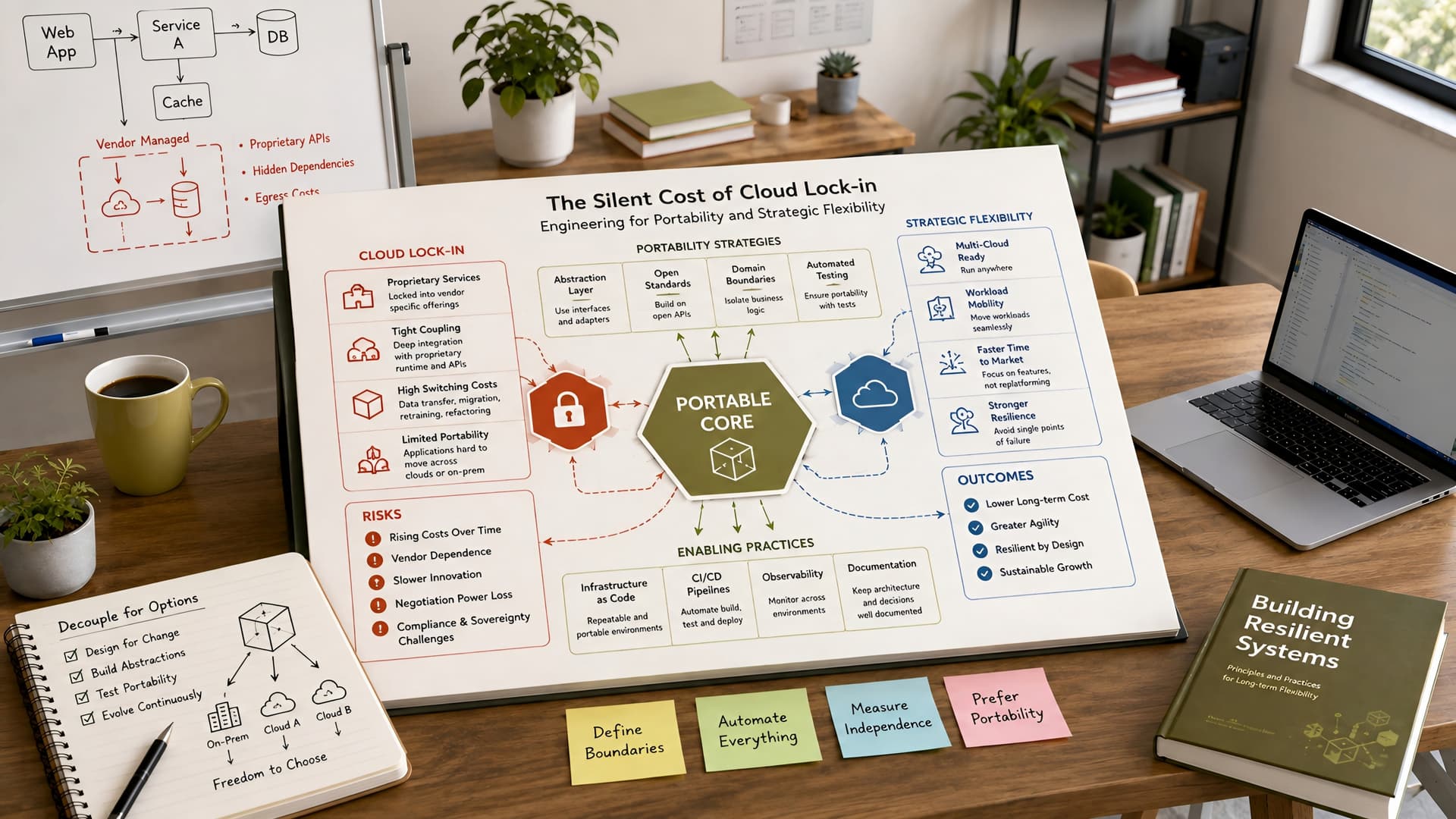
When we embark on a new project or scale an existing one, the promise of cloud computing is irresistible. Instant infrastructure, managed services, and a global reach seem to solve every initial problem.
However, that initial speed often comes with a subtle, long-term trade-off: cloud lock-in. This isn't just about switching costs; it's about a gradual erosion of strategic flexibility and a silent accumulation of future technical debt.
Understanding the Cloud Lock-in Challenge
Cloud lock-in occurs when an organization becomes deeply dependent on a single cloud provider's proprietary services, making it difficult or costly to migrate to another provider or adopt a multi-cloud strategy.
This dependency isn't always obvious at first. It often creeps in through convenient managed services that abstract away underlying complexities, but also bind your application logic directly to that provider's APIs and ecosystem.
The Hidden Costs and Risks
The immediate benefits of a cloud provider's specialized services are clear: faster development, less operational overhead. But this convenience can obscure significant long-term costs.
Pricing models can change, or you might find yourself unable to negotiate better rates because a migration is prohibitively expensive. This directly impacts your operating budget and reduces your leverage in vendor relationships.
Beyond cost, strategic risks loom. What if a better, more specialized service emerges from a different provider, or your business needs dictate a move to a region where your current provider has limited presence?
Without portability, your options are severely constrained, hindering innovation and market responsiveness. This is why we, at Muhyo Tech, prioritize architecting with an eye towards long-term flexibility, even when immediate speed is a factor.
Identifying Common Lock-in Points
Lock-in isn't a single event; it's a spectrum of dependencies. Recognizing where these dependencies form is the first step toward mitigation.
They often manifest in database choices, messaging queues, serverless functions, and specialized AI/ML services that are deeply integrated into a single vendor's platform.
Proprietary Databases and Data Storage
Managed database services like Amazon Aurora, Azure Cosmos DB, or Google Cloud Spanner offer incredible performance and scalability. However, their unique features and API layers can make data migration complex.
Data migration involves not just moving bits, but often re-architecting how your application interacts with the database. This can be a major undertaking.
Managed Messaging and Queueing Services
Services such as AWS SQS/SNS, Azure Service Bus, or Google Cloud Pub/Sub streamline asynchronous communication. While powerful, integrating directly with their APIs ties your application's messaging layer to that specific provider.
Re-implementing message producers and consumers for a different platform can be a significant refactoring effort.
Serverless Functions and Compute Environments
AWS Lambda, Azure Functions, and Google Cloud Functions abstract away server management. But the event models, runtime environments, and deployment mechanisms are highly specific to each provider.
Migrating a complex serverless application often means rewriting significant portions of the function code and reconfiguring deployment pipelines.
Specialized AI/ML Services
Cloud providers offer sophisticated AI/ML services for tasks like natural language processing, image recognition, and predictive analytics. These are often highly optimized for their respective platforms.
While convenient, using these services can create strong dependencies on their specific models and APIs, making it challenging to switch if a more suitable or cost-effective solution emerges elsewhere.
Strategies for Cloud Lock-in Prevention
Preventing lock-in doesn't mean avoiding cloud services entirely. It means making deliberate architectural choices to maintain optionality.
The goal is to leverage the cloud's benefits while minimizing the surface area of proprietary dependencies. We look for patterns that create boundaries between our core application logic and the underlying infrastructure.
Abstraction Layers and APIs
Introduce abstraction layers within your application code. Instead of calling a specific cloud API directly, create an interface that defines the required functionality (e.g., 'send message', 'store object').
Then, implement different adapters for each cloud provider or open-source alternative. This way, your core logic remains decoupled.
Embracing Open Standards and Open Source
Prioritize services and technologies that adhere to open standards or are based on open-source projects. For example, use PostgreSQL instead of a proprietary database variant, or Kafka instead of a vendor-specific messaging queue.
This allows for greater flexibility in deployment environments, whether on-premises or with a different cloud provider. At Muhyo Tech, we often guide clients toward these foundational choices.
Containerization and Orchestration
Container technologies like Docker encapsulate your application and its dependencies, making it highly portable. Orchestration platforms like Kubernetes provide a consistent deployment and management layer across different cloud environments.
This creates a powerful abstraction, allowing your application to run almost anywhere Kubernetes is supported, significantly reducing infrastructure-level lock-in.
Infrastructure as Code (IaC)
Tools like Terraform, Pulumi, or Ansible define your infrastructure in code. While these tools often have provider-specific modules, the code itself provides a clear, documented blueprint of your infrastructure.
This makes auditing dependencies easier and provides a starting point for re-platforming, even if it doesn't eliminate all lock-in.
Data Portability Strategies
Design your data models to be as database-agnostic as possible. Use standard data formats (e.g., JSON, Parquet) for storage and exchange.
Regularly test your data export and import processes to ensure you can move your critical data effectively if needed.
The Trade-offs: Speed vs. Flexibility
Engineering for portability isn't free. It often introduces an initial overhead and can mean foregoing some of the most advanced, deeply integrated features of a specific cloud provider.
This is a critical decision point for technical founders and CTOs: how much upfront engineering effort are you willing to invest for long-term strategic flexibility?
| Consideration | High Lock-in Approach (Proprietary Services) | Low Lock-in Approach (Portability Focused) |
|---|---|---|
| Initial Development Speed | Very high (leveraging managed services directly) | Moderate (requires abstraction layers, open-source setup) |
| Operational Overhead | Low (provider manages most infrastructure) | Moderate (may involve managing open-source components) |
| Long-term Cost Flexibility | Low (dependent on vendor pricing) | High (can move to optimize costs) |
| Strategic Agility | Low (difficult to pivot to other providers/technologies) | High (easier to adapt to new tech or business needs) |
| Complexity | Low initial, high migration | Moderate initial, low migration |
| Access to Bleeding Edge Features | High (direct access to vendor-specific innovations) | Moderate (often relies on open-source advancements or common standards) |
When to Accept Some Lock-in
It's not always about zero lock-in. Sometimes, the unique capabilities of a proprietary service are so critical to your product's competitive advantage or time-to-market that the trade-off is acceptable.
For example, if a specific cloud provider's AI service offers a significant performance edge that no open-source alternative can match, it might be worth the dependency. The key is making this a conscious, well-reasoned decision, not an accidental outcome.
Muhyo Tech's Approach to Cloud Architecture
At Muhyo Tech, we advocate for a balanced approach. Our goal is to enable rapid development and deployment for our clients while also safeguarding their long-term strategic options.
We work to understand the client's business trajectory and risk tolerance, then design architectures that leverage the cloud effectively without creating unnecessary future burdens.
Our engineering standards emphasize modularity and clear separation of concerns. This means building applications where components can be swapped out or migrated with minimal disruption, whether it's a database, a message queue, or a deployment target.
For example, when building a full-stack web application, we might use a cloud-managed PostgreSQL database but ensure our application interacts with it through a standard ORM or data access layer.
This makes a future migration to another PostgreSQL instance (on a different cloud or self-hosted) significantly less painful. It's about building resilience into the very fabric of the system.
Checklist for Mitigating Cloud Lock-in
- Evaluate proprietary services: For each cloud service, ask: Is there an open-source alternative? Does it adhere to open standards?
- Design abstraction layers: Implement interfaces for common services (data storage, messaging, authentication) to decouple application logic.
- Containerize applications: Use Docker and Kubernetes for consistent deployment across environments.
- Prioritize open-source databases: Choose databases like PostgreSQL, MySQL, or MongoDB over highly proprietary managed services where feasible.
- Standardize data formats: Use universally readable formats like JSON, XML, or Parquet for data storage and exchange.
- Automate with IaC: Define your infrastructure using tools like Terraform to document and manage resources consistently.
- Regularly review dependencies: Periodically audit your architecture for new or deepening proprietary dependencies.
- Plan for data export/import: Ensure you have tested procedures for moving your data out of a cloud provider's proprietary services.
The Business Value of Strategic Portability
Investing in cloud portability isn't just an engineering exercise; it's a strategic business decision. It directly translates into long-term cost savings, enhanced vendor negotiation power, and increased agility.
Imagine being able to confidently evaluate a new cloud provider's offer or shift your workload to a region that better serves a new market opportunity. This strategic freedom is invaluable.
It mitigates vendor risk, ensuring your business isn't held hostage by a single provider's policies or pricing. Ultimately, it positions your company for sustained growth and innovation, adaptable to whatever technological shifts the future brings.
Frequently Asked Questions (FAQs)
What is the primary difference between cloud lock-in and switching costs?
Switching costs are the direct expenses and efforts involved in moving from one cloud provider to another, like data transfer fees or re-configuration time. Cloud lock-in is a deeper, architectural dependency that makes those switching costs prohibitively high, often due to proprietary APIs and integrated services, effectively making a move strategically unfeasible.
Does multi-cloud automatically prevent lock-in?
Not necessarily. Simply using multiple cloud providers without careful architecture can lead to 'multi-cloud lock-in', where your applications are deeply dependent on services from each provider. True multi-cloud flexibility requires designing for portability between those providers, often using abstraction layers, containers, and open standards.
Is avoiding all proprietary cloud services realistic for a startup?
Complete avoidance is often unrealistic and can hinder speed-to-market. The goal is a balanced approach: consciously choose proprietary services only when their unique benefits are critical and cannot be replicated by open standards, and always seek to isolate those dependencies with abstraction layers where possible. It's about informed trade-offs, not absolute abstinence.
How can I convince my team or stakeholders to invest in portability efforts?
Frame it in terms of long-term business value: reduced operational risk, increased negotiation leverage with vendors, future cost optimization, and enhanced strategic agility to respond to market changes or new technologies. Highlight the potential for costly re-platforming down the line if lock-in becomes too severe.